
Add 1
Overview
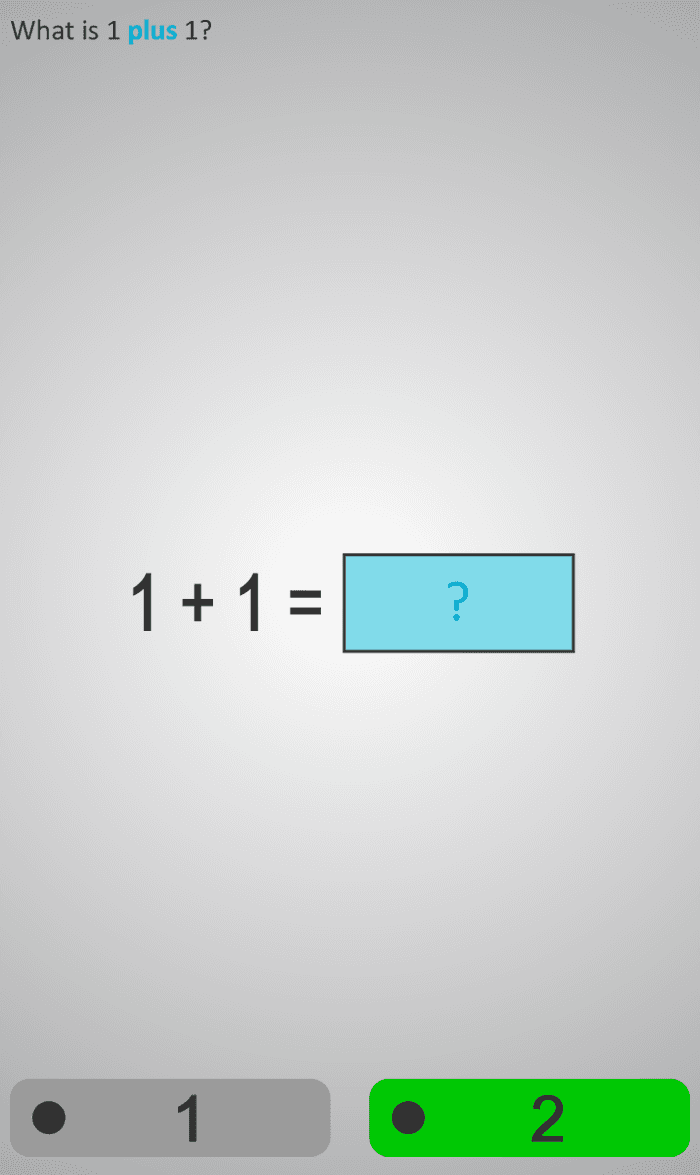
Add 1 introduces learners to the very foundations of arithmetic through simple single-digit addition problems. The Phlow uses clear, step-by-step screens that make the process concrete and approachable. Learners encounter problems such as 1 + 1, 2 + 3, or 4 + 5, framed in an intuitive, visually clean format with multiple-choice answers. This keeps the focus on recognising sums and building early fluency with number operations.
Confidence Building Through Repetition
By working through a series of straightforward addition tasks, learners strengthen their number sense and develop automaticity in combining small numbers. The repetitive practice helps reinforce the idea of moving forward on the number line, while avoiding unnecessary complexity. Each task is short, easy to attempt, and provides immediate feedback, allowing students to self-correct, build confidence, and stay motivated throughout the session.
Engagement and Feedback
The quiz-style format includes clear scoring to track progress and encourage learners. Immediate clarity on whether answers are correct supports independent learning and gives a sense of achievement. The design ensures low cognitive load, keeping students in flow while maintaining their focus on the fundamentals.
Purpose
This Phlow serves as an essential stepping stone into mathematics learning. It establishes the baseline skills of single-digit addition, ensuring learners have the confidence and fluency needed before moving on to more complex operations. It is equally suitable for very young learners taking their first steps in arithmetic and for older students revisiting the basics as revision.
Prerequisite Knowledge Required
No previous Phlows
Main category
Arithmetic
Estimated Completion Time
Approx 5 seconds per question. 10 questions total. Total time: 1 minute.
Cognitive Load / Step Size
Very low step size. Each question requires the same type of thinking (add two small numbers). The transition is intentionally flat (not escalating in difficulty), designed to establish confidence rather than stretch ability. No risk of overwhelm; slight risk of boredom for more advanced learners, but appropriate for Level 1.
Language & Literacy Demand
Questions are short, direct, and use simple vocabulary (“What is 3 + 2?”). Minimal reading demand. Weak readers will not be disadvantaged as all tasks are primarily numeric. No unnecessary wording or story contexts to distract from the maths.
Clarity & Design
Visually clean design with large numbers and answer options. Focuses on digits rather than icons/graphics. Visual simplicity supports early learners — no clutter, no distraction.
Curriculum Alignment
- Develop fluency in working with whole numbers.
- Recall and use addition with clear understanding.
- Recognise addition as combining or increasing.
Engagement & Motivation
Not inherently “fun” but purposefully straightforward; engagement comes from success and instant feedback.
Error Opportunities & Misconceptions
- Miscounting when adding.
- Choosing distractor options by guessing rather than counting.
- Confusing addition with subtraction.
Transferability / Real-World Anchoring
Highly transferable — addition is a core skill applied in all later arithmetic contexts. Even without real-world scenarios here, the skill supports counting objects, money, or time in daily life.
Conceptual vs Procedural Balance
Currently procedural: repeated practice of “how” to add. Conceptual understanding (e.g. why addition works, use of number line or grouping) is limited. Best seen as a fluency-building Phlow to support later conceptual tasks.
Learning Objectives Addressed
- Develop automatic recall of small number sums.
- Strengthen number sense through repeated addition tasks.
- Gain confidence in answering basic arithmetic questions independently.
- Build a foundation for later operations (subtraction, multiplication, larger addition).
What your score says about you
- Less than 5: You may not yet be comfortable with adding small numbers — more practice is needed with counting and number recognition.
- Between 6–7: You are beginning to get it — some mistakes may be slips in counting or choosing the wrong option.
- Between 8–9: Strong grasp of basic addition. Occasional errors may be due to rushing rather than misunderstanding.
- 10/10: Excellent fluency with simple addition — you’re ready to move forward confidently.