
Algebra 1A
Introduction
This Phlow introduces students to solving basic algebraic equations where a variable is isolated using subtraction. The focus is on recognising that equations such as a – 3 = 0 can be solved by finding the value of the variable that makes the statement true.
Introducing Variables in Equations
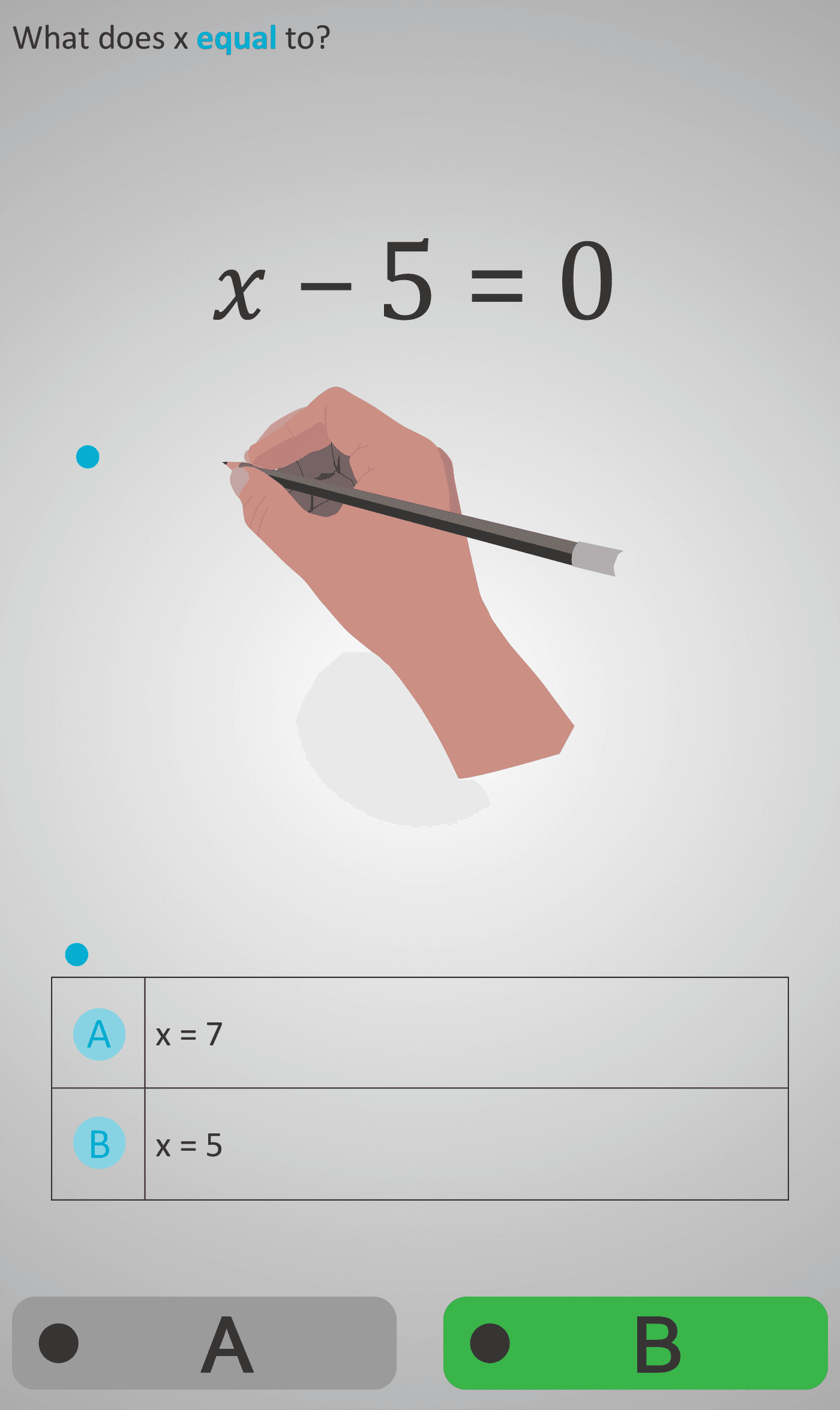
Learners are presented with one-step equations involving different variables (e.g., a – 3 = 0, x – 5 = 0, y – 8 = 0). Each is paired with two possible answers, and students must select which value correctly balances the equation.
From Symbols to Solutions
The activity reinforces that the solution to an equation is the number that makes both sides equal. For example, when shown x – 5 = 0, learners deduce that x = 5. The simple format ensures focus stays on the concept of solving rather than complex calculation.
Consistency Across Variables
By switching between different letters (a, x, y), students practise generalising the idea that variables are placeholders for unknown values. This prevents over-reliance on one symbol and encourages flexibility in algebraic reasoning.
Building Confidence in Algebra
The final questions provide immediate feedback, confirming correct answers and reinforcing the pattern: solving n – k = 0 always gives n = k. Through repetition with small variations, learners gain confidence in the earliest steps of algebraic problem-solving.
This Phlow builds essential fluency with solving equations, making algebra accessible and concrete for beginners. It establishes the foundation for more complex Phlows where multi-step solutions and additional operations will be introduced.
Prerequisite Knowledge Required
- Secure understanding of subtraction facts within 10.
- Familiarity with recognising when a subtraction sentence equals zero.
- Comfort working with single variables (letters standing for unknowns).
- [Link to previous Level 1 Phlows: Subtract Basics, Number Bonds to 10]
Main Category
Algebra – Introduction to Equations
Estimated Completion Time
Approx 6 seconds per question. 10 questions total. Total time: 1 minute.
Cognitive Load / Step Size
Step size is small and consistent: each equation is of the form variable – constant = 0. Cognitive demand comes from recognising that the variable equals the constant itself. Low chance of overload; risk of boredom if already confident with one-step equations.
Language & Literacy Demand
Language demand is minimal. Each question is short (“What does x equal?”). Equations themselves are visual, reducing reliance on extended reading.
Clarity & Design
Clean, uncluttered layout with large font equations. Multiple-choice design reduces distraction. Visualisation is functional: supports recognition of symbols and keeps learner oriented.
Curriculum Alignment
- Irish Mathematics Curriculum Strand: Algebra
- Learning outcome: Solve simple equations in one variable
- Builds foundational algebra skills linking arithmetic to symbolic representation
Engagement & Motivation
Interaction comes through equation solving with clear right/wrong feedback. Simplicity keeps learners focused. Engagement comes from success and immediate reinforcement.
Error Opportunities & Misconceptions
- Confusing a – 3 = 0 with a – 3 = 3.
- Mixing up variable symbols.
- Thinking subtraction always means “take away” without recognising balance at zero.
Transferability / Real-World Anchoring
Direct transfer to more complex algebra (x – k = n). Foundation for solving linear equations. Real-world anchoring is limited but underpins practical problem-solving.
Conceptual vs Procedural Balance
Primarily procedural: practising the method of isolating a variable when subtracting a constant. Conceptual element: introduces the idea of solving as “finding the value that makes it balance.”
Learning Objectives Addressed
- Recognise equations as statements of balance.
- Solve one-step equations of the form x – n = 0.
- Interpret variables as placeholders for unknown numbers.
- Develop confidence with abstract symbols in simple contexts.
What Your Score Says About You
- Less than 5: More practice needed with subtraction facts and understanding variables.
- 6–7: Basic grasp, may still mix symbols or subtraction steps.
- 8–9: Confident with one-step equations, minor slips only.
- 10/10: Mastery. Fully confident and ready for multi-step algebra.