
Analyse 1A
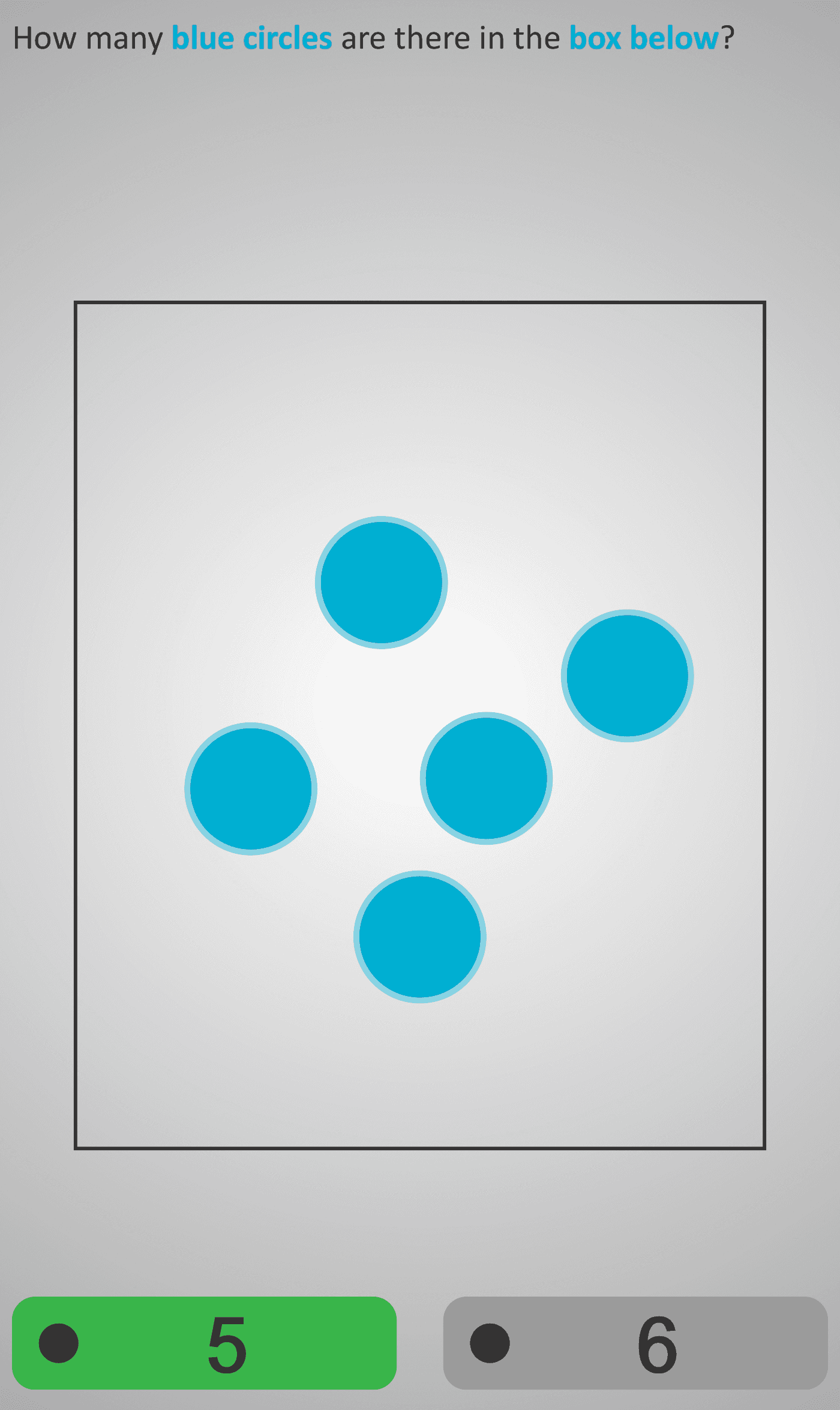
This Phlow introduces learners to the skill of analysing simple visual information by identifying and counting shapes. Students are shown boxes containing coloured circles and asked questions such as: “How many blue circles are there in the box below?”
The sequence progresses from straightforward counting (all circles are blue) to slightly more complex cases where blue and black circles are mixed, requiring learners to filter by colour. Finally, learners encounter examples with zero blue circles, reinforcing the idea that “none” is also a valid count.
By combining clear visuals with simple prompts, this Phlow builds early analysis skills: recognising relevant features, ignoring distractions, and applying basic counting accurately. It sets the stage for higher-level “Analyse” Phlows, where learners will extract and interpret more complex data from diagrams, tables, or graphs.
Prerequisite Knowledge Required:
[Link to previous level Phlows: Add 1, Count 1–10]
Learners should already be familiar with basic counting of objects and distinguishing between small groups of shapes.
Main Category:
Analysis / Early Data Handling
Estimated Completion Time:
Approx 6 seconds per question. 10 questions total. Total time: 1 minute.
Cognitive Load / Step Size:
The steps are deliberately small and accessible, requiring learners to count and then filter by colour. The progression from simple counts to distinguishing between blue and non-blue shapes keeps the challenge incremental without overwhelming the learner.
Language & Literacy Demand:
Minimal. Instructions are short (“How many blue circles are there in the box below?”) and supported by clear visuals. The task relies on visual processing rather than text-heavy prompts, meaning weaker readers can still engage fully.
Clarity & Design:
The graphics are clean and unambiguous. Circles are large, distinct, and colour-coded, ensuring the learner focuses only on the intended attribute. The design avoids clutter, with visual cues (blue vs. black) carrying the main instructional weight rather than long text.
Curriculum Alignment:
Strand: Statistics & Probability – Representing and Interpreting Data.
Learning Outcome: Sorting and classifying objects by one property (e.g., colour),
and recognising when a set has none of a given property.
Engagement & Motivation:
The activity is simple and quick, with immediate feedback after each count. Learners may find the colour-based challenge engaging, especially when faced with “trickier” cases like zero blue circles, which add variety and interest.
Error Opportunities & Misconceptions:
- Learners may miscount when shapes are close together.
- Some may count all shapes instead of filtering for blue only.
- The “zero case” can be confusing, as students may still attempt to choose a non-zero option.
Transferability / Real-World Anchoring:
The skill transfers directly into everyday contexts such as sorting coloured objects, reading charts or graphs, and filtering information by criteria. It is a foundational step for later data handling, probability, and set theory.
Conceptual vs Procedural Balance:
Primarily procedural (counting and filtering), but it introduces the conceptual step of classification: focusing on a subset defined by a property (colour). This builds groundwork for more abstract set-based reasoning later.
Learning Objectives Addressed:
- Identify and count a subset of objects based on a defining property (colour).
- Develop accuracy in simple counting tasks.
- Recognise and correctly handle the concept of “none” or zero.
- Strengthen visual discrimination between relevant and irrelevant items.
What Your Score Says About You:
- Less than 5: You may need more practice with careful counting or focusing only on the relevant property.
- Between 6–7: You’re making progress but still show occasional slips in attention or accuracy.
- Between 8–9: You have a strong grasp of counting subsets, with only minor errors.
- 10/10: Excellent accuracy — you can reliably identify and count objects by property, a key skill for analysis.