
Arrow Dia 1
This Phlow introduces learners to arrow diagrams as a way of representing ordered pairs and relations between two sets.
Building Couples
Students begin by identifying the element in set P (the start of the arrow) and linking it to the correct element in set Q (the end of the arrow). This builds an intuitive understanding of how pairs are formed, represented as (p,q).
Step-by-Step Pairing
The activity asks learners first to identify the first element of the couple (from set P), then the second element (from set Q), reinforcing the ordered nature of pairs.
Validating Relations
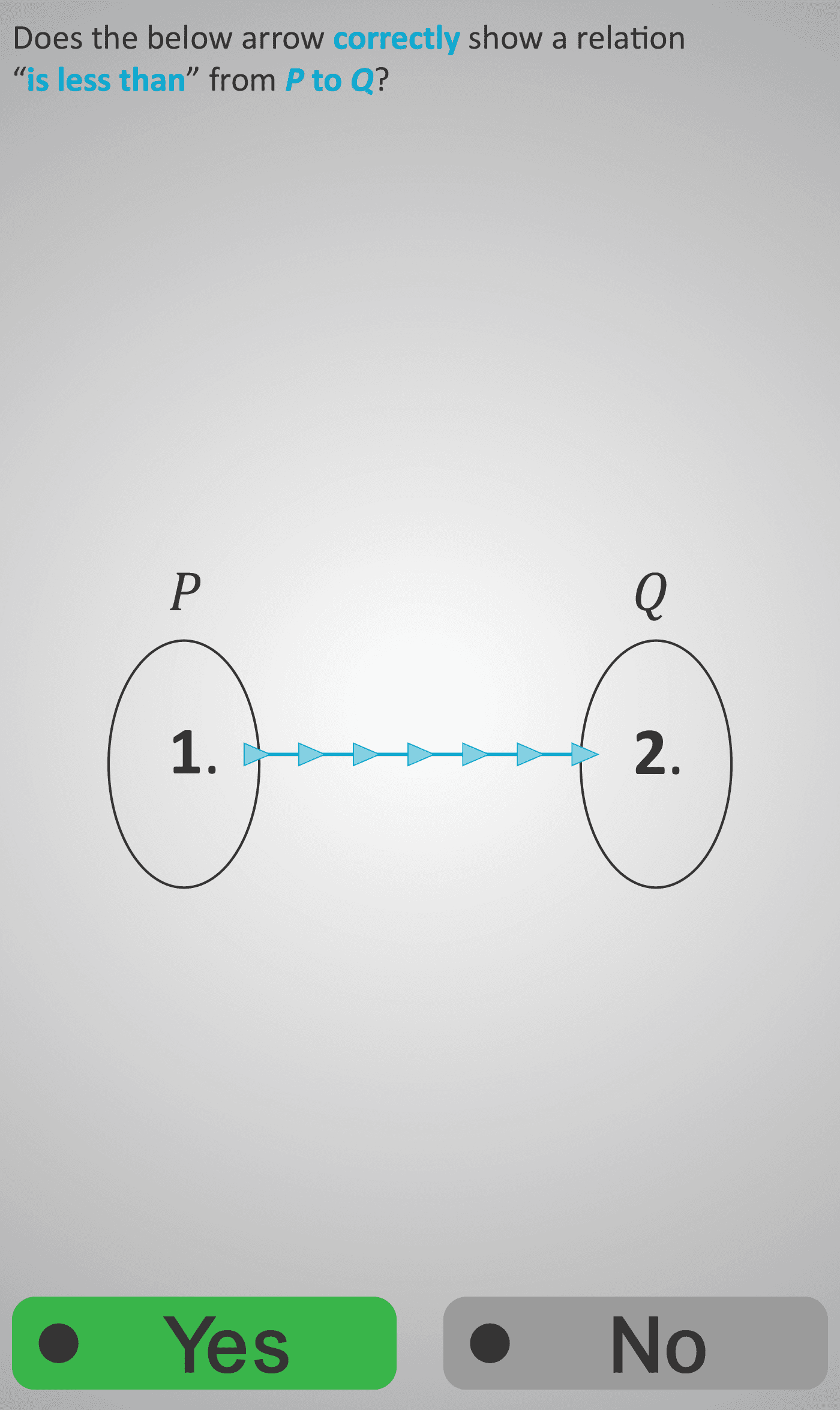
Finally, students check whether an arrow correctly represents a relation such as “is less than” between the two sets. This connects the diagram to a meaningful mathematical relationship, moving beyond symbols into reasoning about set connections.
By the end, learners can confidently read and construct simple ordered pairs, see how relations are visualised with arrows, and begin to generalise how sets can be mapped to one another.
Prerequisite Knowledge Required:
[Analyse 1A] Counting and recognising sets of objects
[Analyse 1B] Comparing numbers and understanding “greater than / less than”
Main Category:
Algebra – Relations and Sets
Estimated Completion Time:
Approx. 6 seconds per question. 10 questions total. Total time: ~1 minute.
Cognitive Load / Step Size:
The cognitive demand is moderate — students move from simply identifying elements in sets to forming ordered pairs and checking relational statements. The step sizes are logical, though some may find the jump from identifying arrows to interpreting the meaning of the relation slightly steep without guidance.
Language & Literacy Demand:
Questions include terms like “element,” “couple,” and “relation,” which may be unfamiliar vocabulary. The visuals (sets, arrows, pairs) support comprehension, but weaker readers may struggle with parsing the longer instructions unless the teacher scaffolds key terms.
Clarity & Design:
The diagrams are clean and focused, with arrows clearly linking elements between sets. The use of bold labels P, Q and ordered pair notation helps bridge visual and symbolic understanding. Design supports comprehension rather than decoration.
Curriculum Alignment:
Aligned with the strand Algebra – Representing relationships using sets and relations, including forming ordered pairs, representing them visually, and interpreting simple relations like “is less than.”
Engagement & Motivation:
The arrow diagrams add a puzzle-like quality, which can be engaging. However, repeated exposure without variety may feel abstract unless paired with relatable examples (e.g., people linked to hobbies, objects to categories).
Error Opportunities & Misconceptions:
- Confusing which element comes first in the ordered pair (p,q).
- Thinking the arrow direction is reversible.
- Misunderstanding the meaning of the relation (e.g., “less than” applied backwards).
Transferability / Real-World Anchoring:
The skill transfers to coordinate geometry, functions, and data representation. Real-world anchoring could be improved by showing relations like “person → favourite fruit” or “student → score.”
Conceptual vs Procedural Balance:
Conceptual: Students learn what an ordered pair represents and why order matters. Procedural: Practice in identifying correct pairs and interpreting relational arrows. Good balance, though slightly tilted toward procedure.
Learning Objectives Addressed:
- Recognise and construct ordered pairs from set diagrams.
- Interpret arrows as relations between elements in two sets.
- Distinguish the meaning of direction in an ordered pair.
- Verify whether a relation like “is less than” is represented correctly.
What Your Score Says About You:
- Less than 5: You may not yet understand how arrows show ordered pairs or relations. Revisit earlier Analyse Phlows.
- Between 6–7: You can identify some ordered pairs but are still making errors with order or relation meaning.
- Between 8–9: You have a strong grasp of ordered pairs and relations, with only occasional slips.
- 10/10: You can confidently construct and interpret ordered pairs and understand the meaning of relations like “less than.”