
Circle 1C
Prerequisite Knowledge Required:
Understanding of radius and diameter from Circle 1A and Circle 1B.
Links: Circle 1A – Identifying Radius and Diameter; Circle 1B – Finding the Radius from the Diameter.
Main Category:
Measurement (Geometry)
Estimated Completion Time:
Approx 6 seconds per question. 10 questions total. Total time: ~1 minute.
Cognitive Load / Step Size:
Low cognitive load. Each question focuses on applying one previously learned relationship (diameter = 2 × radius) within a familiar grid context. The transition from symbolic values to spatial visualisation introduces a small conceptual step, maintaining engagement without overload.
Language & Literacy Demand:
Minimal. Instructions are short and supported by strong visuals. Key terms (e.g. radius, diameter, grid) are colour-highlighted, helping students connect text to visuals. Accessible for all reading levels.
Clarity & Design:
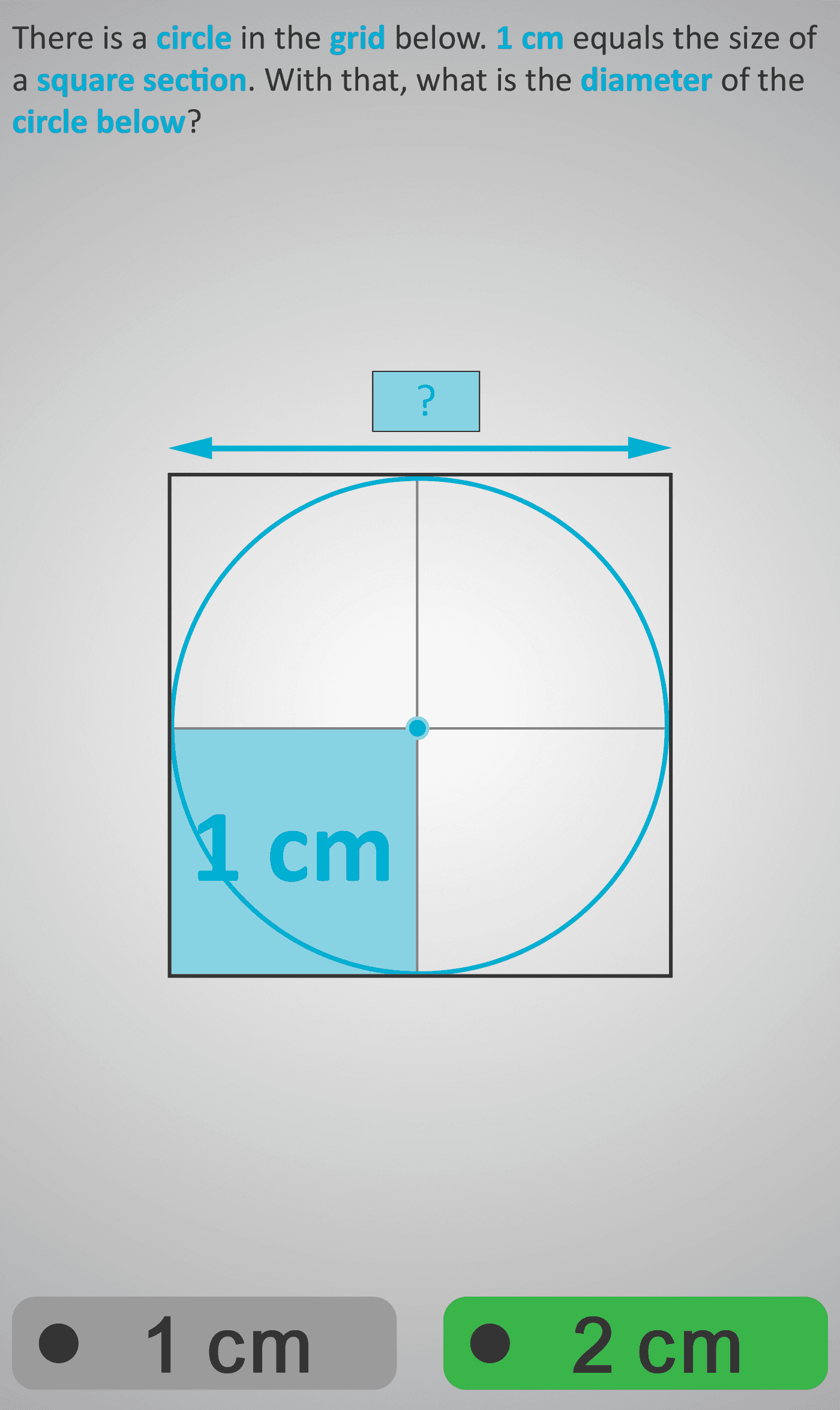
The layout uses clean geometric diagrams with consistent blue arrows and labels for measurement. The grid and shaded regions visually anchor the concept, ensuring the circle’s proportions are intuitive. The visuals are instructional, not decorative, directly reinforcing spatial reasoning.
Curriculum Alignment:
Aligned with the Measurement and Geometry and Trigonometry strands of the Irish Junior Cycle Mathematics curriculum — specifically learning outcomes involving recognising and using relationships between radius, diameter and circumference and representing shapes using scale and units.
Engagement & Motivation:
The grid-based layout makes the task feel interactive and visual rather than abstract. The consistent design allows quick success and confidence-building, while the grid format echoes early spatial reasoning activities (appealing even for weaker learners).
Error Opportunities & Misconceptions:
- Confusing radius and diameter terminology.
- Forgetting that diameter is twice the radius, not equal.
- Misreading the grid squares (especially if focusing only on arrows, not scale).
Transferability / Real-World Anchoring:
Students can apply this understanding to maps, scale drawings, or engineering design, where distances are often interpreted from grids. It also lays groundwork for more complex spatial reasoning in circle area and circumference problems.
Conceptual vs Procedural Balance:
Balanced — students reinforce the conceptual relationship between radius and diameter through procedural identification using a visual model. The grid structure helps them see why the relationship holds rather than just memorising the rule.
Learning Objectives Addressed:
- Recognise and use the relationship between radius and diameter.
- Interpret visual information from a grid to identify circle measurements.
- Strengthen spatial understanding of proportional relationships in geometry.
- Apply measurement reasoning in visual and symbolic forms.
What your score says about you:
- Less than 5: You may need to review Circle 1A and Circle 1B to strengthen your understanding of radius and diameter.
- Between 6–7: You understand the concept but may still mix up terminology — focus on reading diagrams carefully.
- Between 8–9: You’re confident in identifying and applying relationships, with only small visual slips.
- 10/10: Excellent — you’ve fully mastered how to read circle dimensions and can apply this to any diagram or scale.