
Coins 1
Prerequisite Knowledge Required:
Links: Add 1, Numbers 1A — learners should already recognise and understand simple number values and have practised adding single-digit numbers or small quantities.
Main Category:
Arithmetic (Money Addition)
Estimated Completion Time:
Approx 6 seconds per question. 10 questions total. Total time: ~1 minute.
Cognitive Load / Step Size:
The step size is intentionally small — each question reinforces the same addition process with different coin values. This repetition reduces working memory strain, keeping focus on connecting coin visuals to their numeric values. The load is light, suitable for early or foundational learners.
Language & Literacy Demand:
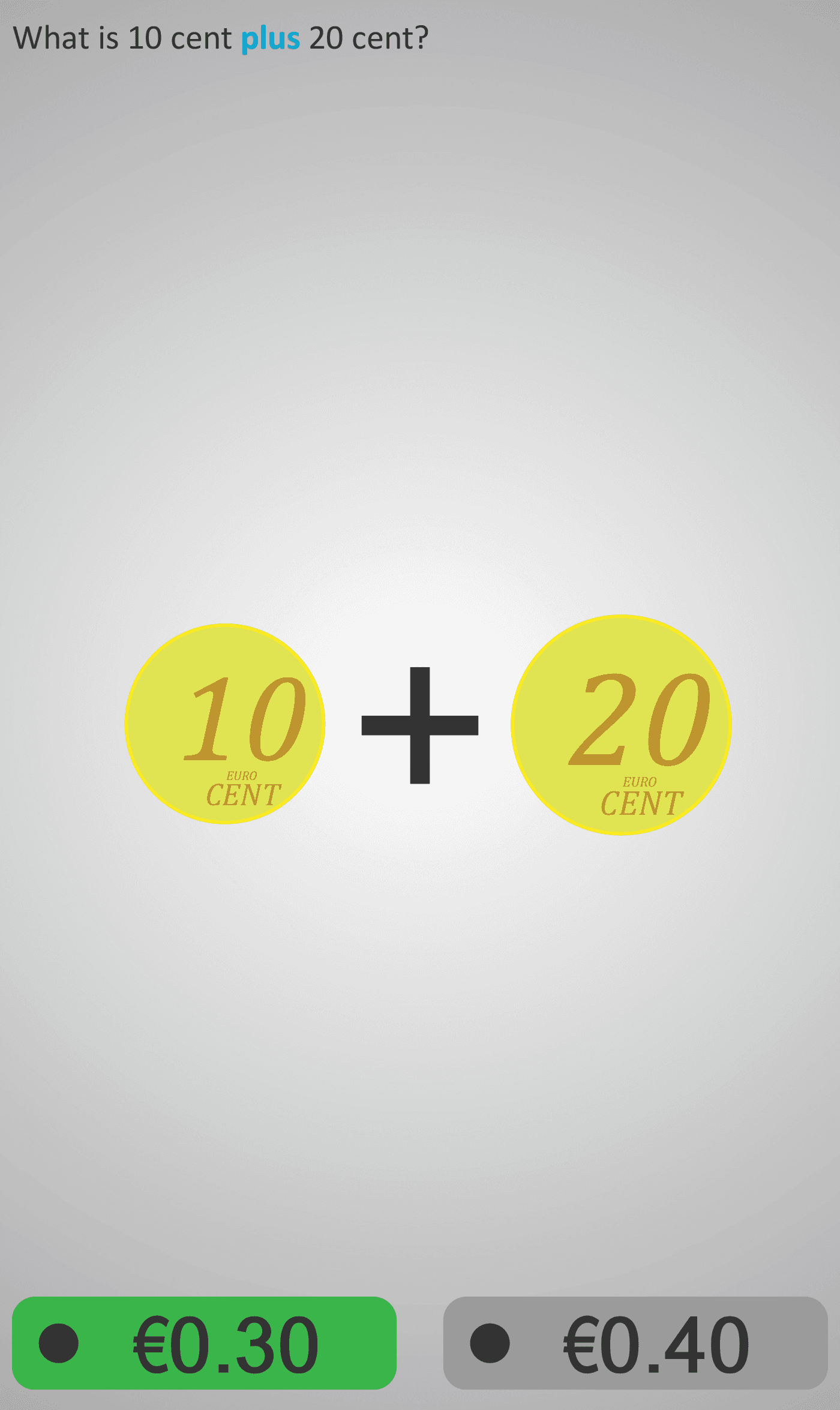
Minimal reading demand. The questions use short, simple phrasing (“What is 10 cent plus 20 cent?”), and the visuals of euro coins provide immediate meaning cues. Weaker readers are fully supported by the clear imagery.
Clarity & Design:
The visual design is strong and functional — coins are realistic but uncluttered, and the use of large numbers, colours, and the euro cent symbol reinforces the link between visual and numeric information. Layout is symmetrical and distraction-free, promoting focus on the operation.
Curriculum Alignment:
Aligned with the Irish curriculum strand “Measures – Money” and “Number – Operations”, particularly learning outcomes involving recognising coin values, adding simple amounts of money, and relating euro and cent notation.
Engagement & Motivation:
Using real-life coins naturally increases relevance. The visual realism and context of everyday money handling make this Phlow instantly relatable and confidence-boosting for learners.
Error Opportunities & Misconceptions:
- Adding only the digits (e.g. 10 + 20 = 1020) instead of understanding the numeric value.
- Confusing euro and cent notation (e.g. treating €0.30 as “30 euro”).
- Misreading the coin labels or overlooking the cent sign.
Transferability / Real-World Anchoring:
Highly transferable — directly links to daily tasks like counting coins, handling change, or reading price labels. Reinforces financial numeracy and contextual problem-solving.
Conceptual vs Procedural Balance:
Primarily procedural (adding small values), but the visual link between coin symbols and numerical addition builds a conceptual bridge from concrete (money) to abstract (numbers).
Learning Objectives Addressed:
- Recognise and identify common euro coin values.
- Add simple monetary amounts using visual and numeric cues.
- Understand the relationship between cent and euro notation.
- Develop fluency in everyday addition tasks.
What your score says about you:
- Less than 5: You may still be getting used to recognising coin values or mixing up cent and euro amounts. Try again slowly, matching coins to numbers.
- Between 6–7: You understand basic addition with coins, but some combinations may still confuse you — great progress!
- Between 8–9: You’re accurate and confident — keep practising to make coin addition automatic.
- 10/10: Excellent! You can add money values accurately and quickly — ready to handle real-world transactions with ease.