
Pie Chart 1
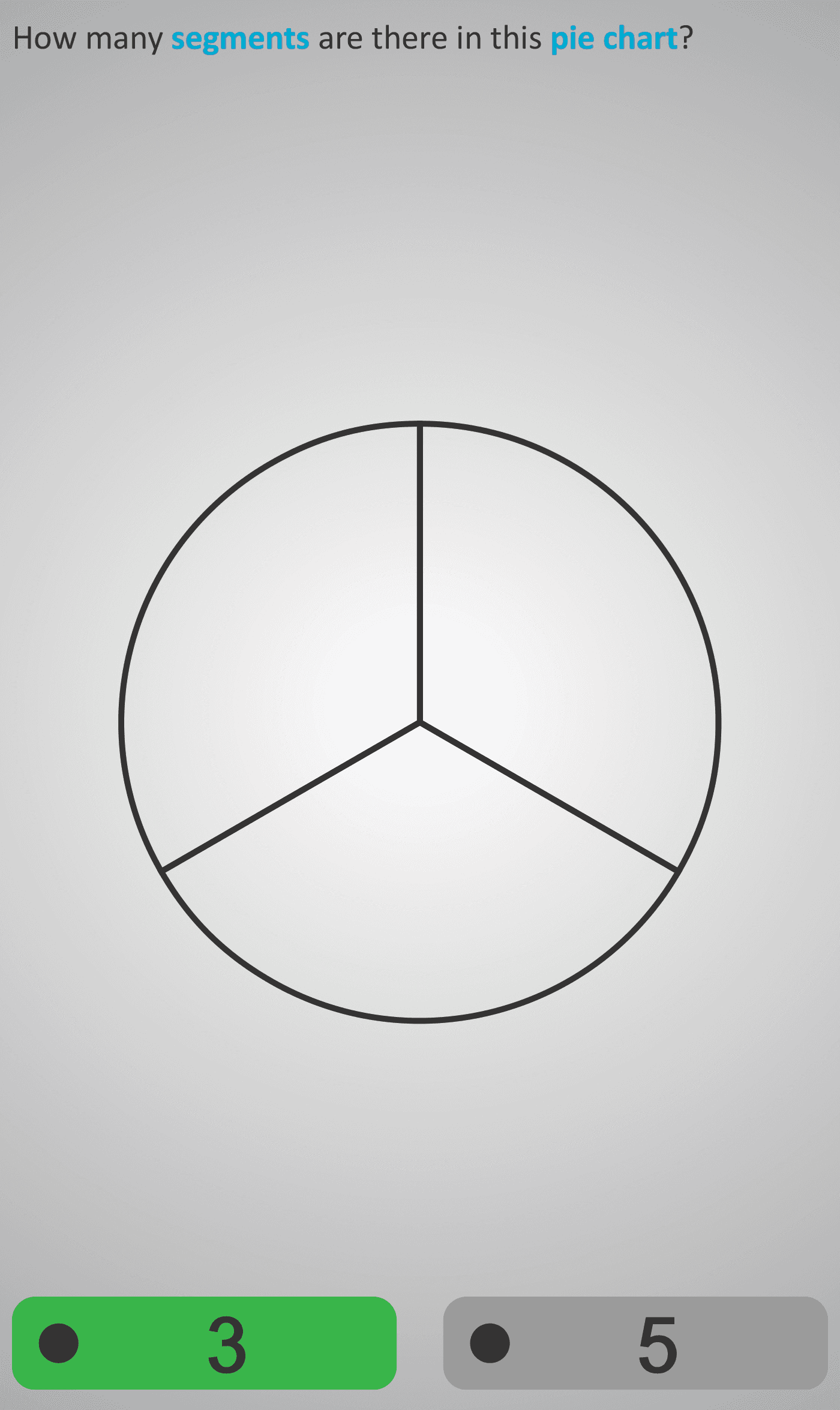
This Phlow introduces learners to the structure of pie charts by focusing on counting and identifying segments within a circle. Through a series of visually guided questions, students are asked how many segments a pie chart has and how many are shaded, reinforcing the concept of dividing a whole into equal parts.
The use of simple, high-contrast visuals allows learners to intuitively connect the circle’s shape with part–whole relationships before any numerical fractions are introduced. The activity progressively develops awareness of how data can be represented in circular form, where each segment stands for a portion of the total.
By highlighting and colouring specific sections, students strengthen their visual discrimination skills and spatial reasoning, learning to interpret graphical information rather than rely on text-heavy explanations. The Phlow serves as an essential precursor to later topics involving fractions, percentages, and proportional reasoning, establishing a visual foundation for understanding how a “whole” can be broken into measurable parts.
Prerequisite Knowledge Required:
Basic understanding of counting objects and recognising simple geometric shapes such as circles.
Linked Phlows: Shapes 1A – Recognising Circles, Counting 1A – Counting Objects up to 10
Main Category:
Data and Representation
Estimated Completion Time:
Approx 6 seconds per question. 10 questions total. Total time: 1 minute.
Cognitive Load / Step Size:
The cognitive load is low and the step size is small — each task involves a single new variation (e.g., changing the number of segments or shaded sections). The transitions are smooth and well-paced, allowing learners to build visual familiarity without overwhelm.
Language & Literacy Demand:
Extremely low. Instructions are short, direct, and visually reinforced through coloured diagrams. Even learners with minimal reading ability can access the task because comprehension relies on recognising shapes and colours rather than reading complex text.
Clarity & Design:
The design is clean and highly visual, using consistent line thickness, balanced layout, and a light grey background for focus. The blue shading and bold black outlines clearly distinguish parts of the circle. The visuals are functional, not decorative — every colour and line contributes directly to understanding the concept of segments and portions.
Curriculum Alignment:
Aligned with Measures and Data strands in the Irish mathematics curriculum — specifically, identifying parts of a whole and representing simple data using pictorial forms such as pie charts.
Engagement & Motivation:
The circular, colourful format is inherently engaging for visual learners. The task feels like a puzzle or pattern-recognition game rather than a text-based problem, sustaining attention while developing early data interpretation skills.
Error Opportunities & Misconceptions:
- Miscounting segments or losing track of dividing lines.
- Assuming shaded sections are unequal in value.
- Confusing “segments” with “sides,” especially when first transitioning from polygons to circles.
Transferability / Real-World Anchoring:
This Phlow builds foundational skills for interpreting pie charts seen in real-life contexts — such as surveys, food portions, and media graphics — helping learners connect mathematical visuals with daily information.
Conceptual vs Procedural Balance:
Heavily conceptual. The focus is on understanding how a whole object can be divided into equal parts and visually represented, rather than on performing numeric calculations.
Learning Objectives Addressed:
- Identify and count equal segments in a circle.
- Recognise shaded versus unshaded parts within a whole.
- Understand the link between part–whole relationships and visual representation.
- Develop early data-visualisation literacy for interpreting pie charts.
What your score says about you:
- Less than 5: You may still be learning to count or visually separate segments in shapes. Try again slowly and focus on tracing each section.
- Between 6–7: You can identify most segments correctly — great progress! A little more practice will help solidify your visual counting skills.
- Between 8–9: Strong understanding — you’re accurately interpreting part–whole visuals.
- 10/10: Excellent! You clearly recognise how a circle can be divided into equal parts and can apply this to interpret basic pie charts.