
Polygons 1A
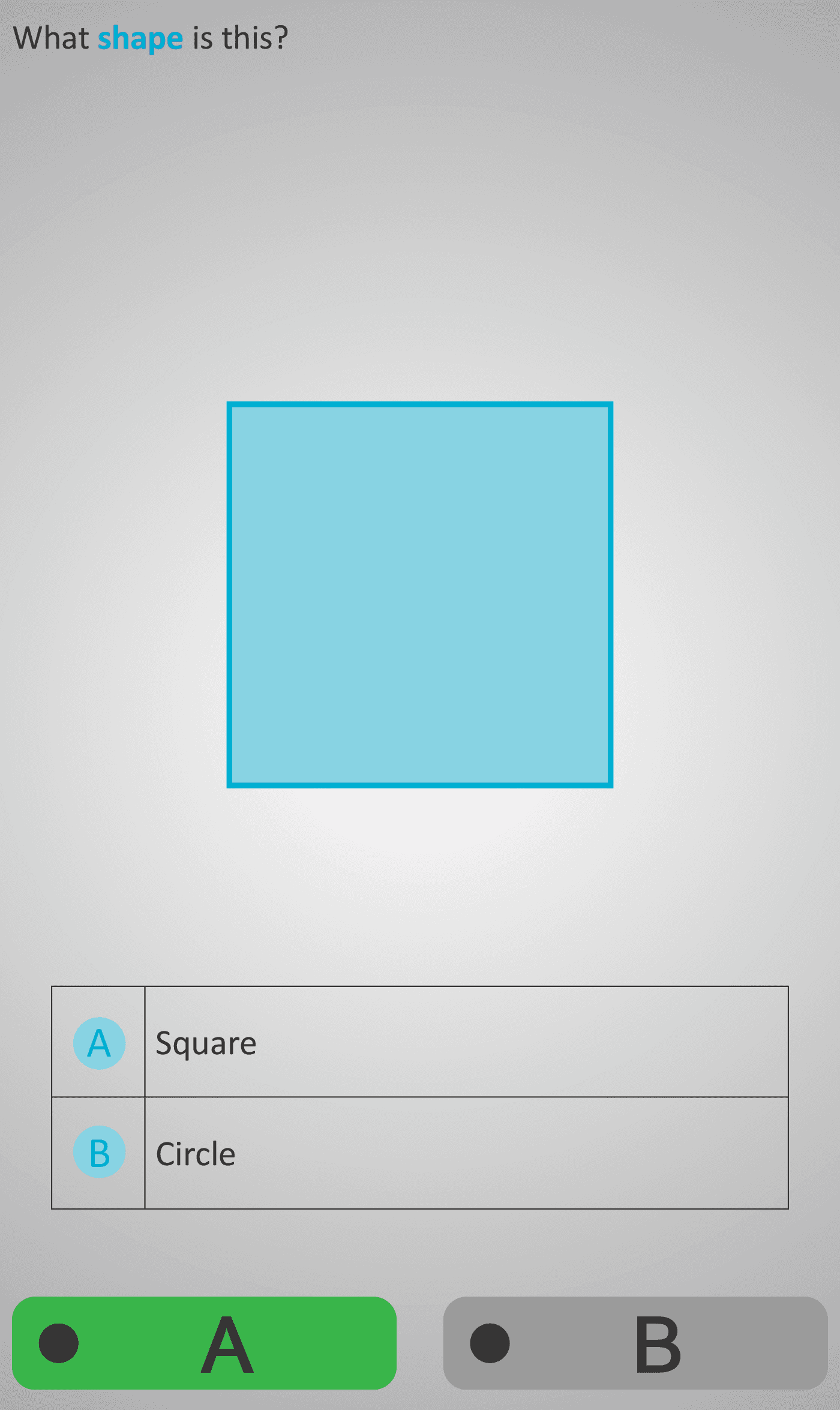
This Phlow, Polygons 1A, focuses on the foundational skill of recognising and naming common two-dimensional shapes: the square, rectangle, and triangle. Each screen presents a clear, colour-filled polygon with two answer options, keeping cognitive demand low and encouraging confident, automatic identification.
The design uses consistent blue highlighting for key terms and uncluttered visuals to reduce distraction and support visual memory. This activity strengthens spatial awareness and shape-language association — key stepping stones for later geometry concepts such as properties of sides, angles, and symmetry.
Learners build confidence as they distinguish between similar shapes (e.g. squares and rectangles), establishing essential visual discrimination skills. The repetition across varied shapes supports mastery and fluency in recognising geometric forms.
Prerequisite Knowledge Required:
Familiarity with basic visual shapes from early learning environments such as squares, circles, rectangles, and triangles.
Linked Phlows: Shapes Intro 1, Compare 1A
Main Category:
Geometry
Estimated Completion Time:
Approx 6 seconds per question. 10 questions total. Total time: 1 minute.
Cognitive Load / Step Size:
Extremely low cognitive load. Each question introduces one visual recognition task with clear binary choices. Step size is small, ensuring early success and confidence building. Transitions between questions are minimal — ideal for early mastery, though slightly repetitive for advanced learners.
Language & Literacy Demand:
Minimal. Each question uses a short, direct sentence (“What shape is this?”). The key term shape is colour-highlighted to draw focus. The task relies primarily on visual recognition rather than reading comprehension, reducing barriers for weaker readers.
Clarity & Design:
Clean and uncluttered layout with large, well-defined blue polygons. Consistent use of colour and contrast improves recognition and reduces extraneous load. The graphics are functional, not decorative — each visual directly supports the learning objective.
Curriculum Alignment:
Aligned with the Geometry and Trigonometry strand, specifically the learning outcome: recognise, describe, and classify common 2D shapes according to their properties.
Engagement & Motivation:
The bright visuals and quick-response format maintain engagement for beginners. The Phlow gives immediate success feedback, supporting intrinsic motivation through progress and positive reinforcement.
Error Opportunities & Misconceptions:
- Confusing squares and rectangles due to similar features.
- Misidentifying triangles if attention isn’t focused on the number of sides.
Transferability / Real-World Anchoring:
The skill easily transfers to real-world contexts — identifying shapes in the environment (e.g., screens, doors, signs, and road markings).
Conceptual vs Procedural Balance:
Primarily conceptual. Emphasises recognition and classification rather than calculations or procedures. Builds foundational understanding for future topics like perimeter, area, and symmetry.
Learning Objectives Addressed:
- Identify and name common 2D shapes (square, rectangle, triangle).
- Distinguish shapes by visual properties such as side length and angles.
- Build vocabulary and confidence in describing geometric forms.
- Strengthen foundational spatial awareness skills.
What your score says about you:
- Less than 5: You’re just starting to recognise basic shapes — try again for familiarity and fluency.
- Between 6–7: You can identify most shapes, but sometimes mix up similar ones.
- Between 8–9: You’ve got a strong grasp of 2D shape recognition.
- 10/10: Excellent visual recognition — you’re ready for Polygons 1B to explore sides and corners in more detail.