
Sets 1
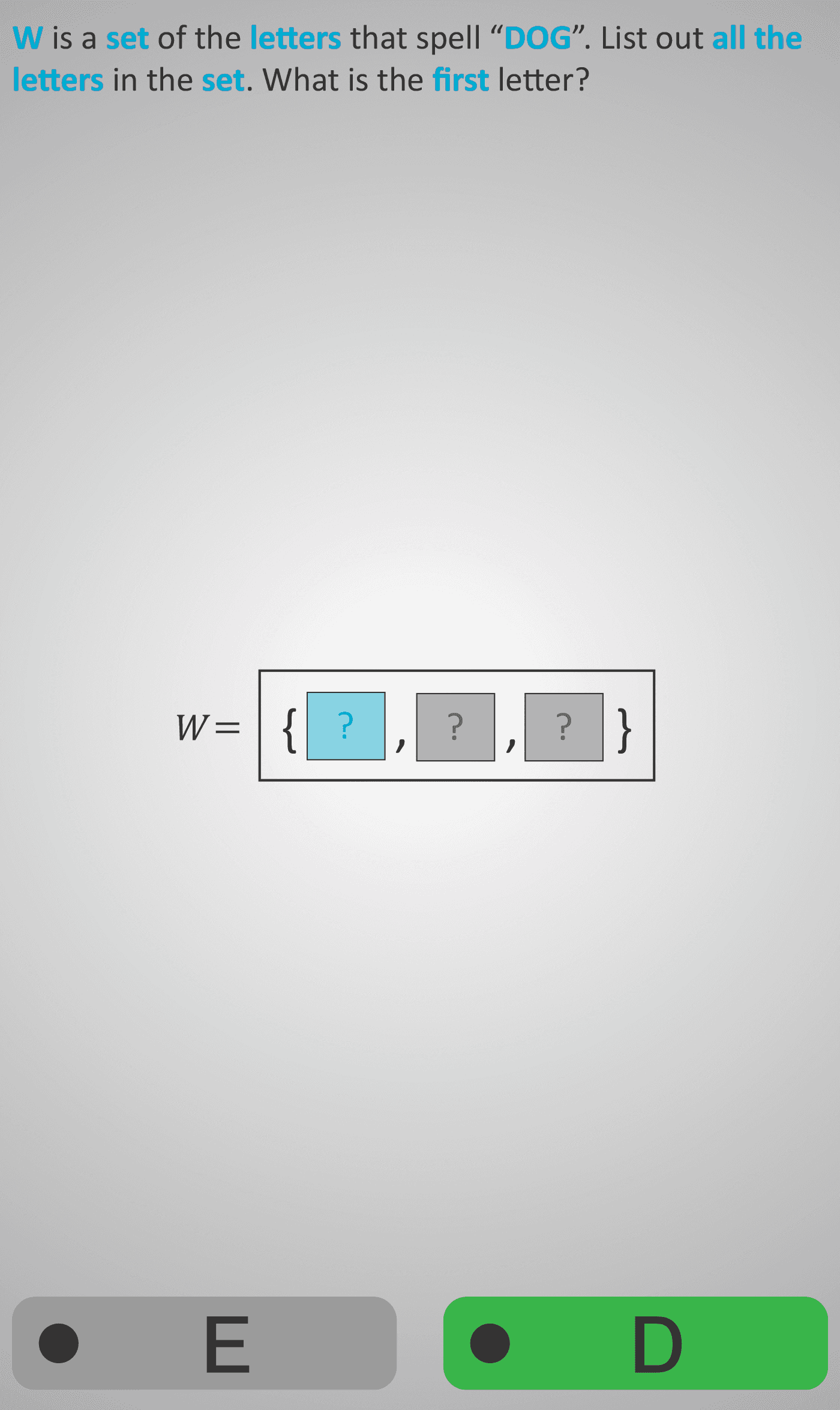
This Phlow introduces learners to the concept of a set through a simple, language-based example. Students are shown that a set can contain elements such as letters, and that these are listed within curly brackets { }.
Using the familiar word “DOG”, each question progressively reveals one more letter, guiding the learner to identify the elements of the set step-by-step. This activity strengthens early pattern recognition and symbolic understanding, preparing students for later use of sets with numbers and other mathematical objects.
The progression from first to last letter reinforces sequencing and structure within a clear, visual framework.
Prerequisite Knowledge Required:
- Recognition of letters and basic alphabetical order.
- Understanding that items can belong to a group or collection.
Linked Phlows: Patterns 1A, Group 1, Objects 1A
Main Category:
Algebra – Foundations of Set Theory
Estimated Completion Time:
Approx. 6 seconds per question. 10 questions total. Total time: ~1 minute.
Cognitive Load / Step Size:
The step size is intentionally minimal. Each question builds on the last by revealing one additional letter, maintaining flow through predictability and clarity. This sequence minimises cognitive load and reinforces confidence, ideal for introducing the concept of a set without abstract notation overload.
Language & Literacy Demand:
The text includes mild literacy demand (“set”, “letters”, “first”, “next”, “last”) but is supported by strong visuals and consistent colour cues. Learners can infer meaning from structure even without full reading fluency, keeping it accessible for weaker readers.
Clarity & Design:
The layout uses boxed symbols and curly brackets { } to visually define a set, with progressive blue highlighting guiding attention. Design is functional rather than decorative — every visual cue reinforces mathematical meaning (order, containment, identity).
Curriculum Alignment:
Aligned with the Irish Junior Cycle Mathematics – Strand 3: Algebra, specifically Learning Outcome 3.1: “Recognise and describe patterns, relationships and structures in sets.”
Also supports Strand 1: Unifying Strand by reinforcing mathematical language and representation.
Engagement & Motivation:
Using the familiar word “DOG” introduces warmth and simplicity, easing students into abstract thinking. The task feels like a game of uncovering or decoding rather than a formal maths exercise, supporting early confidence in algebraic reasoning.
Error Opportunities & Misconceptions:
- Confusing order of letters with importance (believing sets must be ordered).
- Misreading curly brackets
{ }as parentheses or boxes. - Expecting repetition or spacing within the set notation.
These can be corrected through later Phlows on unordered sets and number sets.
Transferability / Real-World Anchoring:
Supports understanding of how data and groups are represented symbolically — transferable to lists, databases, Venn diagrams, and coding logic.
Conceptual vs Procedural Balance:
Highly conceptual — builds foundational understanding of what a set is before applying operations or number-based examples. No procedures are required beyond recognition and ordering.
Learning Objectives Addressed:
- Understand that a set is a collection of distinct items or elements.
- Recognise and use set notation
{ }. - Sequence and categorise symbols or letters logically.
- Build confidence interpreting abstract notation with familiar content.
What your score says about you:
- Less than 5: You may still be learning what a set is and how items are grouped.
- Between 6–7: You recognise letters as members of a set but may mix order or structure.
- Between 8–9: You understand how to list elements of a set with minor slips in sequence.
- 10/10: You can confidently identify all elements in a set and understand its notation.