
Stem Leaf 1
This Phlow introduces the concept of stem-and-leaf diagrams, helping learners understand how to organise numerical data visually by splitting each number into two parts — the stem (tens) and the leaf (ones).
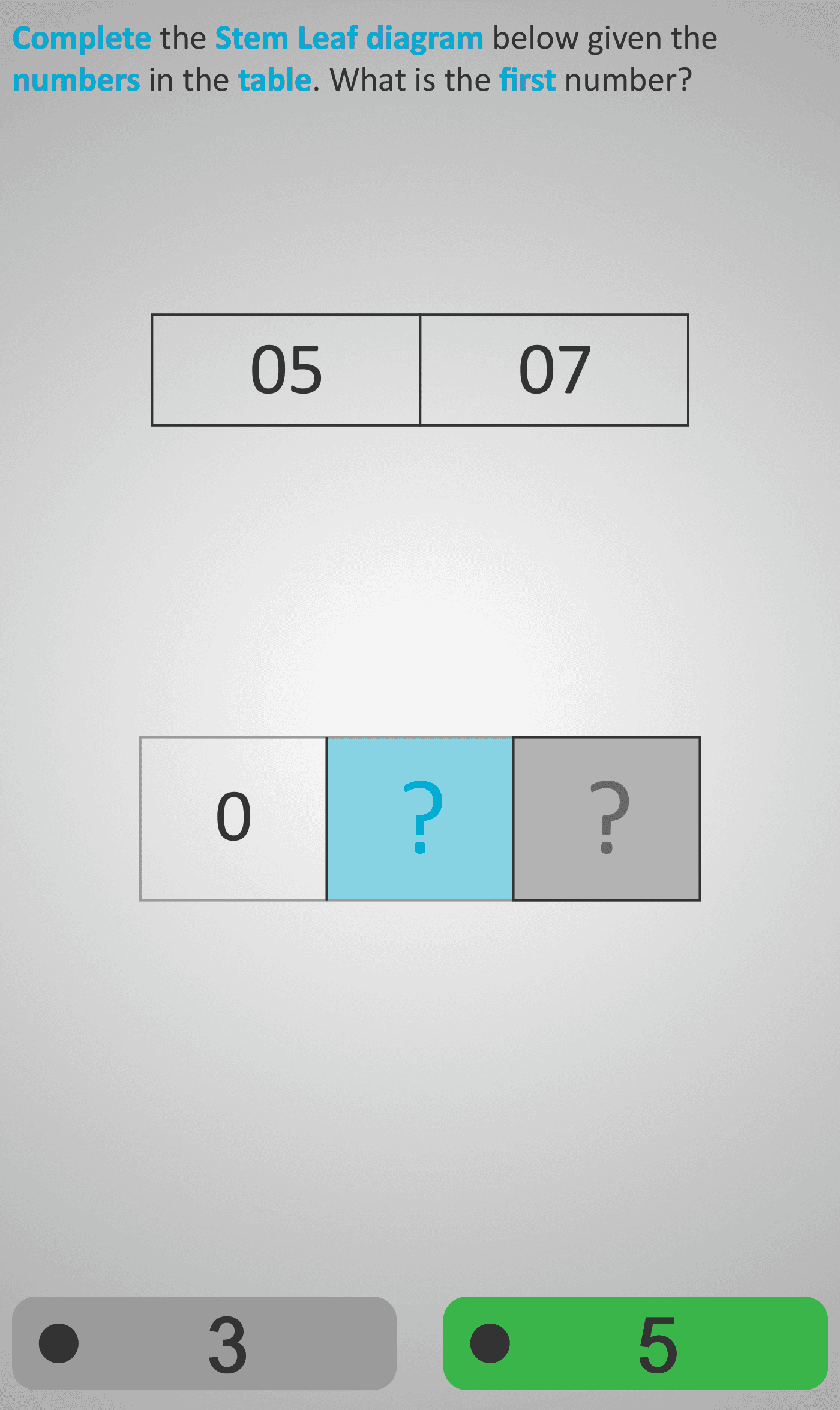
The first questions use small, clear numbers like 05 and 07, allowing students to identify the stem “0” and the leaves “5” and “7.” Visual boxes reinforce how numbers are broken down and displayed, while colour highlights draw attention to the part being completed.
This early-stage Phlow builds the foundation for interpreting and constructing more complex data representations in later levels.
Prerequisite Knowledge Required:
- ✅ Numbers 1 — recognising two-digit numbers
- ✅ Place Value 1A — identifying tens and ones
Main Category:
Data Handling / Statistics
Estimated Completion Time:
Approx 6 seconds per question. 10 questions total. Total time: 1 minute.
Cognitive Load / Step Size:
Very low cognitive load. Each question adds only one new leaf or stem at a time, ensuring smooth progression without overload.
Language & Literacy Demand:
Minimal text; supported by clear visuals and colour cues. Suitable for all reading levels — comprehension depends on number sense, not literacy.
Clarity & Design:
Clean visual layout with high contrast and focused colour highlighting. The use of boxes for stems and leaves effectively reinforces the data structure rather than being decorative.
Curriculum Alignment:
Aligned with Statistics: Representing Data — constructing and interpreting simple data representations, including stem-and-leaf diagrams.
Engagement & Motivation:
The visual interactivity and pattern recognition aspect make it feel like a puzzle, keeping students engaged while reinforcing number decomposition.
Error Opportunities & Misconceptions:
- Students might reverse the stem and leaf or misread the place value.
- The clear layout helps prevent this by consistently showing the stem first.
Transferability / Real-World Anchoring:
Skills learned transfer to interpreting data tables and charts in real-world contexts, such as scores, measurements, or survey results.
Conceptual vs Procedural Balance:
Strongly conceptual — focuses on why numbers are split and displayed, not just how to fill in blanks.
Learning Objectives Addressed:
- Understand that numbers can be split into tens (stems) and ones (leaves).
- Construct a simple stem-and-leaf diagram from a data list.
- Recognise patterns and order in numerical data.
- Build readiness for comparing and analysing datasets.
What Your Score Says About You:
- Less than 5: You’re beginning to understand how data can be represented visually. Try again and focus on tens vs ones.
- Between 6–7: You understand the structure but may mix up stems and leaves — good progress!
- Between 8–9: You can confidently complete simple stem-and-leaf diagrams with minor slips.
- 10/10: Excellent! You can interpret and build data diagrams accurately — ready for next-level data tasks.