
Subtract 1
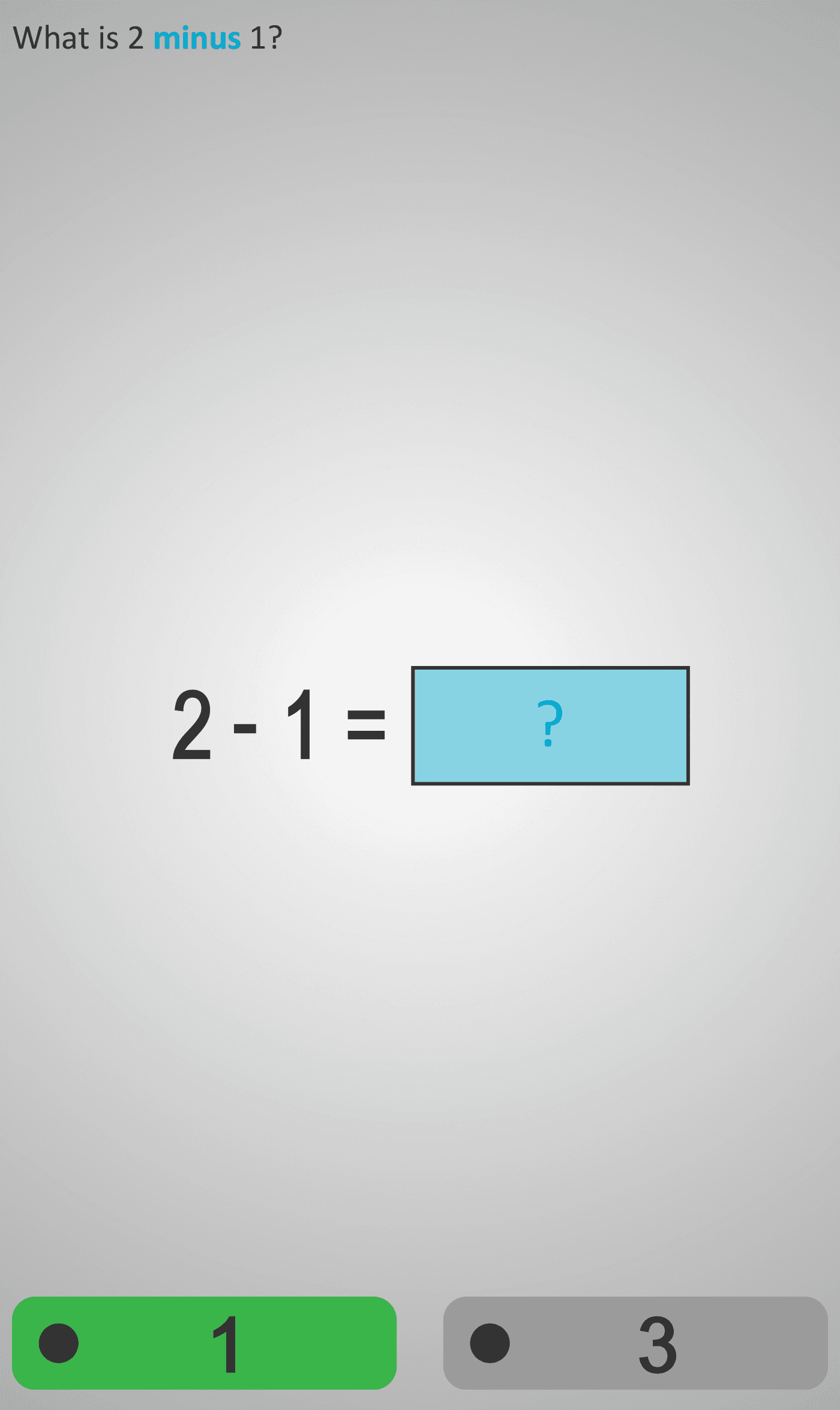
This Phlow focuses on developing early subtraction fluency through highly visual, single-step problems such as 2 − 1 = ? and 7 − 3 = ?.
Each screen isolates a single subtraction, ensuring focus on the operation itself rather than on complex language or mixed arithmetic. The layout is clean and consistent: the subtraction equation appears prominently with a shaded answer box prompting active response. Colour and spacing help direct attention to the key numbers and symbols.
The exercise reinforces subtraction as “taking away” or “finding what’s left,” and serves as an essential bridge between counting and understanding number relationships. The repetition of simple examples supports memory consolidation and number sense, while the variety of pairs prevents rote guessing. This Phlow helps learners recognise subtraction as the inverse of addition, preparing them for future number pattern and algebraic reasoning tasks.
Prerequisite Knowledge Required:
- Understanding of number sequence up to at least 10
- Familiarity with the concept of taking away one (from “Add 1” Phlow)
- Prior completion of Add 1, Numbers 1, and Count 1A/B Phlows
Main Category:
Arithmetic
Estimated Completion Time:
Approx. 6 seconds per question × 10 questions = 1 minute total
Cognitive Load / Step Size:
The step size is minimal and well-controlled. Each subtraction involves small numbers with a consistent format, allowing learners to focus entirely on recognising subtraction patterns without overload.
Language & Literacy Demand:
Extremely low. Sentences are short (“What is 2 minus 1?”) and use high-frequency mathematical vocabulary. Visuals provide context without requiring reading comprehension. Suitable for emerging readers or English language learners.
Clarity & Design:
Strong visual clarity — black numerals, a bright answer box, and clean white background remove distractions. Each question isolates one operation, reinforcing procedural accuracy. The consistent use of blue for keywords (e.g., “minus”) subtly reinforces focus on the operation sign.
Curriculum Alignment:
Aligns with the Number strand of the Irish mathematics curriculum — understanding subtraction as the inverse of addition and using number facts up to 10 for basic operations.
Engagement & Motivation:
Short, immediate-response questions maintain focus. The alternating number combinations keep it from feeling repetitive, while instant feedback supports motivation and self-efficacy.
Error Opportunities & Misconceptions:
- Reversing subtraction (e.g., confusing 2−1 with 1−2).
- Overcounting or skipping numbers.
- The fixed visual layout helps reduce such mistakes by keeping order clear.
Transferability / Real-World Anchoring:
Directly applies to daily contexts like counting down or removing items (“I had 7 apples, I ate 3”). Forms the foundation for understanding change, difference, and distance.
Conceptual vs Procedural Balance:
Primarily procedural, reinforcing accuracy in applying subtraction facts. Conceptual awareness is supported through pattern recognition and visual layout.
Learning Objectives Addressed:
- Identify subtraction as the operation for “taking away” or “finding the difference.”
- Calculate basic subtraction facts within 10.
- Recognise subtraction as the inverse of addition.
- Build fluency and confidence in single-step mental arithmetic.
🏅 What Your Score Says About You:
- Less than 5: Still developing understanding of subtraction — try using counters or drawings to visualise “taking away.”
- Between 6–7: You can subtract small numbers correctly but might need to slow down to avoid slips.
- Between 8–9: Strong accuracy and speed — subtraction facts are nearly automatic.
- 10/10: Excellent fluency! You can instantly recall subtraction facts within 10 and are ready for higher-level problem-solving.