
Venn Diagram 1A
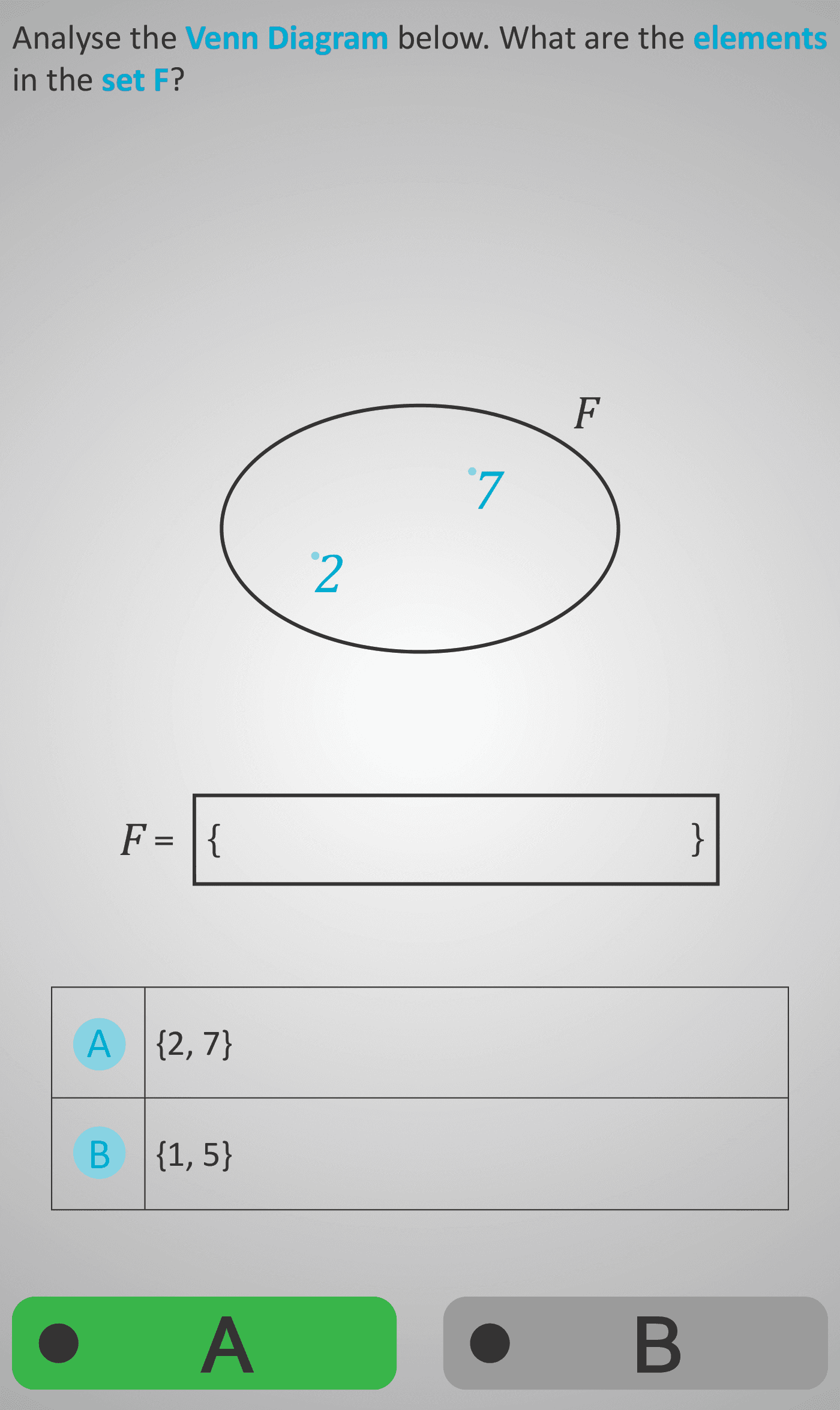
Venn Diagram 1A introduces the concept of sets and elements through simple Venn diagrams containing one circle. Each question shows a labelled set (e.g., F, D, H) with numbers placed inside. Students are asked to identify which numbers belong to that set and represent them correctly using set notation, such as F = {2, 7}.
The task builds visual familiarity with how Venn diagrams represent membership — elements inside the oval belong to the set, while any numbers outside do not. The structure remains consistent across examples, allowing focus on concept recognition rather than layout changes. Each question provides two answer options in multiple-choice form, supporting early learners to recognise the correct pattern before later advancing to open-form set construction. This Phlow lays the groundwork for future topics involving intersections, unions, and complements of sets.
Prerequisite Knowledge Required:
- Understanding of numbers and number sets
- Awareness of curly brackets { } as notation for listing items in a set
- Basic recognition of shapes and position (“inside” vs “outside”)
Related Earlier Phlows:
- Sets 1 — introduces what sets and elements are
- Polygons 1A — supports visual scanning and categorisation practice
Main Category:
Data & Statistics
Estimated Completion Time:
Approx. 6 seconds per question, 10 questions total → ~1 minute
Cognitive Load / Step Size:
Low. Each step introduces a new set label (F, D, H) while keeping logic identical. The simplicity and repetition strengthen understanding without strain.
Language & Literacy Demand:
Minimal. Wording uses consistent phrasing and visually highlights keywords like “Venn Diagram”, “elements”, and “set F”. Suitable for developing readers.
Clarity & Design:
Excellent visual clarity. Clean diagrams, distinct ovals, and colour-coded highlights. Numbers are clearly placed inside or outside sets. Multiple-choice layout reinforces learning effectively.
Curriculum Alignment:
Strand: Data
Learning Outcome: Represent sets of objects or numbers using simple diagrams and set notation; identify elements belonging to a set.
Engagement & Motivation:
The simple, repetitive structure supports confidence and quick success. Changing set labels provides a sense of progression and variation.
Error Opportunities & Misconceptions:
- Confusing numbers outside and inside the set
- Forgetting curly brackets { } in notation
- Assuming order matters in listing elements (thinking {7, 2} ≠ {2, 7})
Transferability / Real-World Anchoring:
Applies to sorting and categorisation tasks across subjects — from data grouping to science classifications and everyday organisation.
Conceptual vs Procedural Balance:
Balanced. Builds both conceptual understanding (what sets mean) and procedural skill (writing elements in proper notation).
Learning Objectives Addressed:
- Identify which elements belong to a set using a Venn diagram
- Represent elements in correct mathematical set notation
- Distinguish between elements that are and are not members of a set
- Build familiarity with visual data representation and categorisation
What Your Score Says About You:
- Less than 5: Still learning what a set means — review examples and focus on what’s inside the circle.
- 6–7: Understands the basics but mixes up some elements — great progress!
- 8–9: Strong understanding — accurately identifies and writes most elements.
- 10/10: Excellent! Confidently interprets simple Venn diagrams with correct notation.