
Visual Algebra 1
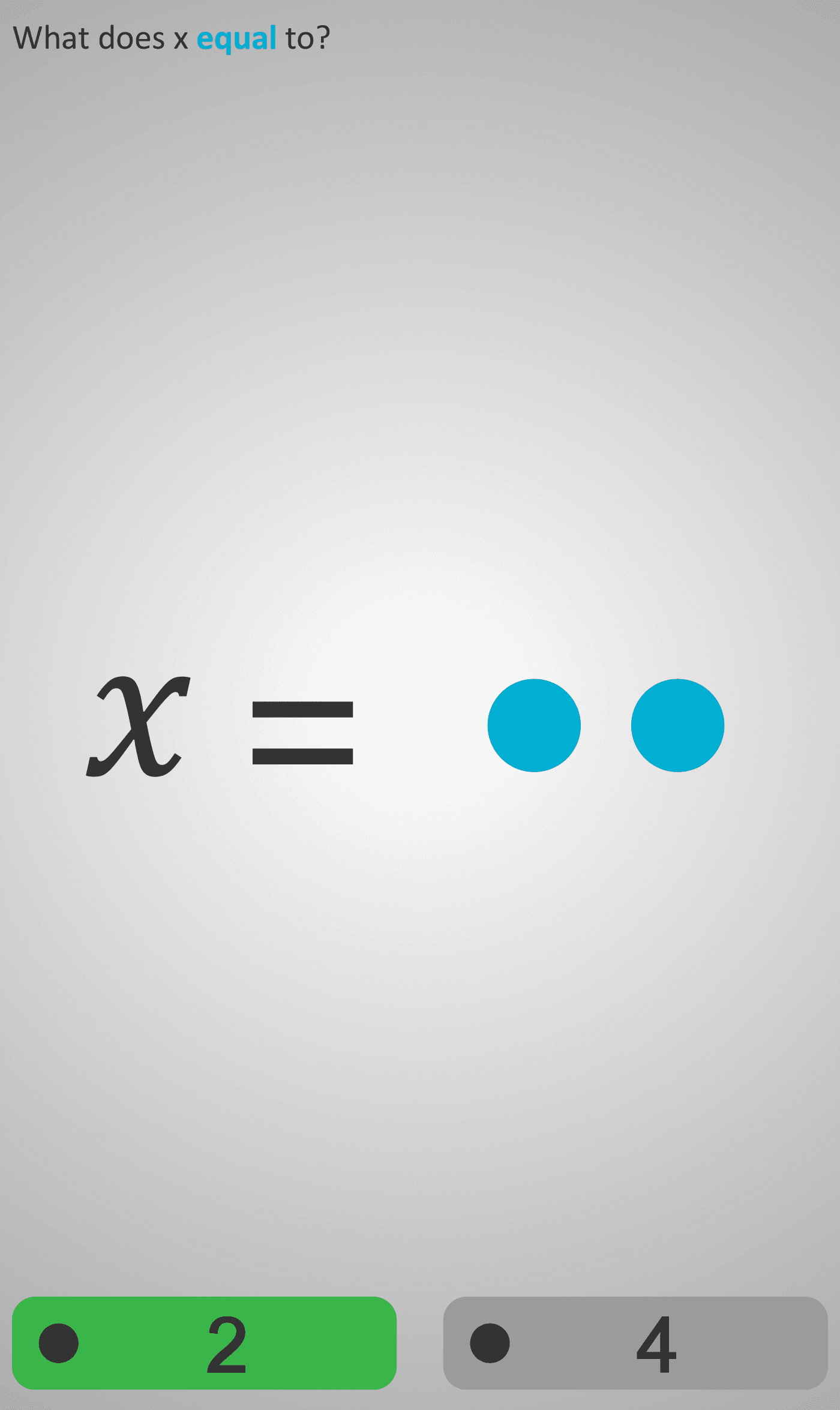
Visual Algebra 1 bridges arithmetic and algebra by using dots to represent numerical values. Learners are shown simple equations like x = ●●, y = ●●●, and a = ●, and must determine what number each variable represents.
By pairing symbolic notation with visual counting, this activity builds the concept of variables as placeholders for numbers, preparing students for symbolic manipulation in later Phlows. The minimal text and clean layout reduce cognitive load, making it ideal for early algebra learners. Each question reinforces the one-to-one link between the visual model (dots) and the algebraic form (x = 2, y = 3, etc.), helping students gain familiarity with symbols while maintaining a concrete sense of what they represent.
Prerequisite Knowledge Required:
- Recognition of numbers up to at least 5
- Understanding of “equals” as “the same as”
- Experience counting visual items (from Count 1 or Add 1)
Linked Previous Phlows:
- Count 1
- Add 1
- Equal 1 (Intro to = sign)
Main Category:
Algebra
Estimated Completion Time:
Approx. 6 seconds per question × 10 questions = ~1 minute
Cognitive Load / Step Size:
Each question introduces only one new symbol (x, y, or a), maintaining extremely low cognitive load. The visual quantity and the symbol appear simultaneously, helping learners generalise without abstraction overload. Step size is small and appropriately paced for concept formation.
Language & Literacy Demand:
Very low. Only minimal text (“What does x equal to?”) is used, supported by clear visuals. The question structure repeats, allowing pattern recognition rather than decoding effort.
Clarity & Design:
Highly visual and minimalist. Blue dots contrast against the light background and are easily countable. The variable and equals sign are bold, drawing focus to algebraic structure. The consistent format reduces distraction and highlights meaning.
Curriculum Alignment:
Strand: Algebra
Learning Outcome: Recognise and use letters to represent numbers; understand the use of symbols in equations and formulae.
Engagement & Motivation:
Students find satisfaction in decoding the relationship between dots and symbols — it feels like solving a code. The immediate feedback reinforces confidence in early algebra.
Error Opportunities & Misconceptions:
- Miscounting dots (e.g. seeing three instead of two)
- Confusing = as an instruction rather than equivalence
- Believing the variable is the dots rather than representing their number
Transferability / Real-World Anchoring:
Builds the foundational idea that symbols stand for quantities — transferable to all future algebraic work, physics formulas, and coding variables.
Conceptual vs Procedural Balance:
Conceptual focus — understanding what a variable means, not manipulating it. No arithmetic required beyond counting.
Learning Objectives Addressed:
- Identify what a variable represents in a simple equation
- Translate between visual and symbolic representations
- Interpret = as an equivalence statement
- Build readiness for symbolic algebraic manipulation
What Your Score Says About You:
- Less than 5: You’re still linking the idea of symbols to numbers — repeat the activity and focus on counting carefully.
- 6–7: You can identify visual quantities but may mix up variable-symbol meaning.
- 8–9: You’re developing strong symbolic understanding — one or two slips in attention.
- 10/10: Excellent! You’ve built the foundational concept of what variables represent — ready for Visual Algebra 2.