
Algebra 2D
Overview
This Phlow introduces students to solving one-step linear equations involving addition and subtraction. Learners are guided to understand that when a constant is added or subtracted to the variable, it must be moved to the opposite side of the equation with the operation reversed.
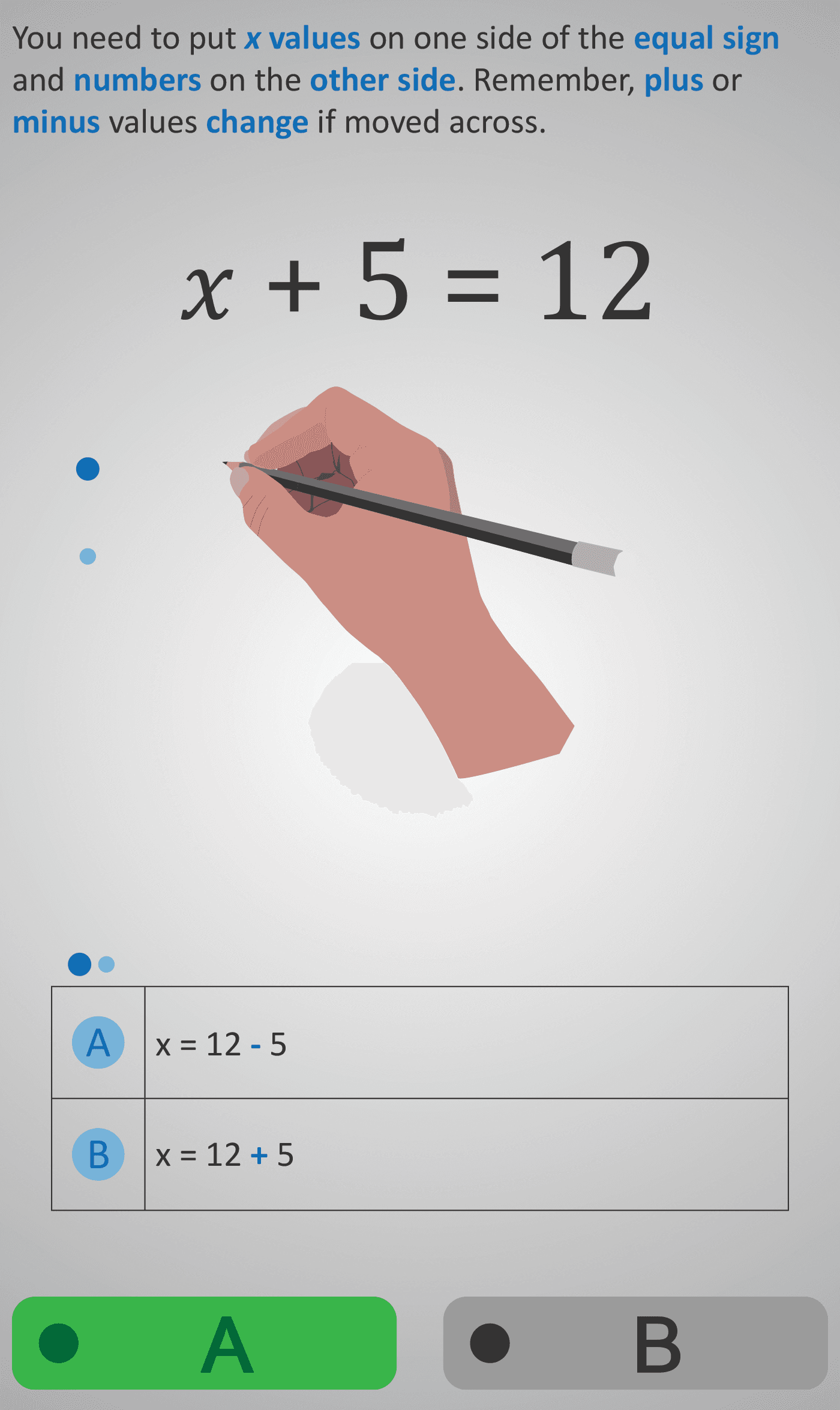
The first sequence uses x + 5 = 12 to demonstrate how constants are moved across the equal sign. Students must choose the correct rearrangement, recognising that x = 12 − 5. The process continues step-by-step, confirming that x = 7.
Next, the activity flips the structure with y − 7 = 11. Students are reminded that a minus becomes a plus when moved across, leading to y = 11 + 7. They then calculate y = 18.
The progression builds confidence in balancing equations while reinforcing the core rule: whatever is added or subtracted on one side must be undone on the other. Through interactive choices and step-by-step substitution, students develop fluency in handling both positive and negative constants. This Phlow strengthens algebraic reasoning, provides a foundation for multi-step equations, and supports mastery by encouraging learners to carefully track sign changes across the equal sign.
Prerequisite Knowledge Required
- Understanding of inverse operations (addition ↔ subtraction)
- Familiarity with algebraic notation (x, y, etc.)
- Experience with one-step equations involving multiplication/division (see Algebra 2C)
Main Category
Algebra
Estimated Completion Time
Approx 6-10 seconds per question. 20 questions total. Total time: 2-4 minute.
Cognitive Load / Step Size
Moderate — the new concept of moving terms across the equals sign introduces a mild increase in abstraction. The Phlow scaffolds learning through clear examples and reversed operations, preventing overwhelm.
Language & Literacy Demand
Low — uses minimal text, with clear symbolic representation of each step. Learners interpret simple algebraic statements rather than reading complex sentences.
Clarity & Design
Visually clean and structured. Equations are spaced clearly with immediate feedback after each step, helping learners see how sign changes occur. The layout reinforces procedural accuracy and conceptual understanding simultaneously.
Curriculum Alignment
Aligned with the Patterns and Algebra strand of the Irish Junior Cycle mathematics curriculum — specifically, “form and solve linear equations in one variable.”
Engagement & Motivation
Interactive, fast-paced tasks maintain engagement while encouraging logical reasoning. The “undoing” of operations provides an intuitive and satisfying sense of problem-solving mastery.
Error Opportunities & Misconceptions
- Forgetting to reverse the sign when moving a constant.
- Confusing the direction of subtraction.
Transferability / Real-World Anchoring
Directly applicable to solving everyday formula-based problems (e.g., finding unknown totals, differences, or values in budget and measurement contexts).
Conceptual vs Procedural Balance
Balanced — focuses on both why operations are reversed (conceptual) and how to apply them step-by-step (procedural).
Learning Objectives Addressed
- Apply inverse operations to solve one-step equations with addition and subtraction.
- Understand how to move constants across the equals sign while reversing operations.
- Strengthen reasoning about equation balance and sign changes.
- Build procedural fluency to support solving multi-step equations.
What Your Score Says About You
- Less than 5: Review the rule of reversing operations — revisit Algebra 2C for grounding.
- Between 6–7: You’re beginning to apply inverse operations but may lose track of sign changes.
- Between 8–9: Strong grasp of solving equations with small calculation errors.
- 10/10: Excellent fluency — confident with both addition and subtraction equation solving.