
Analyse 2B
Overview
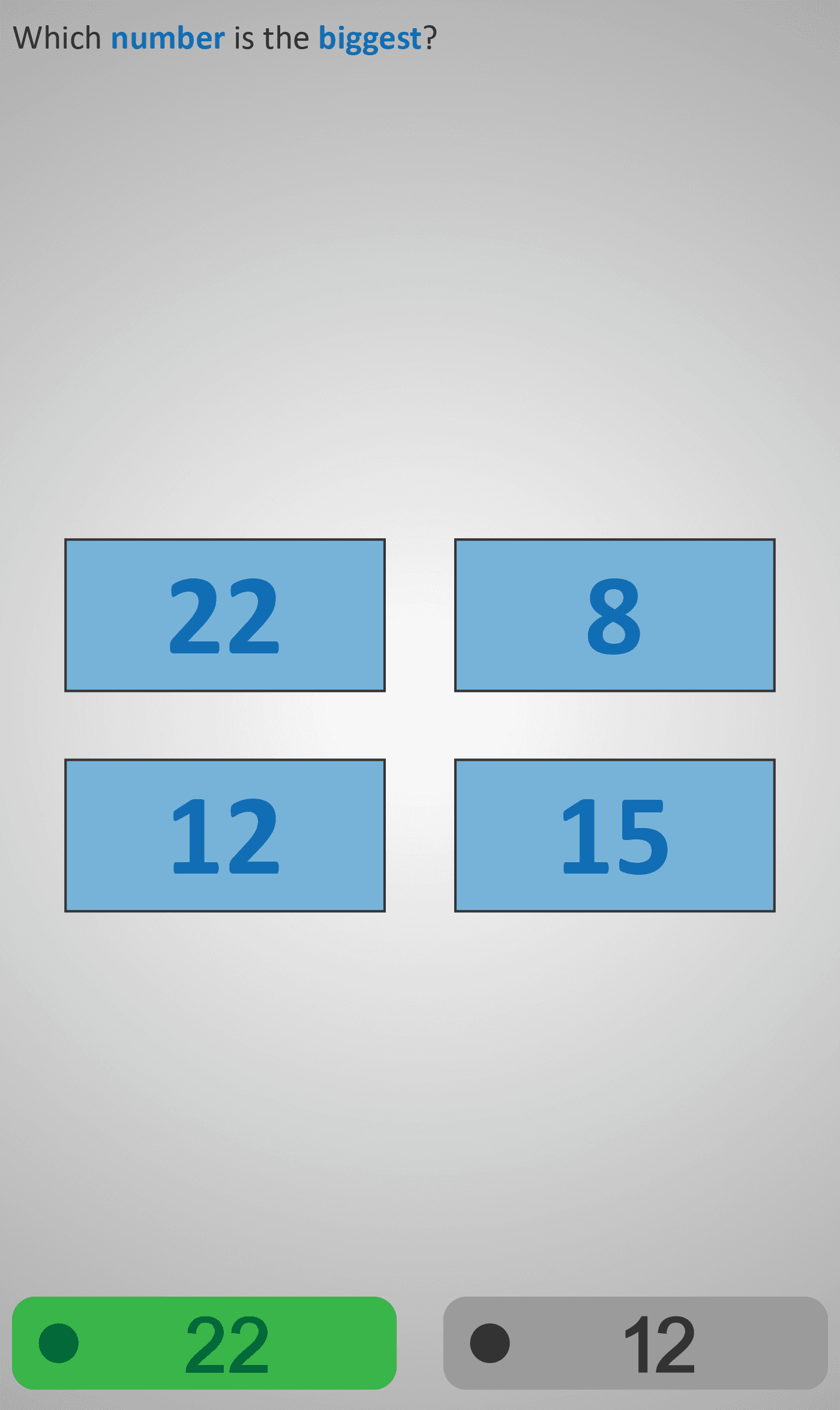
In this Phlow, students practise comparing whole numbers to identify the smallest or the largest value in a set of four options. Each screen presents a simple multiple-choice question, such as “Which number is the smallest?” or “Which number is the biggest?”. Students must quickly assess the relative size of the numbers shown (e.g., 28, 44, 13, 14) and select the correct answer.
The design strengthens number sense, encouraging learners to visualise and compare values without needing to perform detailed calculations. Questions alternate between finding the lowest and highest value, reinforcing both directions of comparison.
This Phlow is particularly effective for:
- Building confidence in recognising magnitude.
- Reinforcing understanding of place value and order.
- Developing fluency in quick decision-making with numbers.
By the end of Analyse 2B, learners should feel more comfortable scanning sets of numbers and immediately identifying relative size, a foundation skill for later topics such as ordering, sequencing, and interpreting data.
Prerequisite Knowledge Required
- Recognition of whole numbers and their relative values.
- Understanding that numbers increase in size from left to right on a number line.
- Familiarity with comparing two numbers (see Numbers 1, Add 1, Subtract 1).
Main Category
Number Sense & Comparison
Estimated Completion Time
Approx 6-10 seconds per question. 20 questions total. Total time: 2-4 minute.
Cognitive Load / Step Size
Low — each step focuses on a single comparison task, requiring recognition rather than computation. Alternating between “smallest” and “largest” maintains engagement while reinforcing bidirectional comparison.
Language & Literacy Demand
Minimal. Uses short, direct language (“Which number is the smallest?”). Students must only understand key comparative terms like smallest and biggest.
Clarity & Design
Visually clear interface with evenly spaced options. The numerical layout supports quick scanning, helping students rely on visual pattern recognition rather than text-heavy prompts.
Curriculum Alignment
Supports the Number strand of the Irish Junior Cycle mathematics curriculum: “Compare, order, and represent whole numbers; understand and use the concept of place value.”
Engagement & Motivation
Fast-paced and interactive — learners receive instant feedback, which reinforces accuracy and motivates improvement through repetition.
Error Opportunities & Misconceptions
- Students may confuse “smallest” with “largest,” especially if instructions alternate.
- Rushing without carefully reading the question prompt.
Transferability / Real-World Anchoring
Directly applicable to everyday decision-making (e.g., comparing prices, distances, or quantities) and foundational for interpreting data in charts or tables.
Conceptual vs Procedural Balance
Primarily conceptual — focuses on understanding numerical magnitude rather than performing operations.
Learning Objectives Addressed
- Identify the smallest and largest numbers in a set.
- Strengthen understanding of numerical order and magnitude.
- Reinforce comprehension of comparative language (smallest/largest).
- Develop rapid decision-making and confidence in number recognition.
What Your Score Says About You
- Less than 5: You may need more practice distinguishing numerical order. Try visualising the number line.
- Between 6–7: You understand comparisons but may hesitate under time pressure.
- Between 8–9: Strong grasp of ordering and place value with minor slips.
- 10/10: Excellent fluency in number comparison — well-prepared for sequencing and data interpretation.