
Angles 2B
Overview
Introduces students to measuring angles inside triangles using a protractor and angle facts. The exercises ask learners to identify the size of given angles and choose the correct measurement from options provided.
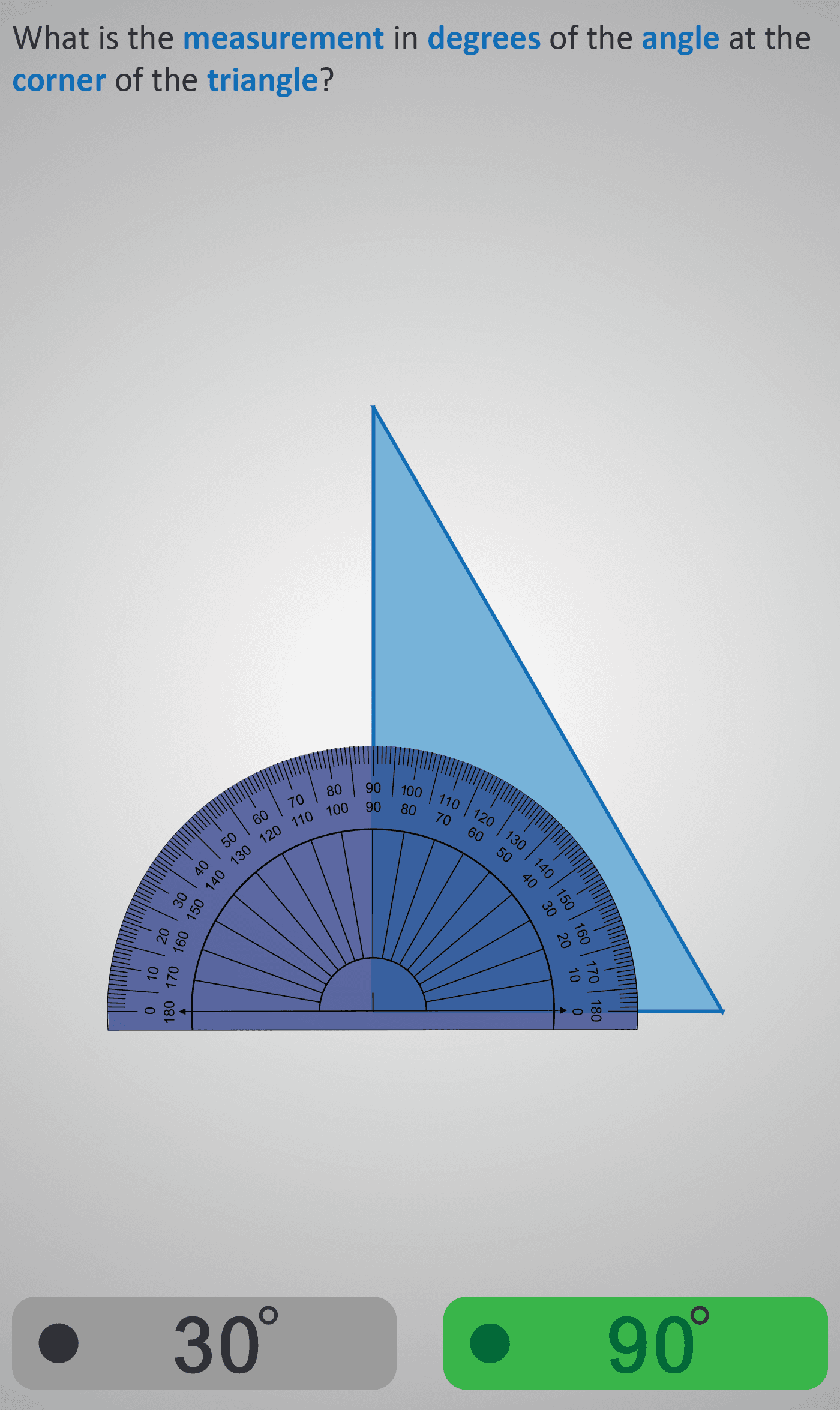
In the first task, students use a protractor to confirm that the angle at the base of a right triangle is 90°, reinforcing recognition of right angles. The second screen continues with protractor use, guiding students to measure and select a 60° angle. In the third exercise, learners combine protractor reading with angle rules in triangles. Given two angles (90° and 60°), they deduce the missing angle must be 30°, applying the fact that the angles in a triangle add up to 180°.
This Phlow blends practical measurement with deeper reasoning. It trains students to both read protractors accurately and use logical deduction about angle sums. By the end, learners strengthen their grasp of angle facts while building confidence in applying them within triangles.
Prerequisite Knowledge Required
- Understanding of what an angle is and familiarity with acute, right, and obtuse angles (see Angles 1A and Angles 2A).
- Basic knowledge of triangle structure and the fact that interior angles in a triangle add up to 180°.
- Some prior experience or visual familiarity with using a protractor.
Main Category
Geometry – Angles and Measurement
Estimated Completion Time
Approx 6-10 seconds per question. 20 questions total. Total time: 2-4 minute.
Cognitive Load / Step Size
Moderate — transitions progress from simple measurement (using a protractor) to combined reasoning (using angle sums). The step size is well-balanced, reinforcing earlier visual comparison skills while introducing analytical reasoning.
Language & Literacy Demand
Low — instructions are concise and supported by clear visuals of triangles and protractors. Minimal reading required beyond short prompts.
Clarity & Design
High — uses accurate, uncluttered triangle diagrams and protractor overlays. Each screen isolates one idea (measuring, identifying, or calculating), reducing cognitive overload.
Curriculum Alignment
Aligns with the Geometry and Trigonometry strand of the Irish Junior Cycle mathematics curriculum:
- Measure and construct angles using appropriate instruments.
- Understand and use the fact that the sum of the angles in a triangle is 180°.
Engagement & Motivation
The mix of measurement and reasoning keeps learners active. Visual protractors make the activity tactile and practical, appealing to visual learners.
Error Opportunities & Misconceptions
- Reading the protractor from the wrong scale (inner vs outer).
- Forgetting to line up the protractor baseline correctly.
- Adding angles incorrectly or failing to apply the 180° triangle rule accurately.
Transferability / Real-World Anchoring
Highly transferable — connects directly to geometry, design, and measurement in real-world contexts such as architecture, drafting, and navigation.
Conceptual vs Procedural Balance
Balanced — combines procedural skill (measuring with a protractor) with conceptual understanding (angle sum property).
Learning Objectives Addressed
- Measure and identify angles accurately using a protractor.
- Apply the 180° rule for triangles to find missing angles.
- Distinguish between measurement-based and deduction-based approaches.
- Build confidence in interpreting and analysing geometric diagrams.
What Your Score Says About You
- Less than 5: You may need more practice aligning the protractor and reading angle scales correctly.
- Between 6–7: You can identify right and acute angles but may need to strengthen reasoning with angle sums.
- Between 8–9: You show solid understanding of measurement and deduction with triangles.
- 10/10: Excellent mastery — you can confidently measure and calculate any angle in a triangle.