
Angles 2C
Overview
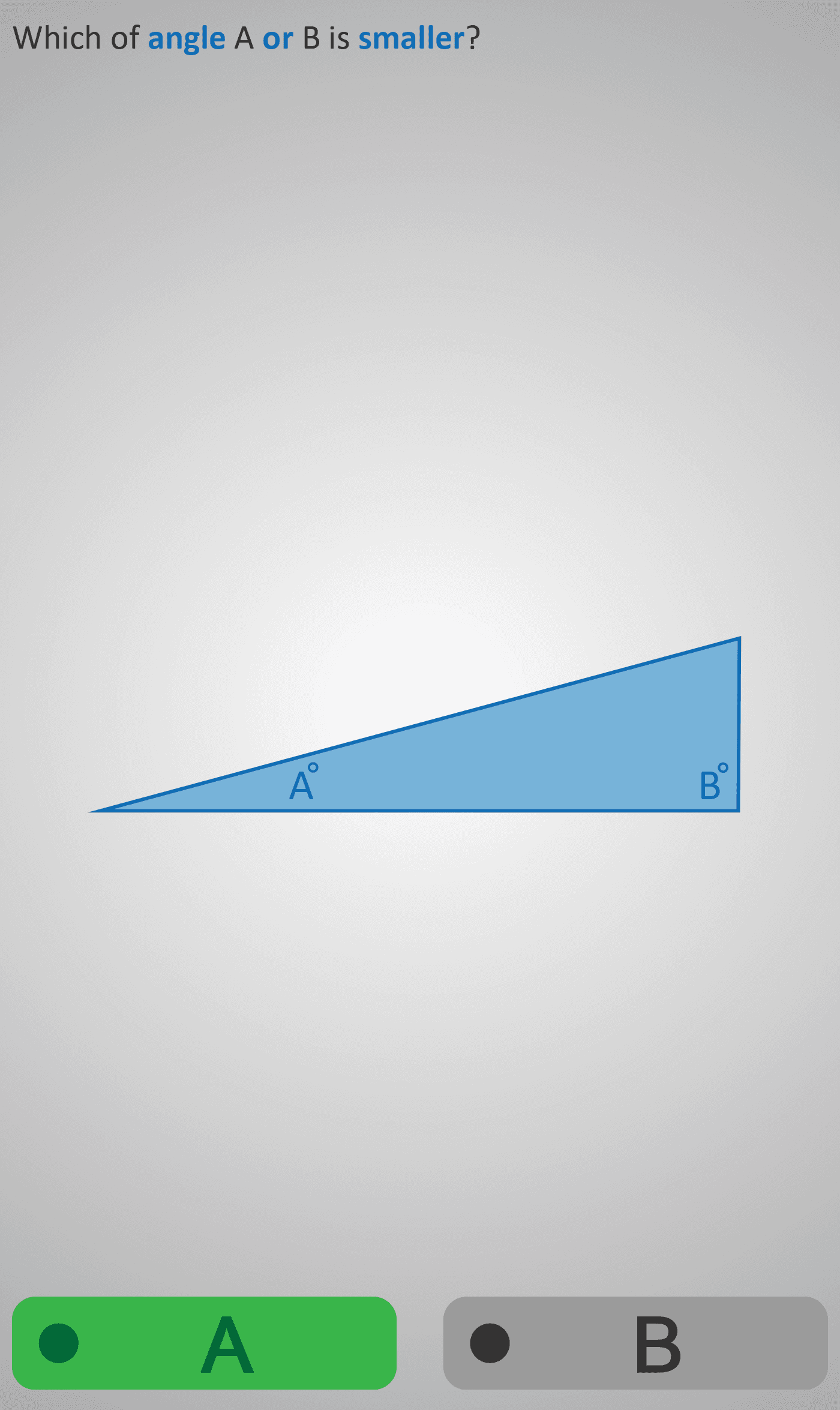
In Angles 2C, learners practise comparing and identifying which angles are larger or smaller within different types of triangles. Each question presents a triangle labelled with two angles, A and B, and asks the student to determine which is bigger or smaller.
The tasks encourage visual estimation without relying on a protractor, helping learners build their intuition about angle sizes based on the triangle’s overall shape. For example, in long narrow triangles, the small acute angle is easily distinguished from a wider one, while in other cases students must carefully compare angles that are closer in size.
This set develops an understanding of how angles vary in different triangles and supports reasoning about angle size relationships. It also strengthens foundational geometry skills, building towards more formal calculations with angle sums and properties of triangles.
Prerequisite Knowledge Required
- Understanding of what an angle represents and how its size can be compared visually (see Angles 2A).
- Familiarity with the basic parts of a triangle (vertices, sides, and angles).
- Awareness that all interior angles in a triangle add up to 180°, even if not yet used for calculation.
Main Category
Geometry – Angles and Shapes
Estimated Completion Time
Approx 6-10 seconds per question. 20 questions total. Total time: 2-4 minute.
Cognitive Load / Step Size
Low to moderate — questions move from obvious visual differences (e.g., one very acute vs. one wide angle) to subtler comparisons. The progression supports intuitive reasoning without introducing new notation or measurement.
Language & Literacy Demand
Low — questions are brief (“Which angle is larger?” / “Which is smaller?”). The visuals carry most of the cognitive work, allowing students of varying reading abilities to succeed.
Clarity & Design
Strong — clean diagrams with two labelled angles (A and B). Clear linework and spacing help direct attention to the comparison task. No unnecessary text or clutter.
Curriculum Alignment
Supports the Geometry and Trigonometry strand of the Irish Junior Cycle mathematics curriculum:
- Recognise and compare acute, right, and obtuse angles.
- Investigate the relationships between sides and angles in triangles.
Engagement & Motivation
Encourages visual reasoning, pattern recognition, and quick decision-making. The simplicity of the format maintains focus and momentum, especially for early geometry learners.
Error Opportunities & Misconceptions
- Confusing longer sides with larger angles without context.
- Over-reliance on diagram scale rather than comparing the actual marked angles.
- Assuming all triangles have one large and one small angle when some have similar angles.
Transferability / Real-World Anchoring
Supports real-world reasoning about shapes, such as interpreting angles in signs, architecture, or design sketches. Builds geometric intuition useful for later trigonometric reasoning.
Conceptual vs Procedural Balance
Primarily conceptual — focuses on intuitive understanding rather than calculation. Builds perceptual judgement before formal measurement or algebraic reasoning is introduced.
Learning Objectives Addressed
- Recognise and compare different angle sizes within a triangle.
- Develop intuition for how the shape of a triangle affects its angles.
- Distinguish acute, right, and obtuse angles visually.
- Build early reasoning skills for geometric relationships.
What Your Score Says About You
- Less than 5: You may need to spend more time observing how triangle shapes affect angle size.
- Between 6–7: You can identify clear differences but might miss subtler comparisons.
- Between 8–9: You show strong visual reasoning and consistent accuracy.
- 10/10: Excellent spatial awareness — you can confidently compare angles across all triangle types.