
Area 2
Overview
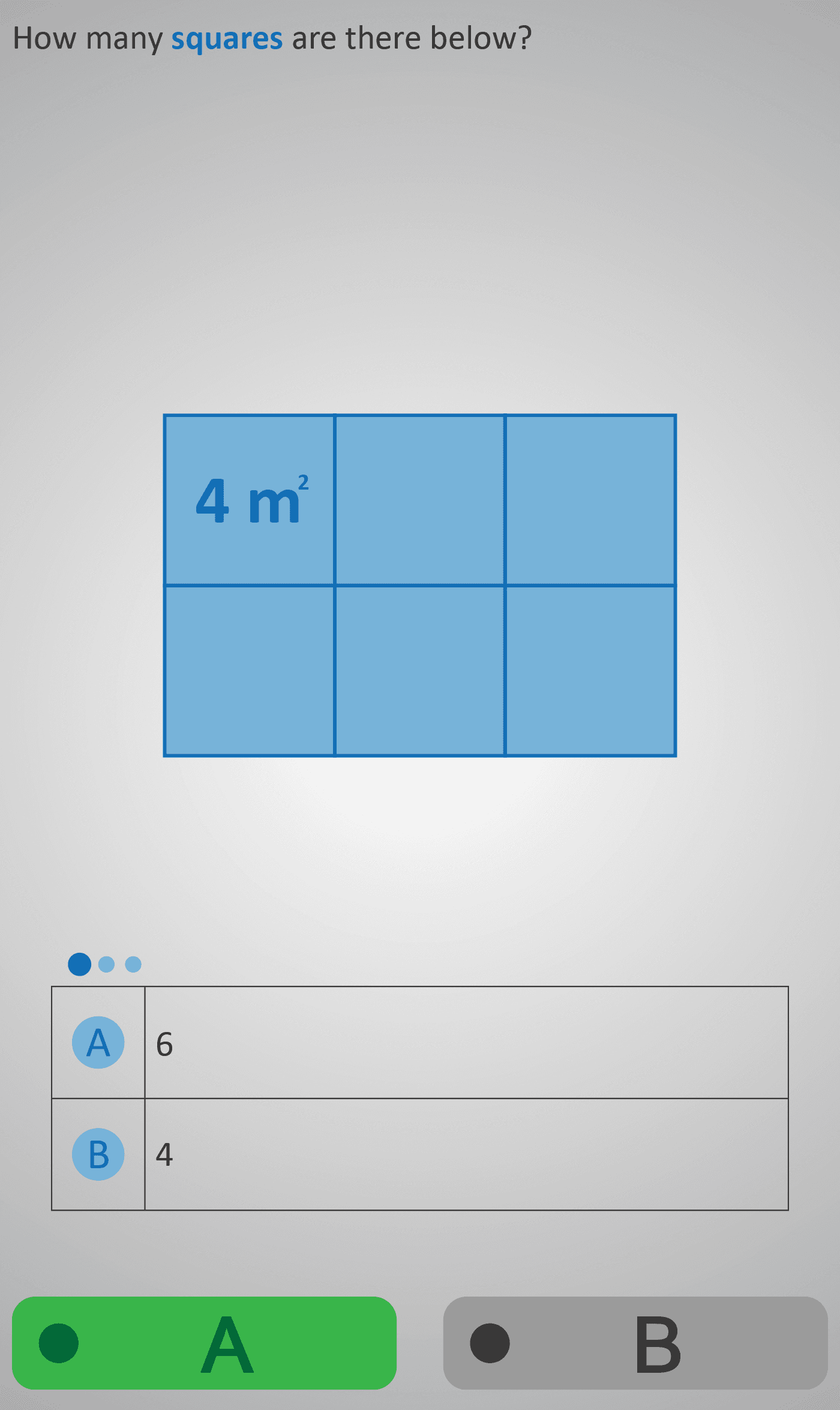
In this Phlow, students move beyond recognising individual square areas to calculating the total area of a group of equal squares. The sequence begins by counting the number of small squares inside a larger rectangle. Each small square is labelled with an area of 4 m², ensuring students link the unit of area directly to the count of squares.
Next, students are challenged to decide whether they should multiply or divide the number of squares by the given area to find the total. This reinforces the concept that total area is found by multiplying the number of equal parts by the area of one part.
Finally, students apply this understanding to compute the total area: with 6 squares, each of 4 m², the calculation is 6 × 4 = 24 m². The step-by-step structure supports conceptual clarity, helping learners connect counting, multiplication, and area measurement into one logical flow.
This Phlow strengthens skills in:
- Counting equal units of area.
- Linking multiplication to repeated area addition.
- Reading and interpreting area units (m²).
- Developing strategies for calculating total area in composite shapes.
Prerequisite Knowledge Required
- Understanding what area means (covered in Area 1).
- Ability to count units in a grid and recognise square metres (m²) as a measure of area.
- Basic multiplication fluency with small whole numbers.
Main Category
Measurement – Area
Estimated Completion Time
Approx 6-10 seconds per question. 20 questions total. Total time: 2-4 minute.
Cognitive Load / Step Size
Moderate — transitions from counting squares to applying multiplication are smooth and scaffolded. The step introducing “multiply or divide” adds conceptual depth without overwhelming the learner.
Language & Literacy Demand
Low — questions are concise and supported by strong visuals. Area values are clearly displayed beside diagrams, limiting text processing demands.
Clarity & Design
Excellent — clear use of grids and labelled squares makes the connection between units and total area explicit. Colour contrast and spacing are used effectively to highlight the parts and the whole.
Curriculum Alignment
Aligned with the Measures strand of the Irish Junior Cycle mathematics curriculum:
- Estimate, measure, and calculate area using square units.
- Recognise relationships between multiplication, repeated addition, and total area.
Engagement & Motivation
The visual, block-based format is accessible and satisfying. Learners gain confidence as they see direct, logical progressions from counting to calculating.
Error Opportunities & Misconceptions
- Dividing instead of multiplying when finding total area.
- Confusing the area of one square (unit area) with the total area of all squares combined.
- Ignoring units (m²) or treating them as numbers rather than measures.
Transferability / Real-World Anchoring
High — applicable to real-world situations such as tiling floors, designing fields, or estimating surface coverage. Builds functional numeracy through practical context.
Conceptual vs Procedural Balance
Balanced — the Phlow begins conceptually (understanding area as repeated units) and transitions into procedural practice (using multiplication).
Learning Objectives Addressed
- Recognise that total area is found by multiplying the number of equal units by the area of one unit.
- Strengthen multiplication fluency in a spatial context.
- Interpret and use square metres (m²) correctly.
- Develop strategies for analysing and combining simple area models.
What Your Score Says About You
- Less than 5: You may need more practice linking area counting with multiplication.
- Between 6–7: You understand the basic idea but occasionally mix up operations.
- Between 8–9: You’re confident in applying multiplication to find total area.
- 10/10: Excellent understanding — you can apply the concept to any group of equal units or composite area.