
Arrow Dia 2
Overview
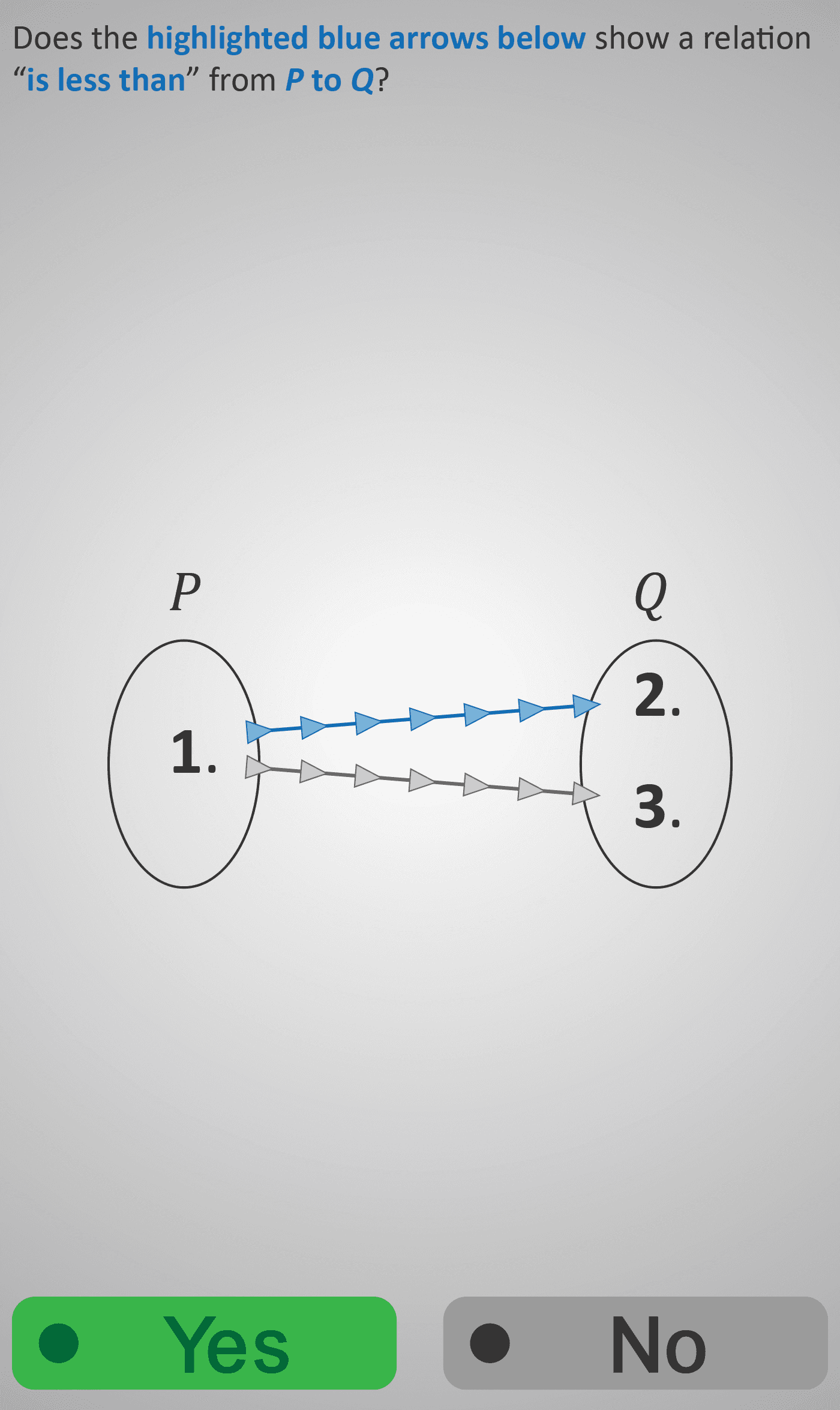
In this Phlow, students deepen their understanding of relations and how they can be represented using arrow diagrams. They examine sets P and Q, with arrows showing possible connections, and are asked to interpret whether these arrows correctly represent a relation such as “is more than” or “is less than.”
Students then move beyond yes/no reasoning to identify the ordered pairs (couples) formed by these arrows. They first determine the element in P at the start of an arrow, then the element in Q at the end of the arrow, gradually building full ordered pairs like (1, 2) and (1, 3). This step-by-step process develops fluency in linking diagrammatic representations to formal relational notation.
The activity concludes with a contrasting example where students must check whether the blue arrows represent “is less than” correctly, reinforcing the idea that the meaning of the relation matters as much as the diagram itself.
Overall, Arrow Dia 2 strengthens students’ ability to:
- Interpret and critique relations in arrow diagrams.
- Construct ordered pairs from visual representations.
- Distinguish between different relational statements (greater than vs. less than).
- Build precision in mapping elements between sets.
This lays an essential foundation for later work in functions, mappings, and set theory, while keeping the learning grounded in simple visual exercises.
Prerequisite Knowledge Required
- Understanding of basic sets and relations (see Arrow Dia 1).
- Familiarity with the concept of ordered pairs (x, y).
- Recognition of comparative terms such as “greater than” and “less than.”
Main Category
Data & Relationships
Estimated Completion Time
Approx 6-10 seconds per question. 20 questions total. Total time: 2-4 minute.
Cognitive Load / Step Size
Moderate — moves from interpreting simple arrow connections to forming ordered pairs. Each step adds one small layer of reasoning, supporting steady progression without overwhelming working memory.
Language & Literacy Demand
Low — relies mainly on visual analysis of arrows and short relational phrases (“is more than,” “is less than”). Limited reading demand; strong visual support throughout.
Clarity & Design
Clean, minimalist arrow diagrams with labelled sets and colour-coded arrows. Blue arrows distinguish relation types. Visual consistency aids focus and comprehension.
Curriculum Alignment
Aligned with the Sets and Relations strand of the Irish Junior Cycle mathematics curriculum:
- Represent relations using arrow diagrams and ordered pairs.
- Distinguish between types of relations using visual and symbolic methods.
Engagement & Motivation
The puzzle-like nature of determining correct arrows and pairs keeps students actively engaged. Each step offers instant validation and visible logic.
Error Opportunities & Misconceptions
- Reversing the order of pairs (writing (y, x) instead of (x, y)).
- Assuming all arrows must represent a valid relation.
- Misinterpreting arrow direction as irrelevant to meaning.
Transferability / Real-World Anchoring
High — supports understanding of data mapping, function inputs/outputs, and logical structures used in computing and statistics.
Conceptual vs Procedural Balance
Balanced — combines conceptual understanding of relationships with procedural accuracy in forming ordered pairs.
Learning Objectives Addressed
- Interpret and construct ordered pairs from visual arrow diagrams.
- Understand directionality and meaning in relations.
- Develop accuracy in mapping and reading relational structures.
What Your Score Says About You
- Less than 5: You may be mixing up arrow directions — review the meaning of each relation.
- Between 6–7: You understand relations but occasionally reverse pairs.
- Between 8–9: You can accurately build and interpret ordered pairs.
- 10/10: Excellent understanding — confident with arrow diagram logic and notation.