
Axis of Sym 2
Overview
This Phlow introduces learners to identifying axes of symmetry in simple geometric shapes (squares, triangles, and rectangles). Each screen presents a shape with two possible lines drawn, and the task is to determine which line is the correct axis of symmetry.
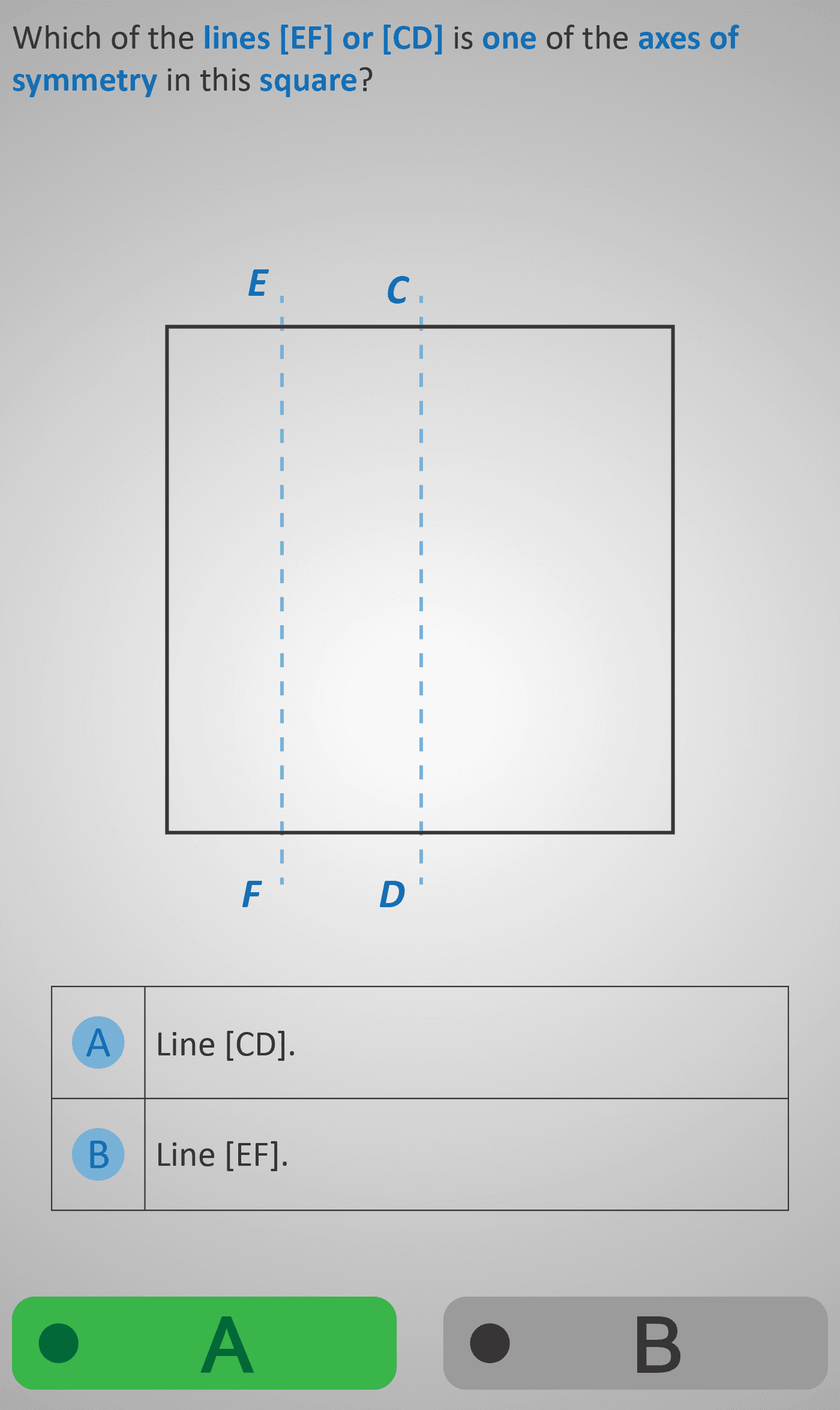
Square (Lines EF or CD) – The learner is asked which of the two vertical dashed lines is an axis of symmetry of the square. Line CD is correct, as it passes through the middle of the square and divides it into two identical halves.
Triangle (Lines GH or IJ) – An isosceles triangle is shown with two dashed lines. The correct axis of symmetry is line IJ, which runs from the top vertex through the centre of the base, dividing the triangle into two equal mirrored parts.
Rectangle (Lines KL or MN) – The rectangle is shown with a diagonal (KL) and a vertical line (MN). The diagonal is not an axis of symmetry for a rectangle, but line MN is correct, since it vertically bisects the rectangle into two equal halves.
This sequence builds understanding by comparing plausible but incorrect options (e.g., diagonals or offset lines) with the true symmetry axes. It strengthens visual reasoning and prepares students to generalise symmetry concepts across different shapes.
Prerequisite Knowledge Required
- Axis of Symmetry 1 — introduction to the concept of “mirror halves” and basic symmetry recognition.
- Familiarity with common 2D shapes (square, triangle, rectangle).
- Understanding of geometric terminology such as “line,” “centre,” and “equal halves.”
Main Category
Geometry – Shape & Space
Estimated Completion Time
Approx 8 seconds per question. 8–10 questions total. Total time: ~1 minute 20 seconds.
Cognitive Load / Step Size
Low to moderate — the task isolates one new decision per step (which line is symmetrical) and builds visual discrimination gradually across familiar shapes. Cognitive demand increases slightly when comparing non-symmetrical diagonals.
Language & Literacy Demand
Low — text is minimal, relying on short visual prompts (“Which line is the axis of symmetry?”). Learners can focus on the shapes and their spatial properties without heavy reading.
Clarity & Design
Excellent — clean geometric diagrams with clearly drawn dashed lines and balanced proportions. The contrast between correct and incorrect axes is visually distinct, making feedback immediately meaningful.
Curriculum Alignment
Aligned with Geometry and Trigonometry – Properties and Constructions from the Irish Junior Cycle Mathematics Curriculum:
- Identify lines of symmetry in plane shapes.
- Describe and use symmetry in problem solving and pattern recognition.
Engagement & Motivation
Good — familiar shapes keep the learner confident while the two-option design adds challenge and satisfaction when correct. The variety of shapes sustains interest.
Error Opportunities & Misconceptions
- Confusing diagonals as symmetry lines (especially in rectangles).
- Assuming all lines through the centre are axes of symmetry.
- Misjudging isosceles vs scalene triangles.
Transferability / Real-World Anchoring
Strong — symmetry recognition is applicable to art, architecture, design, and pattern-based reasoning (e.g., folding, reflection, balance).
Conceptual vs Procedural Balance
Conceptual — emphasises understanding why one line divides the shape evenly rather than memorising answers. Visual comparison supports reasoning, not rote recall.
Learning Objectives Addressed
- Identify correct axes of symmetry in common 2D shapes.
- Distinguish between valid and invalid symmetry lines.
- Develop visual reasoning about geometric balance and reflection.
- Apply symmetry principles to more complex shapes later.
What Your Score Says About You
- Less than 5: You may be mixing up diagonals or misunderstanding what “mirror halves” mean — revisit the concept using folding or tracing.
- Between 6–7: You can identify some symmetry lines correctly but need more visual practice distinguishing valid from invalid axes.
- Between 8–9: You show solid understanding with minor slips — strong grasp of shape balance and structure.
- 10/10: You can confidently identify symmetry in all standard 2D shapes — ready to extend to rotational symmetry and composite figures.