
Buy & Sell 2
Overview
This Phlow introduces students to profit and cost calculations through real-life examples of buying and selling items.
Profit from Selling Price
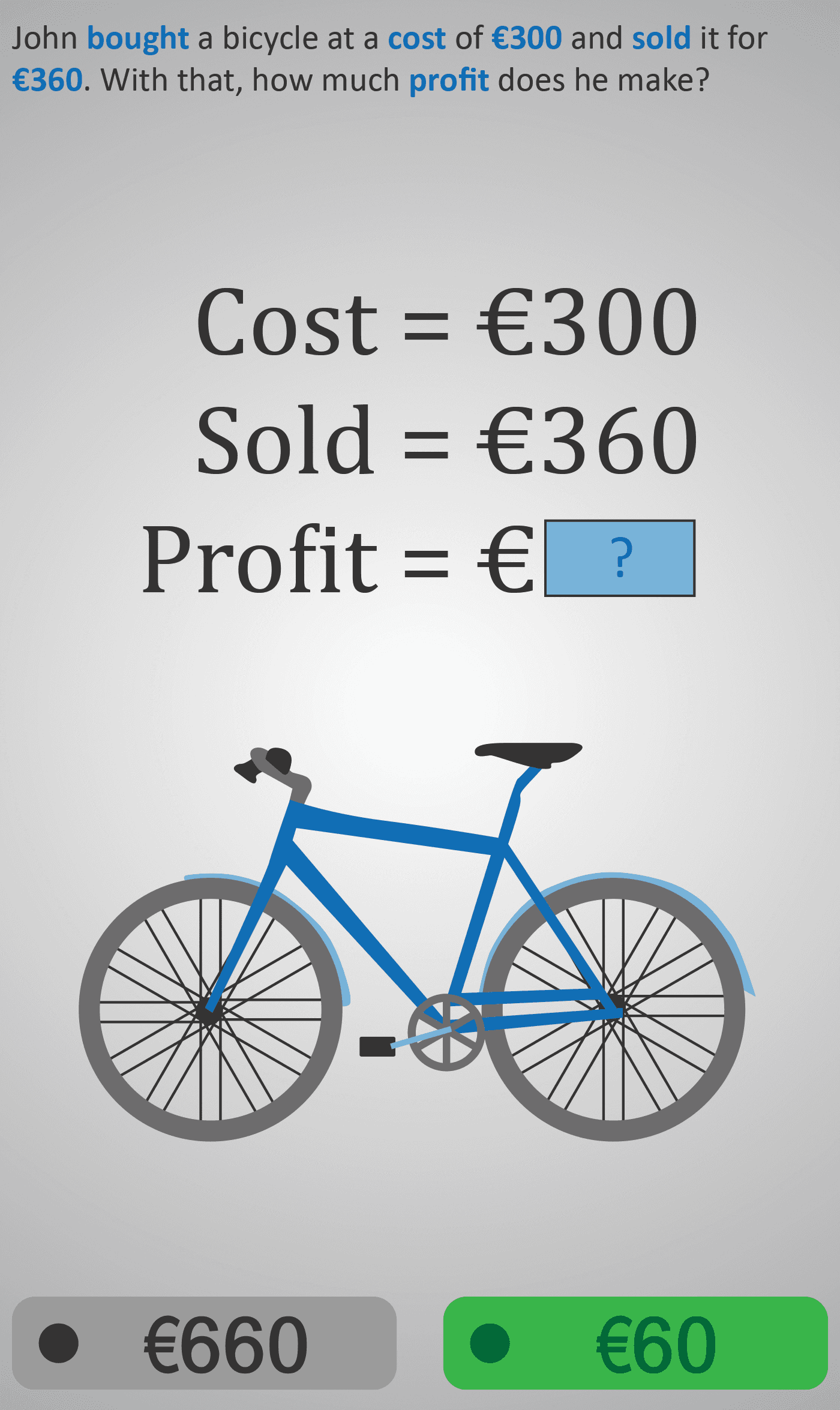
John buys a bicycle for €300 and sells it for €360.
Students calculate the profit using the formula:
Profit = Selling Price − Cost Price
Correct answer: €60.
Finding Selling Price from Profit
Steve buys a bicycle for €200 and makes a profit of €275.
Students must work out the selling price using the formula:
Selling Price = Cost Price + Profit
Correct answer: €475.
Finding Cost Price from Profit
Tony sells a bicycle for €500, making a profit of €100.
Students calculate the cost price using the formula:
Cost Price = Selling Price − Profit
Correct answer: €400.
👉 This sequence helps students practise all three variations of profit problems:
- Calculating profit from cost and selling price.
- Finding selling price from cost and profit.
- Finding cost from selling price and profit.
Prerequisite Knowledge Required
- Add & Sub 2 – addition and subtraction of larger numbers.
- Total Cost 1 – understanding of cost, items, and total value.
- Familiarity with euro (€) notation and basic money calculations.
Main Category
Applied Arithmetic – Financial Maths
Estimated Completion Time
Approx 8–10 seconds per question. 10 questions total. Total time: ~1.5 minutes.
Cognitive Load / Step Size
Moderate — learners handle three related formulas, but each step isolates one operation. The structured sequence (profit → selling price → cost price) keeps transitions logical and manageable.
Language & Literacy Demand
Moderate — key terms (“profit,” “cost,” “selling price”) are mathematical but clearly introduced and repeated across examples. Sentences are short and supported by numeric context, minimising literacy barriers.
Clarity & Design
High — clear layout with money values presented in bold and formulas displayed step-by-step. Realistic scenarios (buying and selling bicycles) make the problems relatable and easy to visualise.
Curriculum Alignment
Aligned with Number – Applied Arithmetic and Measure in the Irish Junior Cycle Mathematics Curriculum:
- Solve problems involving profit, loss, cost price, and selling price.
- Apply arithmetic operations in real-world financial contexts.
Engagement & Motivation
Strong — the real-life framing around trading and earning profit is relatable and motivating. The use of names and everyday items adds a sense of story to each problem.
Error Opportunities & Misconceptions
- Reversing subtraction when calculating profit (e.g., Cost − Selling instead of Selling − Cost).
- Forgetting to add or subtract correctly when finding missing values.
- Confusing profit with percentage profit (not covered here).
Transferability / Real-World Anchoring
Excellent — directly applicable to business, retail, and personal finance scenarios. Builds economic reasoning for later studies in commerce and budgeting.
Conceptual vs Procedural Balance
Balanced — students apply straightforward formulas (procedural) while also reasoning about real-world relationships between cost, selling, and profit (conceptual).
Learning Objectives Addressed
- Calculate profit given cost and selling price.
- Determine selling price or cost price when profit is known.
- Understand relationships between cost, selling, and profit.
- Apply arithmetic operations to financial word problems.
What Your Score Says About You
- Less than 5: You may be mixing up which value to add or subtract — review the meaning of cost, selling, and profit.
- Between 6–7: You understand the formulas but occasionally reverse operations — more practice will solidify this.
- Between 8–9: You have a solid grasp and can confidently apply the relationships.
- 10/10: You fully understand profit calculations and can easily apply them to new real-world scenarios.