
Circle 2A
Overview
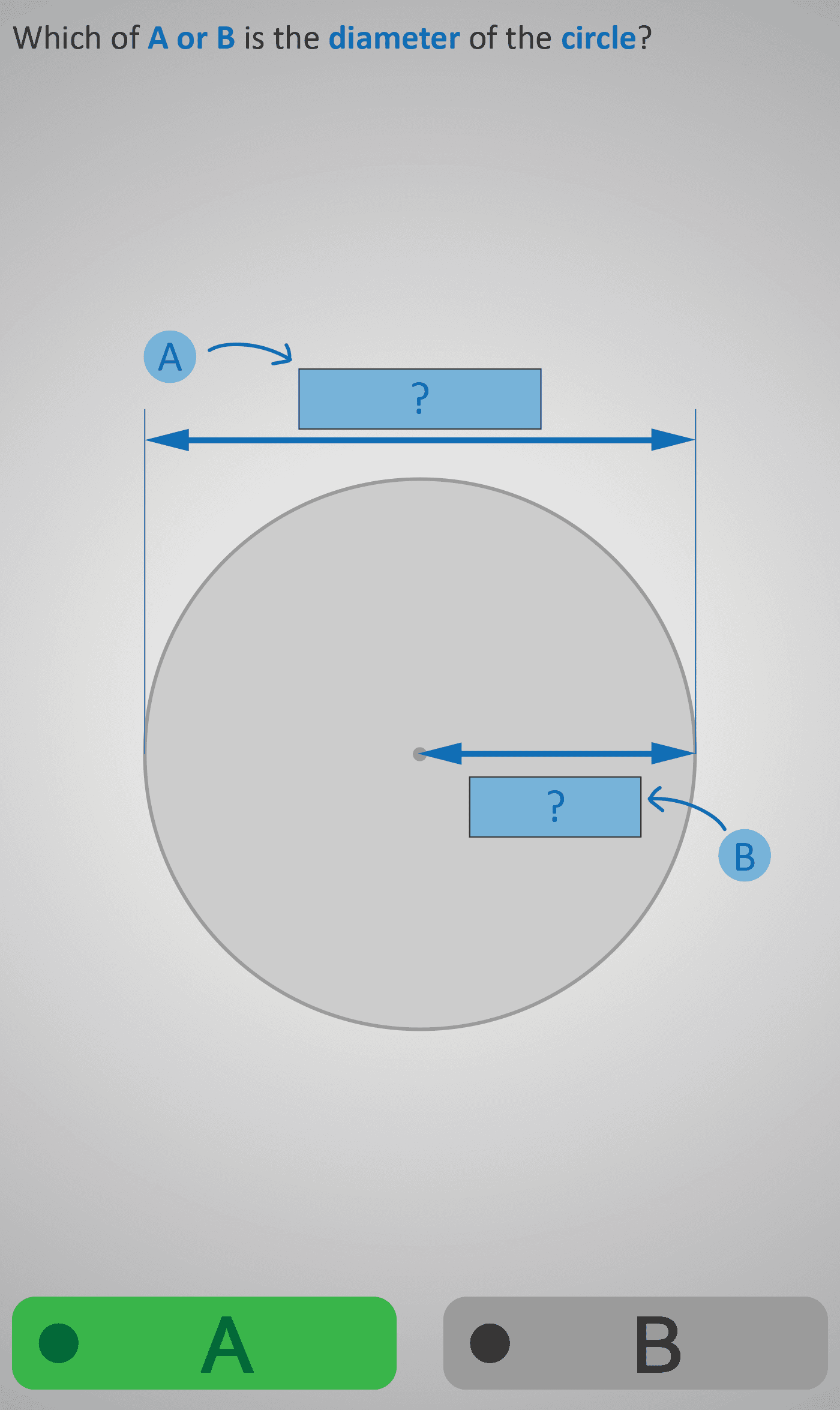
This Phlow introduces students to the relationship between the radius and the diameter of a circle. First, learners are asked to distinguish between two line segments drawn on a circle: one spanning the full width through the centre (the diameter) and one stretching from the centre to the edge (the radius). They identify which is the diameter.
Next, students are given the radius of a circle (e.g., 11 cm) and must calculate the diameter by recalling that the diameter is twice the radius.
Finally, another example with a radius of 13 cm reinforces the rule, with learners selecting the correct doubled value for the diameter (26 cm).
By the end, students will confidently recognise and calculate the diameter of a circle when the radius is known, and vice versa.
Prerequisite Knowledge Required
- Circle 1A – recognising parts of a circle (centre, edge, curved boundary).
- Length 1 or Measure 1 – familiarity with centimetre units and measuring line segments.
- Basic multiplication by 2.
Main Category
Geometry – Properties of Circles
Estimated Completion Time
Approx 7 seconds per question. 10 questions total. Total time: ~1–1.5 minutes.
Cognitive Load / Step Size
Low — each task builds directly from the previous one: first identifying parts, then applying a simple doubling rule. Step transitions are smooth, maintaining engagement without overload.
Language & Literacy Demand
Low — clear and concise phrasing (“What is the diameter?” / “Radius = 11 cm”) supported by strong visual cues. No extended text, making it highly accessible.
Clarity & Design
Excellent — simple diagrams of circles with labelled lines for radius and diameter. Visual differentiation (e.g., one line passing through the centre, one stopping at the edge) reinforces meaning without clutter.
Curriculum Alignment
Aligned with Geometry and Trigonometry – Circles in the Irish Junior Cycle Mathematics Curriculum:
- Recognise and describe the features of a circle (centre, radius, diameter, circumference).
- Understand the relationship between the radius and diameter.
Engagement & Motivation
Moderate to strong — the visual comparison between lines gives an intuitive sense of symmetry and proportion. The step-by-step doubling builds confidence and fluency.
Error Opportunities & Misconceptions
- Confusing radius and diameter when both are shown.
- Forgetting to multiply or divide by 2 when switching between them.
- Misinterpreting radius as the distance across rather than from the centre to the edge.
Transferability / Real-World Anchoring
High — reinforces spatial reasoning for practical contexts such as wheel design, circular objects, or measuring round tables. Builds foundation for area and circumference calculations.
Conceptual vs Procedural Balance
Balanced — students gain conceptual understanding (what each line represents) and procedural fluency (how to calculate one from the other).
Learning Objectives Addressed
- Identify the radius and diameter of a circle.
- Apply the rule: diameter = 2 × radius.
- Visually distinguish line segments within circular shapes.
- Develop fluency in reasoning about circle dimensions.
What Your Score Says About You
- Less than 5: You may be mixing up the radius and diameter — review their definitions.
- Between 6–7: You understand the idea but sometimes forget to double or halve correctly.
- Between 8–9: You’re confident identifying and calculating both terms.
- 10/10: You’ve mastered the relationship between radius and diameter — excellent foundation for future geometry topics.