
Circle 2B
Overview
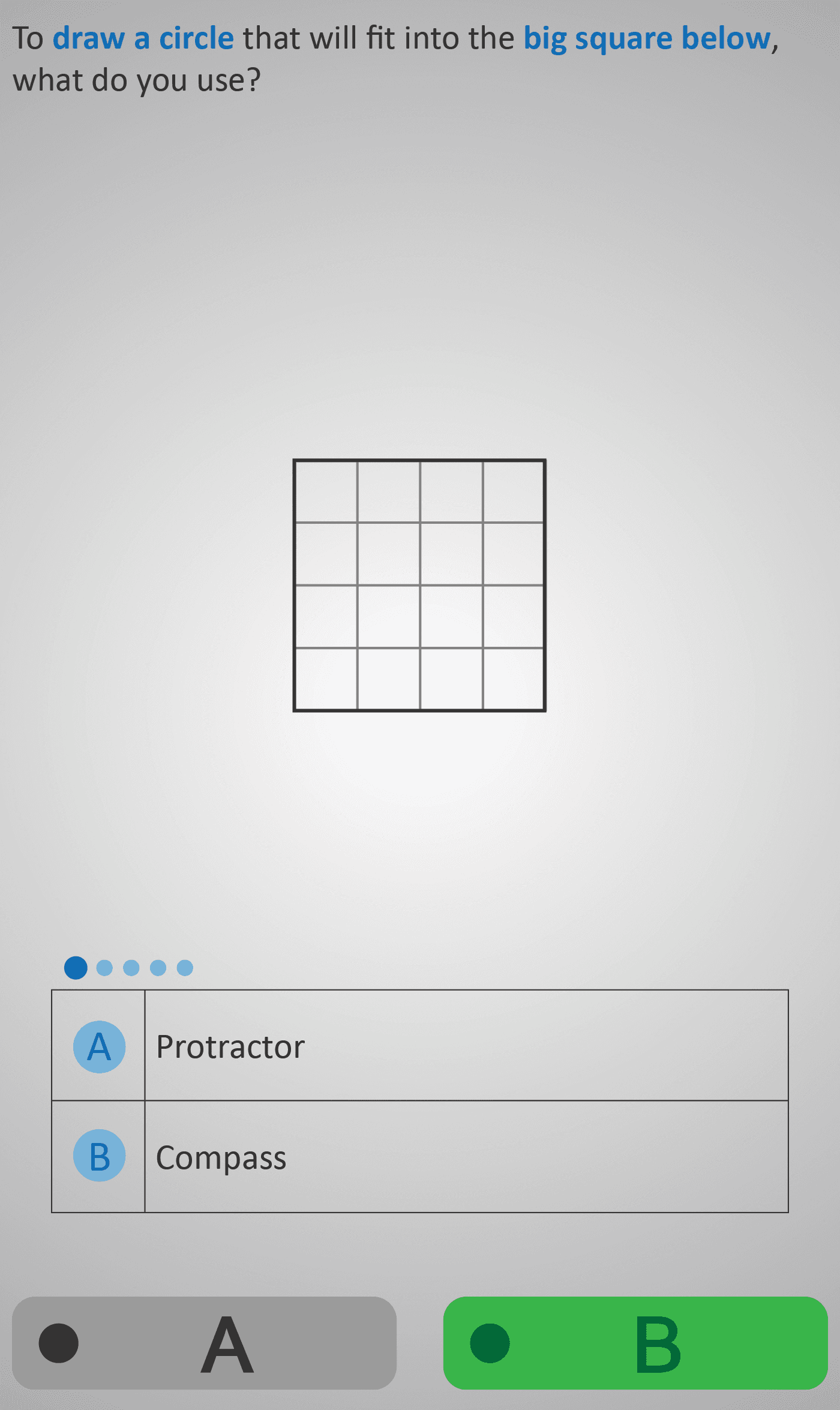
This Phlow teaches students how to use a compass to draw circles that fit within a square grid.
Choosing the Tool – Students identify that a compass, not a protractor, is the correct tool to draw a circle inside a square.
Finding the Centre – The task asks students to place the compass needle at the centre of the square to draw the circle accurately.
Setting the Radius – Students choose where to place the nib of the compass along the horizontal grid line, which will define the radius of the circle.
Drawing the Circle – They then identify which of two options shows the largest circle that can fit into the square.
Measuring the Diameter – Finally, using the fact that each small square in the grid is 1 cm × 1 cm, they measure and calculate the diameter of the circle (7 cm).
This sequence develops practical geometry skills by guiding students step by step through using a compass, understanding radius and diameter, and connecting measurements with circle properties.
Prerequisite Knowledge Required
- Circle 2A – understanding of radius and diameter relationships.
- Measure 1 or Geometry 1 – familiarity with centimetres and grid measurement.
- Basic spatial awareness of shapes within boundaries (square in this case).
Main Category
Geometry – Constructions and Measurement
Estimated Completion Time
Approx 8 seconds per question. 10 questions total. Total time: ~1–1.5 minutes.
Cognitive Load / Step Size
Low to moderate — each step introduces one clear action: tool selection → positioning → radius setting → drawing → measuring. The visual progression is intuitive and well-sequenced.
Language & Literacy Demand
Low — instructions use short, practical prompts (“Which tool draws a circle?”, “Where should the compass point go?”). Visuals and diagrams guide comprehension, reducing reading reliance.
Clarity & Design
Strong — clean diagrams on grid paper clearly show compass points, circle boundaries, and measurement lines. Visual comparison between options (e.g., smaller vs larger circle) effectively reinforces accuracy.
Curriculum Alignment
Aligned with Geometry and Trigonometry – Constructions and Circles in the Irish Junior Cycle Mathematics Curriculum:
- Construct circles given a radius or diameter.
- Use geometrical instruments appropriately (e.g., compass, ruler, protractor).
- Measure and interpret dimensions using metric units.
Engagement & Motivation
High — learners enjoy interactive, tool-based problem-solving. Using a compass to create a perfect circle adds a tactile, visual satisfaction that strengthens conceptual learning.
Error Opportunities & Misconceptions
- Confusing a protractor with a compass.
- Placing the compass off-centre or setting inconsistent radius lengths.
- Miscounting grid squares when measuring the diameter.
Transferability / Real-World Anchoring
High — directly applicable to technical drawing, design, construction, and geometry-based art. Builds confidence in precision measurement and manual control using mathematical tools.
Conceptual vs Procedural Balance
Balanced — combines understanding why the compass radius determines circle size with the how of drawing and measuring it correctly.
Learning Objectives Addressed
- Identify and select the appropriate tool for drawing circles.
- Use a compass to construct a circle with a given radius.
- Measure diameter using grid units.
- Relate visual construction steps to underlying geometric definitions.
What Your Score Says About You
- Less than 5: You may be unsure how to use the compass or measure the circle accurately — review the steps carefully.
- Between 6–7: You understand circle construction but may need to double-check placement and measurement.
- Between 8–9: You demonstrate strong practical and conceptual understanding of compass use.
- 10/10: You can confidently construct, measure, and explain circles using a compass — excellent geometric control.