
Circle 2D
Overview
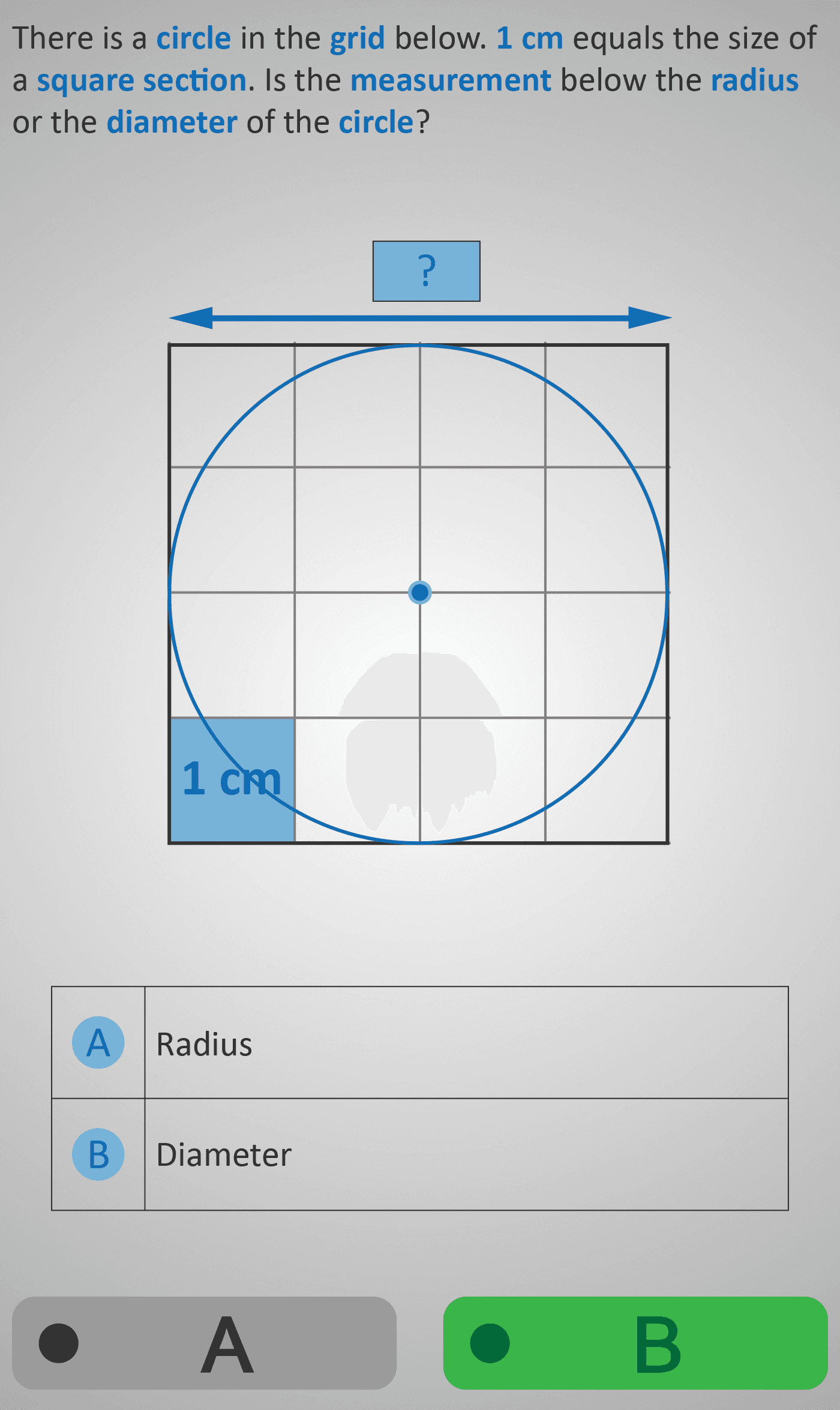
This Phlow helps students practise distinguishing between radius and diameter when a circle is drawn inside a square grid. Each square measures 1 cm, providing a visual scale to reinforce measurement understanding.
Step 1 – Students are asked if the horizontal line across the full width of the circle represents the radius or the diameter (correct answer: diameter).
Step 2 – Students then check a smaller circle within the grid and decide whether the horizontal line drawn across the centre represents radius or diameter (correct answer: diameter again).
Step 3 – In the next example, the line from the centre to the edge of the circle is shown, and students must identify it correctly as the radius.
Step 4 – A final grid-based circle is shown with the radius line clearly marked, giving students another chance to confirm their understanding.
By combining grids, circles, and labelled arrows, this set of tasks builds clarity on how to recognise and measure radius and diameter. It also strengthens spatial reasoning and connects the concepts to practical measurement skills.
Prerequisite Knowledge Required
- Circle 2A – understanding radius vs diameter conceptually.
- Circle 2C – calculating radius and diameter.
- Measure 1 – interpreting metric grid scales (e.g., 1 cm squares).
Main Category
Geometry – Circles and Measurement
Estimated Completion Time
Approx 6-10 seconds per question. 20 questions total. Total time: 2-4 minute.
Cognitive Load / Step Size
Low — gradual progression from identifying diameter to identifying radius, with clear visual cues on each step. Cognitive demand focuses on visual distinction rather than calculation.
Language & Literacy Demand
Low — short, directive prompts such as “Which line shows the radius?” supported by labelled diagrams. Ideal for visual learners and those with limited reading fluency.
Clarity & Design
High — circles and grid lines are drawn cleanly with centre points and lines colour-coded or labelled (e.g., A/B). The grid provides a consistent visual reference that enhances comprehension.
Curriculum Alignment
Aligned with Geometry and Trigonometry – Circles in the Irish Junior Cycle Mathematics Curriculum:
- Recognise and use the terms centre, radius, and diameter of a circle.
- Use appropriate units of measure in geometric contexts.
Engagement & Motivation
Moderate — visual clarity and interactive questioning maintain attention. The grid-based structure appeals to spatial reasoning and practical learners.
Error Opportunities & Misconceptions
- Mistaking diameter for radius (especially when both appear similar in short spans).
- Forgetting that the diameter passes through the circle’s centre.
- Misinterpreting grid measurements (counting squares incorrectly).
Transferability / Real-World Anchoring
High — reinforces geometric reasoning used in technical drawing, design, construction, and measurement tasks.
Conceptual vs Procedural Balance
Conceptual — focuses on recognition and understanding rather than computation. Builds strong foundational geometry vocabulary and spatial awareness.
Learning Objectives Addressed
- Identify the radius and diameter of a circle on a grid.
- Relate geometric features of circles to measurable grid units.
- Develop visual accuracy and confidence in recognising geometric properties.
- Strengthen foundational vocabulary and reasoning for circle geometry.
What Your Score Says About You
- Less than 5: You may still be confusing radius and diameter — review the difference between half and full width.
- Between 6–7: Good progress — your recognition is improving but may need more practice with measurement cues.
- Between 8–9: Strong visual understanding and consistent accuracy in identifying radius and diameter.
- 10/10: Excellent mastery — you can recognise and measure radius and diameter correctly in any diagram or real-world example.