
Cylinder 2
Overview
In this Phlow, students explore the properties of a cylinder by identifying and distinguishing between its key measurements: diameter, radius, and height.
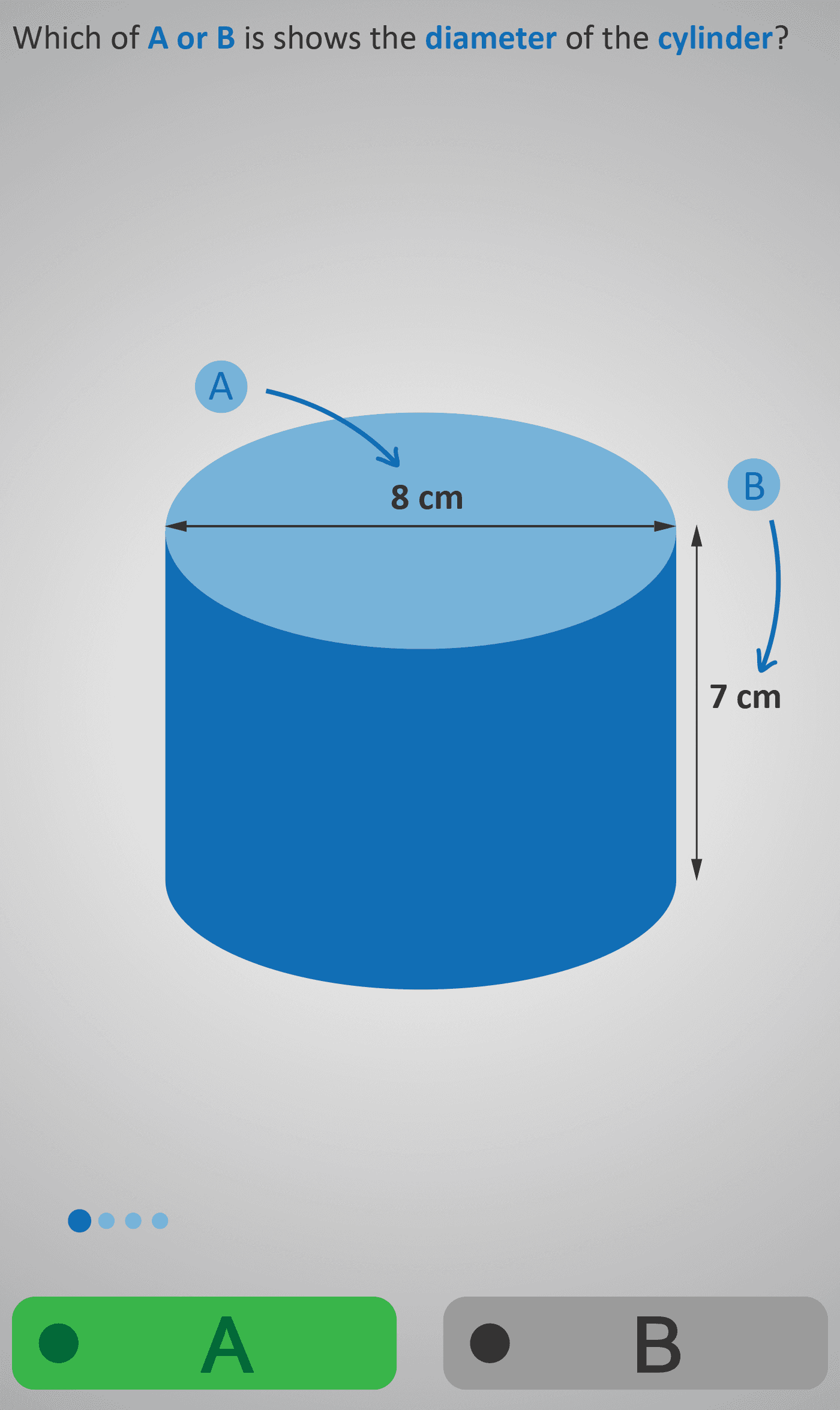
In the first screen, students are asked to decide whether measurement A (8 cm across the top) or B (7 cm vertical) represents the diameter of the cylinder.
The second screen checks understanding by asking if the 7 cm vertical measurement is the radius of the cylinder, reinforcing the difference between radius and height.
The third screen directly asks students: “What is the diameter of the cylinder?” with the correct answer being 8 cm.
The final screen asks: “What is the height of the cylinder?” with the correct answer being 7 cm.
This sequence helps learners practise distinguishing between different dimensions of 3D objects, ensuring they do not confuse diameter with radius or height. It reinforces correct mathematical vocabulary while applying it to a familiar 3D shape.
Prerequisite Knowledge Required
- Circle 2A – understanding radius and diameter.
- Circle 2C / 2D – calculating radius from diameter and vice versa.
- 3D Shapes 1 – recognising basic 3D objects (cube, sphere, cylinder).
Main Category
Geometry – 3D Shapes and Measurement
Estimated Completion Time
Approx 6-10 seconds per question. 20 questions total. Total time: 2-4 minute.
Cognitive Load / Step Size
Low — each screen isolates one concept (diameter, radius, or height). The transitions between questions are small and logical, ensuring clarity without overload.
Language & Literacy Demand
Minimal — concise phrasing (“What is the diameter of the cylinder?”) supported by clear visuals. Accessible for all literacy levels.
Clarity & Design
Strong — clear 3D diagrams with visible labels (A, B) and distinct dimensions. Visual emphasis on the cylinder’s top and side views aids understanding of spatial orientation.
Curriculum Alignment
Aligned with Geometry and Trigonometry – 3D Shapes and Measurement outcomes:
- Recognise and label key features of common solids.
- Understand relationships between radius, diameter, and height in cylinders.
- Use correct geometric terminology when describing 3D shapes.
Engagement & Motivation
Moderate — visual tasks with familiar real-world shapes (cylinders resemble everyday objects like cans). The interactivity maintains attention.
Error Opportunities & Misconceptions
- Confusing height with diameter.
- Misidentifying the radius as the full width of the circle.
- Assuming vertical dimensions are always the radius.
Transferability / Real-World Anchoring
High — reinforces understanding for practical contexts like measuring containers, pipes, or cylinders in design and engineering.
Conceptual vs Procedural Balance
Conceptual — focuses on identifying and understanding the geometric meaning of dimensions rather than performing calculations.
Learning Objectives Addressed
- Identify diameter, radius, and height in 3D shapes.
- Distinguish between circular and vertical measurements.
- Apply correct terminology for geometric features.
- Strengthen spatial reasoning in interpreting diagrams of solids.
What Your Score Says About You
- Less than 5: You may be mixing up height and diameter — review 3D shape features.
- Between 6–7: You understand the terms but may misread diagrams occasionally.
- Between 8–9: You can confidently recognise and label most cylinder dimensions.
- 10/10: Excellent — you clearly understand and can visualise all cylinder measurements.