
Division 2
Overview
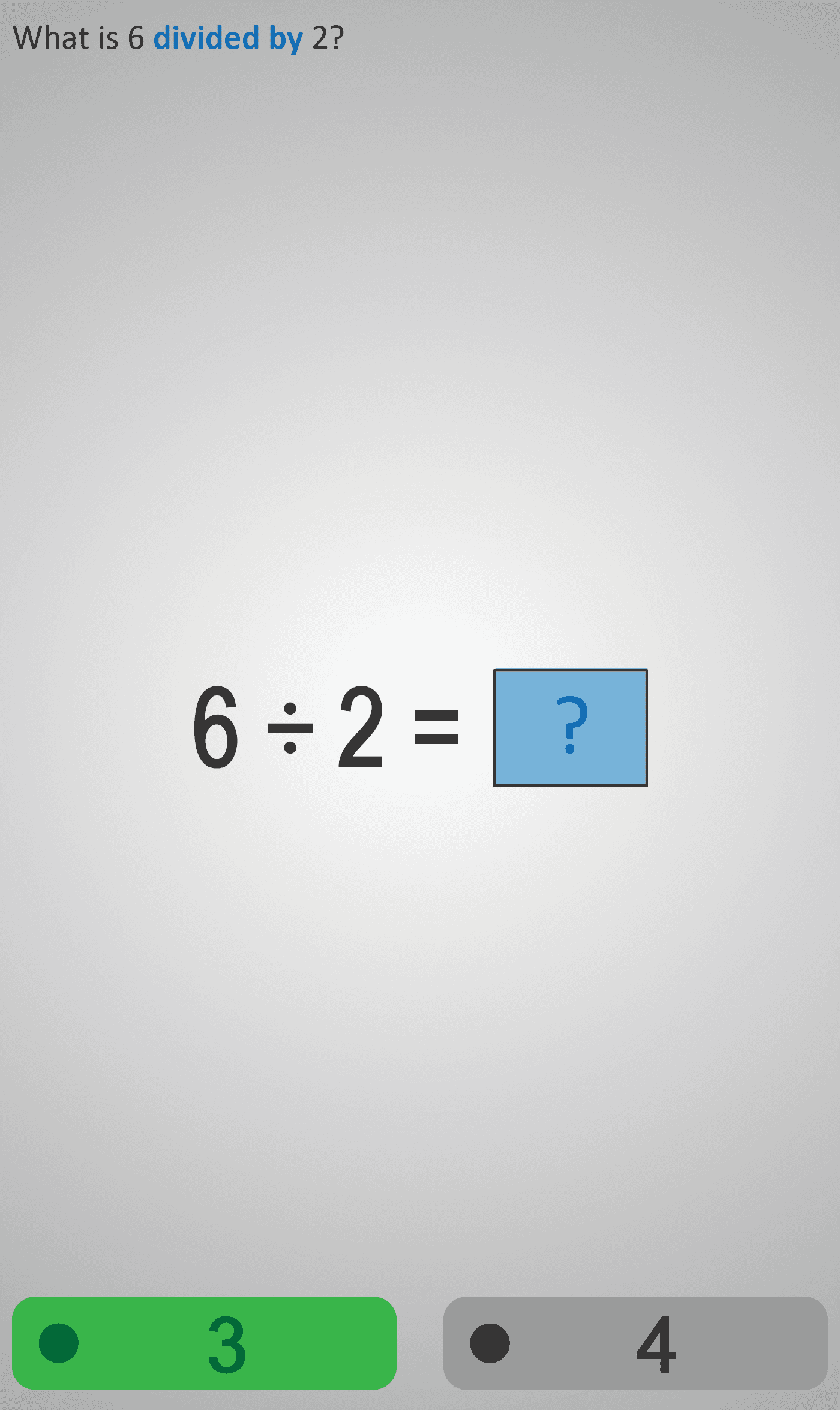
Introduces students to simple division using small numbers and clear visual layouts. Each screen presents a question such as 4 ÷ 2 = ?, 6 ÷ 3 = ?, or 6 ÷ 2 = ?, reinforcing the concept of sharing equally or grouping numbers into parts. Learners select the correct answer from two options, practising mental division and consolidating number-fact fluency.
The sequence focuses on interpreting the division symbol (÷) and understanding that division is the inverse of multiplication. By working through short, self-contained examples, students strengthen confidence with facts up to 10 ÷ 2 and 6 ÷ 3, building automatic recall that supports future problem solving with larger numbers and fractions.
Prerequisite Knowledge Required
- Understanding of repeated addition and multiplication facts up to 10.
- Familiarity with equal groups and sharing concepts (from Multiply 1 or Add 2).
- Recognition of division as the opposite of multiplication.
Main Category
Arithmetic
Estimated Completion Time
Approx 6-10 seconds per question. 20 questions total. Total time: 2-4 minute.
Cognitive Load / Step Size
Each question introduces one clear numerical operation with only two answer choices, keeping cognitive load low. Step progression remains small and consistent—ideal for automatic-recall practice without overload.
Language & Literacy Demand
Minimal text demand. The key phrase “divided by” is highlighted for focus. Visual equation format supports comprehension for weaker readers.
Clarity & Design
Large, uncluttered layout with centred equation and high-contrast numerals. Colour cues (blue question box, green correct option) enhance clarity. Visual simplicity keeps attention on the arithmetic structure rather than wording.
Curriculum Alignment
Irish Curriculum – Number strand:
- “Use multiplication and division as inverse operations to check results and solve simple number sentences.”
- (Primary Mathematics Curriculum – Number Operations)
Engagement & Motivation
Fast-paced, game-like format encourages accuracy and confidence. Instant feedback reinforces success, maintaining engagement through repetition and short-term challenge.
Error Opportunities & Misconceptions
- Confusing division with subtraction or multiplication.
- Selecting the divisor as the answer (e.g., choosing 2 for 6 ÷ 2 by habit).
- Overreliance on rote recall without visualising equal groups.
Transferability / Real-World Anchoring
Skills transfer to everyday contexts of sharing or grouping (e.g., dividing sweets, teams, or objects equally).
Conceptual vs Procedural Balance
Primarily procedural (fact fluency), but conceptually anchored in “sharing equally” understanding established in earlier levels.
Learning Objectives Addressed
- Recognise and interpret the division symbol (÷).
- Calculate basic division facts with single-digit numbers.
- Understand division as the inverse of multiplication.
- Develop accuracy and speed in mental arithmetic.
What Your Score Says About You
- Less than 5: Needs more practice with equal-sharing and division facts.
- Between 6–7: Understands the idea but may confuse symbols or recall.
- Between 8–9: Shows strong division fluency with occasional slips.
- 10/10: Excellent recall – fully fluent with simple division facts.