
Estimate 2
Overview
This Phlow introduces students to rounding decimal numbers to the nearest whole number. It builds intuition by placing decimals visually between surrounding whole numbers and guiding learners to choose the closest one.
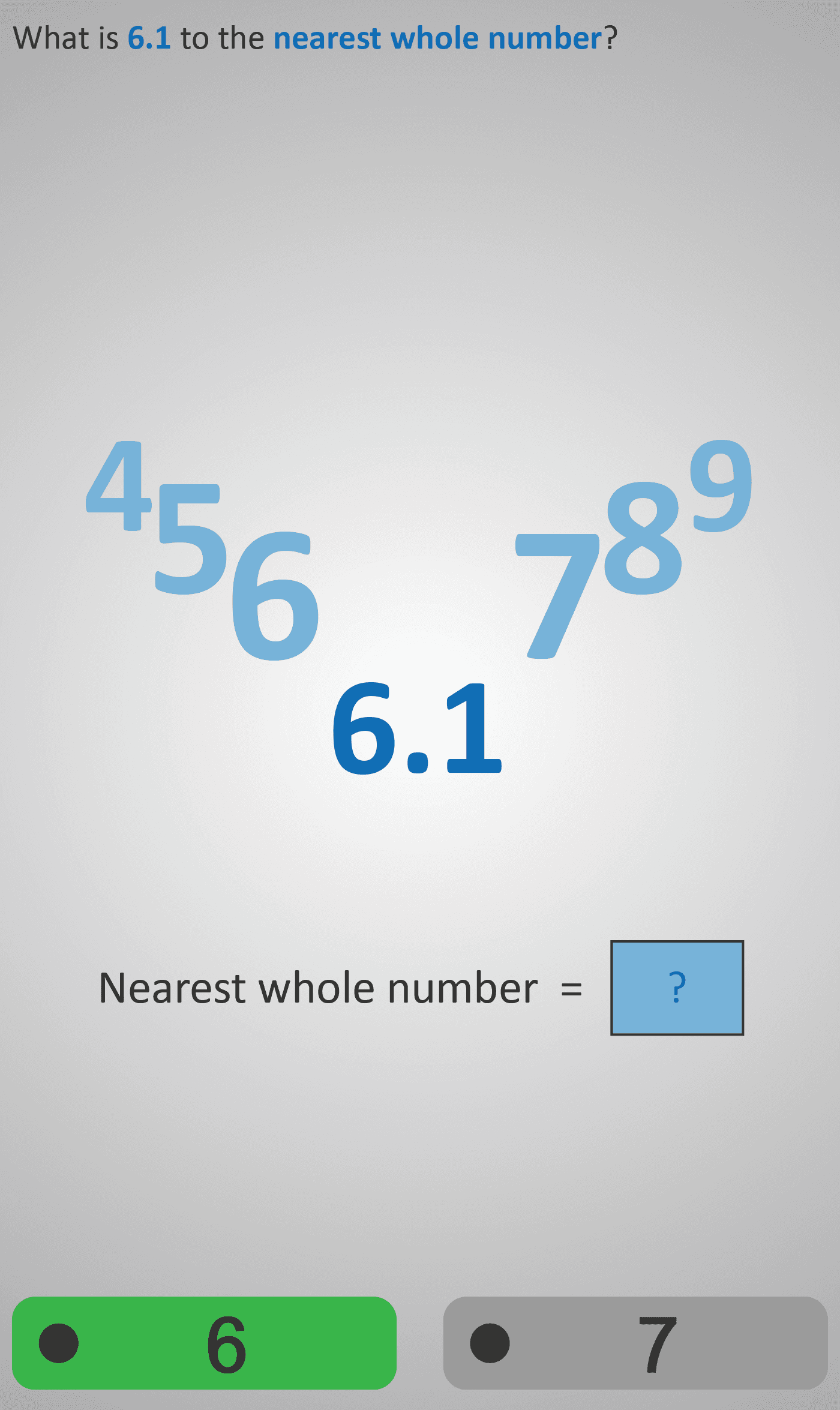
Stage 1: Students are asked to round 6.1 to the nearest whole number. The number line-style layout shows 6.1 positioned between 6 and 7, helping them see that it rounds down to 6.
Stage 2: Students practise with 4.3, reinforcing the idea that decimals less than .5 round down. The correct answer is 4.
Stage 3: The challenge increases with 5.6, a decimal greater than .5, where students must round up. This highlights the rule that decimals .5 and above round to the next whole number, giving the answer 6.
By the end of Estimate 2, students can confidently:
- Identify which whole numbers a decimal lies between.
- Apply the rounding rule (.5 and above rounds up, below .5 rounds down).
- Strengthen number sense with both smaller and larger decimals.
Prerequisite Knowledge Required
- Understanding of place value to tenths (from Decimals 1).
- Ability to identify numbers between consecutive whole numbers.
- Basic familiarity with the concept of “closer to” on a number line.
Main Category
Number / Estimation
Estimated Completion Time
Approx 6-10 seconds per question. 20 questions total. Total time: 2-4 minute.
Cognitive Load / Step Size
Small, steady steps from decimals below 0.5 to those above 0.5. Visual number line supports reasoning, minimising cognitive strain and promoting conceptual clarity.
Language & Literacy Demand
Minimal reading required. Phrases like “nearest whole number” and “round up/down” are supported by visual cues. Accessible for all reading levels.
Clarity & Design
Clean visual design using decimals placed between two whole numbers. Contrasting colours and spacing make the rounding decision intuitive and focus attention on the key decimal value.
Curriculum Alignment
Irish Curriculum – Number strand:
- “Round whole numbers and decimals to the nearest ten, unit, tenth, or appropriate degree of accuracy.”
- (Primary Mathematics Curriculum – Number: Operations and Place Value)
Engagement & Motivation
Interactive number comparison creates an intuitive “which is closer?” challenge. Immediate feedback and clear visuals maintain engagement and reinforce rules through repetition.
Error Opportunities & Misconceptions
- Rounding all decimals up regardless of the decimal part.
- Misunderstanding the threshold at .5.
- Overlooking the role of place value in rounding decisions.
Transferability / Real-World Anchoring
Applies directly to real-life estimation tasks (e.g., rounding prices, measurements, or time). Strengthens numeracy skills used in shopping, budgeting, and approximation.
Conceptual vs Procedural Balance
Balanced — builds conceptual understanding through visual models while practising procedural fluency in applying the rounding rule.
Learning Objectives Addressed
- Recognise where decimals lie between whole numbers.
- Apply rounding rules correctly to decimals below or above .5.
- Strengthen place value understanding and number estimation.
- Build fluency in approximating numerical values.
What Your Score Says About You
- Less than 5: Needs to review decimal value placement and rounding rules.
- Between 6–7: Understands the idea but occasionally rounds incorrectly near .5.
- Between 8–9: Strong grasp of rounding concepts with minor slips.
- 10/10: Fully fluent — confident rounding of any decimal to the nearest whole number.