
Factors 2
Overview
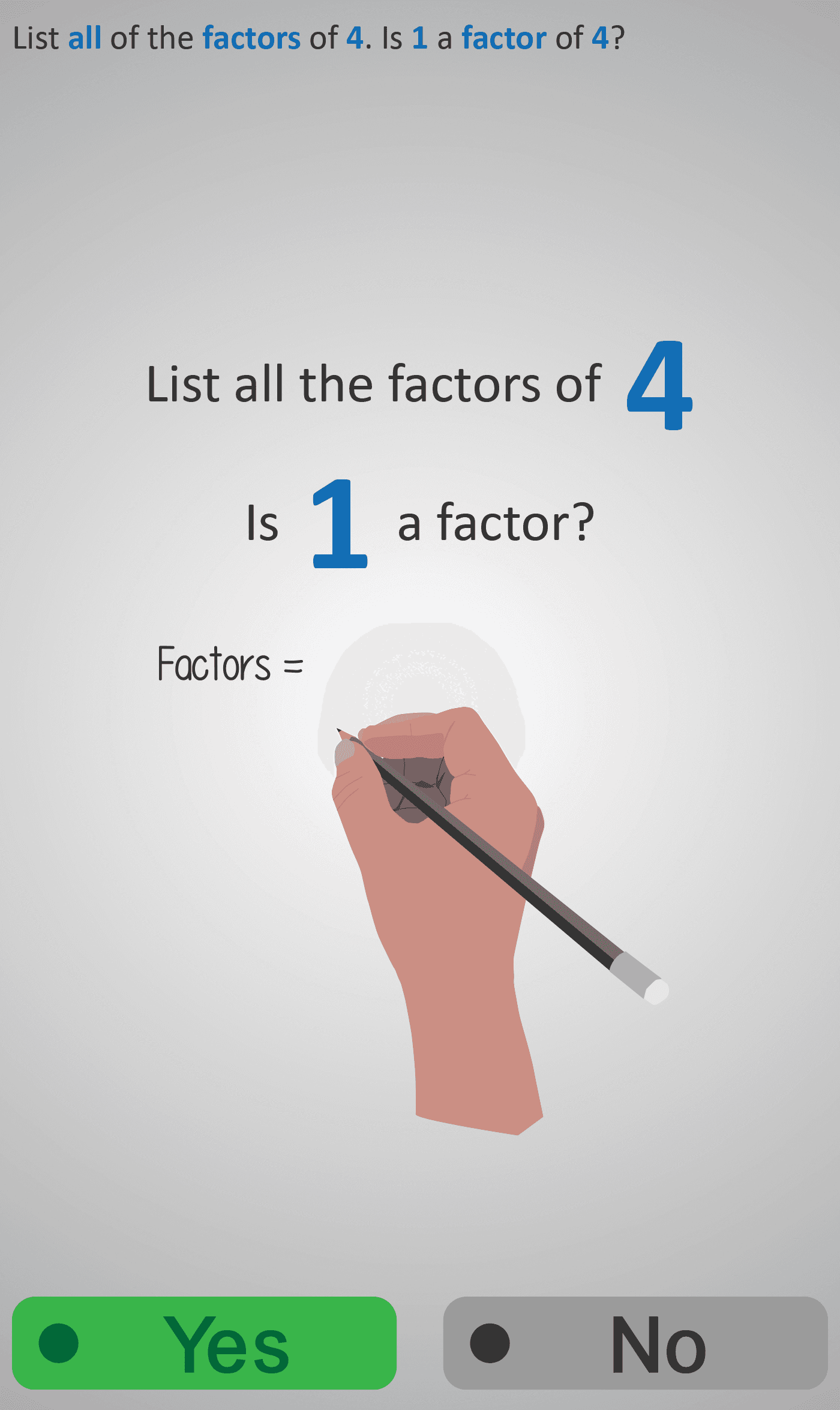
Introduces learners to the idea of identifying and listing all the factors of a number, using 4 as the example. The activity is interactive, guiding students step by step to decide if specific numbers are factors of 4.
It begins by asking whether 1 is a factor of 4, reinforcing the definition that factors divide a number exactly.
Next, learners check if 2 is a factor, adding it to the growing list of factors.
Then, they are asked about 3, recognising that it does not divide 4 evenly.
Finally, the activity confirms that 4 is a factor of itself.
By the end, the full list of factors of 4 is built up: 1, 2, and 4. This sequence helps learners practise systematically checking divisibility, strengthens their understanding of factors, and builds confidence in working with small numbers before moving to more complex cases.
Prerequisite Knowledge Required
- Understanding of multiplication and division relationships.
- Familiarity with the concept of a number “dividing evenly.”
- Recall of basic times tables up to 4×.
Main Category
Number / Factors & Multiples
Estimated Completion Time
Approx 6-10 seconds per question. 20 questions total. Total time: 2-4 minute.
Cognitive Load / Step Size
Low – each step introduces one potential factor at a time. Repetition with visual confirmation (✓ / ✗) reinforces the concept without overloading working memory.
Language & Literacy Demand
Minimal. The question pattern (“Is 2 a factor of 4?”) is consistent, allowing focus on mathematical reasoning rather than reading complexity.
Clarity & Design
Clean layout with bold numerals and simple yes/no options. Visual reinforcement of “correct” factors supports conceptual retention.
Curriculum Alignment
Irish Curriculum – Number Strand:
- “Explore, identify and list factors and multiples of whole numbers.”
- (Junior Cycle Mathematics – Number)
Engagement & Motivation
Quick, gamified sequence builds momentum as learners uncover all factors. Immediate feedback maintains engagement and sense of progress.
Error Opportunities & Misconceptions
- Assuming all smaller numbers are factors.
- Confusing divisibility with subtraction or multiplication.
- Overlooking that every number is a factor of itself.
Transferability / Real-World Anchoring
Supports later topics in fractions, divisibility, and algebraic simplification where factor recognition is essential.
Conceptual vs Procedural Balance
Balanced – procedural division checks reinforce the conceptual rule that “factors multiply to make the number.”
Learning Objectives Addressed
- Define and identify factors of a given number.
- Test numbers for exact divisibility.
- Build fluency in recognising factor patterns.
- Strengthen foundational number reasoning.
What Your Score Says About You
- Less than 5: Needs to review how division defines a factor.
- 6–7: Understands concept but may confuse non-factors.
- 8–9: Strong fluency identifying correct factors.
- 10/10: Fully confident listing all factors of a number.