
Fraction 2A
Overview
This activity introduces students to the concept of finding the lowest number (Lowest Common Multiple) that two numbers will both divide into evenly. The worked example uses 1 and 2 to guide understanding step by step.
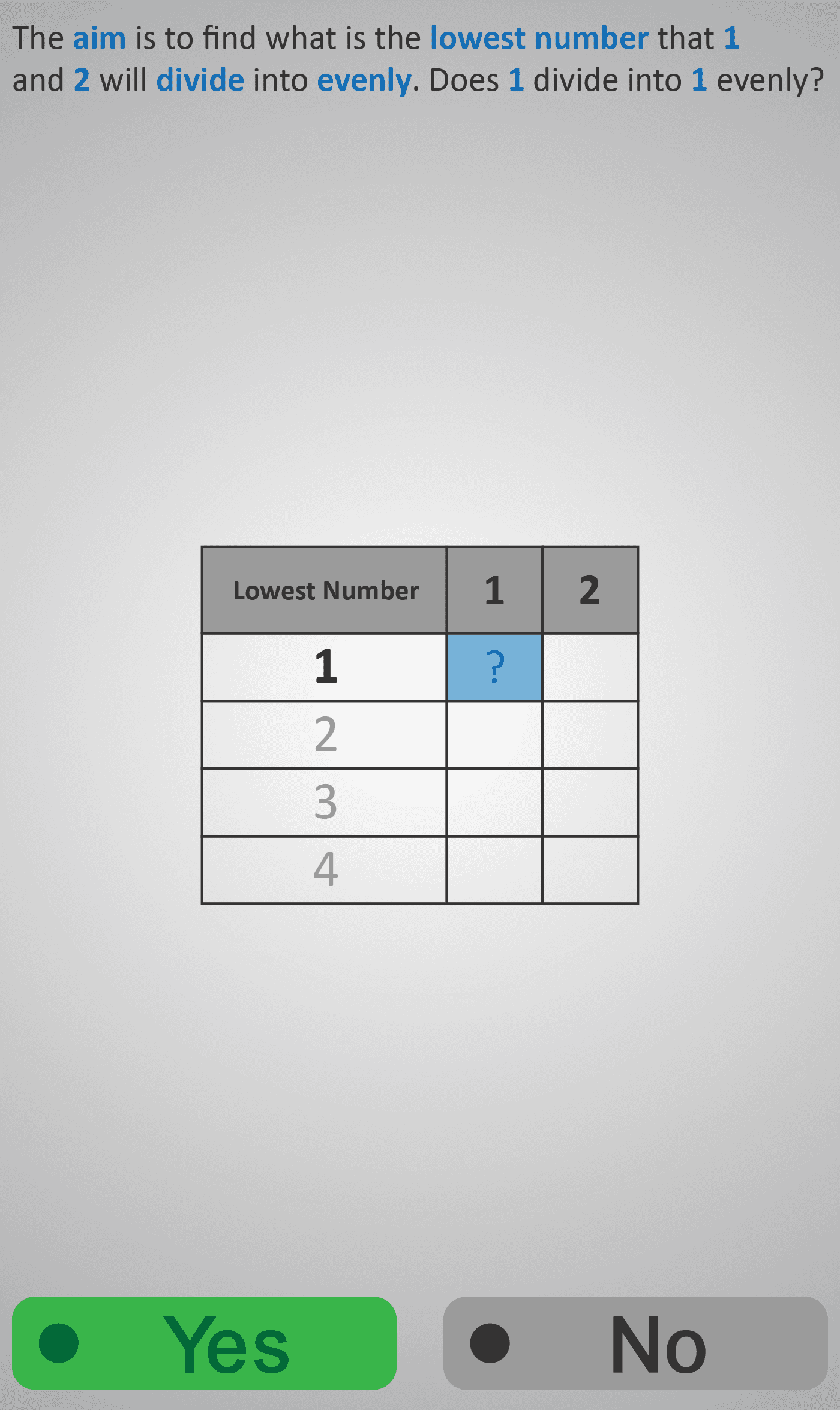
Students begin with a table showing possible lowest numbers (1, 2, 3, 4).
For each candidate number, they are asked: “Does 1 divide into this number evenly?” and “Does 2 divide into this number evenly?”
The first frame checks if 1 divides into 1 evenly, reinforcing that any number divides into itself.
The next step asks if 2 divides into 1 evenly, showing that it does not (introducing the idea of remainders).
Students then test the next candidate, 2, confirming that both 1 divides into 2 and 2 divides into 2.
This leads to the conclusion that the lowest number divisible by both 1 and 2 is 2.
This scaffolded sequence builds the foundation for understanding Lowest Common Multiples, a key concept for working with fractions, ratios, and algebra.
Prerequisite Knowledge Required
- Understanding of basic multiplication and division.
- Familiarity with the concept of a multiple (e.g., 2, 4, 6 are multiples of 2).
- Confidence counting in simple sequences (1s, 2s, 3s etc.).
Main Category
Number / Fractions & Multiples
Estimated Completion Time
Approx 6-10 seconds per question. 20 questions total. Total time: 2-4 minute.
Cognitive Load / Step Size
Low – each step isolates one check (e.g., Does 1 divide into 2?), minimising abstraction. Logical progression supports conceptual clarity without overwhelming memory.
Language & Literacy Demand
Simple recurring sentence structure (“Does 1 divide into 2 evenly?”). Vocabulary limited to familiar mathematical terms (divide, evenly, multiple).
Clarity & Design
Table and visual checks (✓ / ✗) make divisibility explicit. Gradual colour cues help students follow the reasoning sequence visually.
Curriculum Alignment
Irish Curriculum – Number Strand:
- “Explore and use the concept of multiples and common multiples to solve problems.”
- (Junior Cycle Mathematics – Number)
Engagement & Motivation
Interactive trial-and-error format encourages prediction and discovery. Each success builds confidence through immediate feedback.
Error Opportunities & Misconceptions
- Confusing factors with multiples.
- Assuming the first common number found is always the smallest.
- Overlooking the relationship between division and multiplication.
Transferability / Real-World Anchoring
Forms the basis for finding common denominators in fractions, comparing ratios, and synchronising patterns in everyday contexts (e.g., time intervals).
Conceptual vs Procedural Balance
Conceptual – focuses on understanding why a common multiple works before introducing procedural methods.
Learning Objectives Addressed
- Define and identify the Lowest Common Multiple.
- Test numbers for common divisibility.
- Strengthen understanding of multiples through pattern recognition.
- Prepare for adding and comparing fractions with unlike denominators.
What Your Score Says About You
- Less than 5: Needs to revisit difference between factors and multiples.
- 6–7: Understands idea but may miss one divisibility check.
- 8–9: Strong grasp of divisibility and multiples.
- 10/10: Fully confident identifying LCMs independently.