
Fraction 2B
Overview
Builds on fraction equivalence by asking students to convert fractions into new but equal forms. Learners are guided to identify missing numerators or denominators by applying multiplication or division consistently to both parts of a fraction.
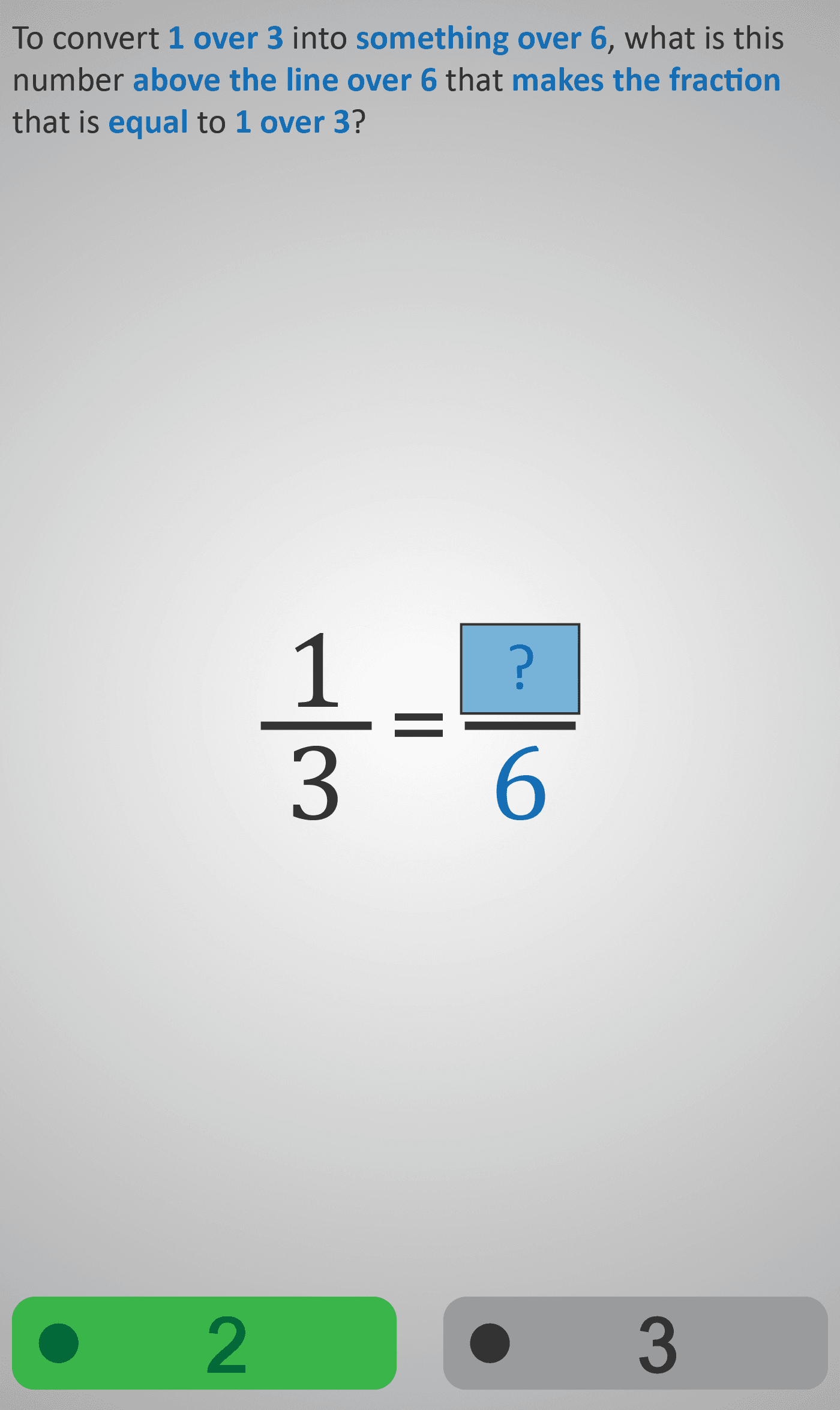
For example, they see how 1/3 can be rewritten as 2/6 or 3/9, and how 3/1 can be expressed as 6/2. Later, they reduce fractions such as 6/10 into their simplest form 3/5. The exercises require them to reason about both scaling up and simplifying down, strengthening number sense and algebraic thinking.
The interactive format encourages learners to test their understanding by filling in the missing value in fractions, reinforcing the concept that multiplying or dividing the numerator and denominator by the same number keeps the fraction’s value unchanged.
This Phlow develops:
- Recognition of equivalent fractions.
- Skills in finding missing numerators/denominators.
- Fraction simplification through common factors.
- Foundations for ratio, proportion, and algebra.
By the end, students gain confidence in rewriting fractions in multiple forms, a key stepping stone for higher-level topics like ratios, proportions, and algebraic fractions.
Prerequisite Knowledge Required
- Understanding of fractions as part-whole relationships.
- Familiarity with multiplication and division facts up to 10.
- Prior exposure to the concept of factors and multiples (see Fraction 2A – LCM Introduction).
Main Category
Number / Fractions
Estimated Completion Time
Approx 6-10 seconds per question. 20 questions total. Total time: 2-4 minute.
Cognitive Load / Step Size
Moderate – introduces proportional reasoning between numerator and denominator. Tasks are sequenced from simple scaling (×2) to more abstract simplification (÷2 or ÷5), ensuring gradual cognitive build-up.
Language & Literacy Demand
Low – each question uses consistent phrasing (“Fill in the missing number”) and mathematical notation. Visual fraction bars or consistent formatting support understanding without heavy text.
Clarity & Design
Uses clear fraction layouts with missing numerators or denominators. The visual symmetry reinforces balance between top and bottom numbers, making the equivalence rule intuitive.
Curriculum Alignment
Irish Curriculum – Number Strand:
- “Compare and order fractions; express equivalent forms; recognise relationships between fractions, ratios and proportions.”
- (Junior Cycle Mathematics – Number)
Engagement & Motivation
Interactive fill-in design encourages active reasoning. Immediate feedback on missing values keeps learners motivated and promotes trial-and-error learning within a safe scaffold.
Error Opportunities & Misconceptions
- Forgetting to apply the same operation to both numerator and denominator.
- Reversing operations when simplifying (e.g. multiplying instead of dividing).
- Assuming larger numerators always mean larger values.
Transferability / Real-World Anchoring
Skills directly transfer to ratio, proportion, and scaling contexts — e.g., recipes, map scales, and algebraic fractions.
Conceptual vs Procedural Balance
Balanced – conceptual understanding of “sameness” in fractions is paired with procedural fluency in multiplying/dividing both terms consistently.
Learning Objectives Addressed
- Identify and generate equivalent fractions.
- Apply multiplication or division to create equivalent forms.
- Simplify fractions using common factors.
- Strengthen proportional reasoning and visual fraction awareness.
What Your Score Says About You
- Less than 5: Needs to revisit how operations affect both numerator and denominator.
- 6–7: Developing understanding; beginning to recognise equivalence patterns.
- 8–9: Good command of equivalence and simplification processes.
- 10/10: Fully confident manipulating and simplifying fractions independently.