
Fraction 2C
Overview
In this exercise, students learn how to calculate a fraction of a whole number by following a step-by-step process of dividing and multiplying. The problems guide learners through breaking down the calculation into two stages:
- Divide by the denominator (the number below the line).
- Multiply by the numerator (the number above the line).
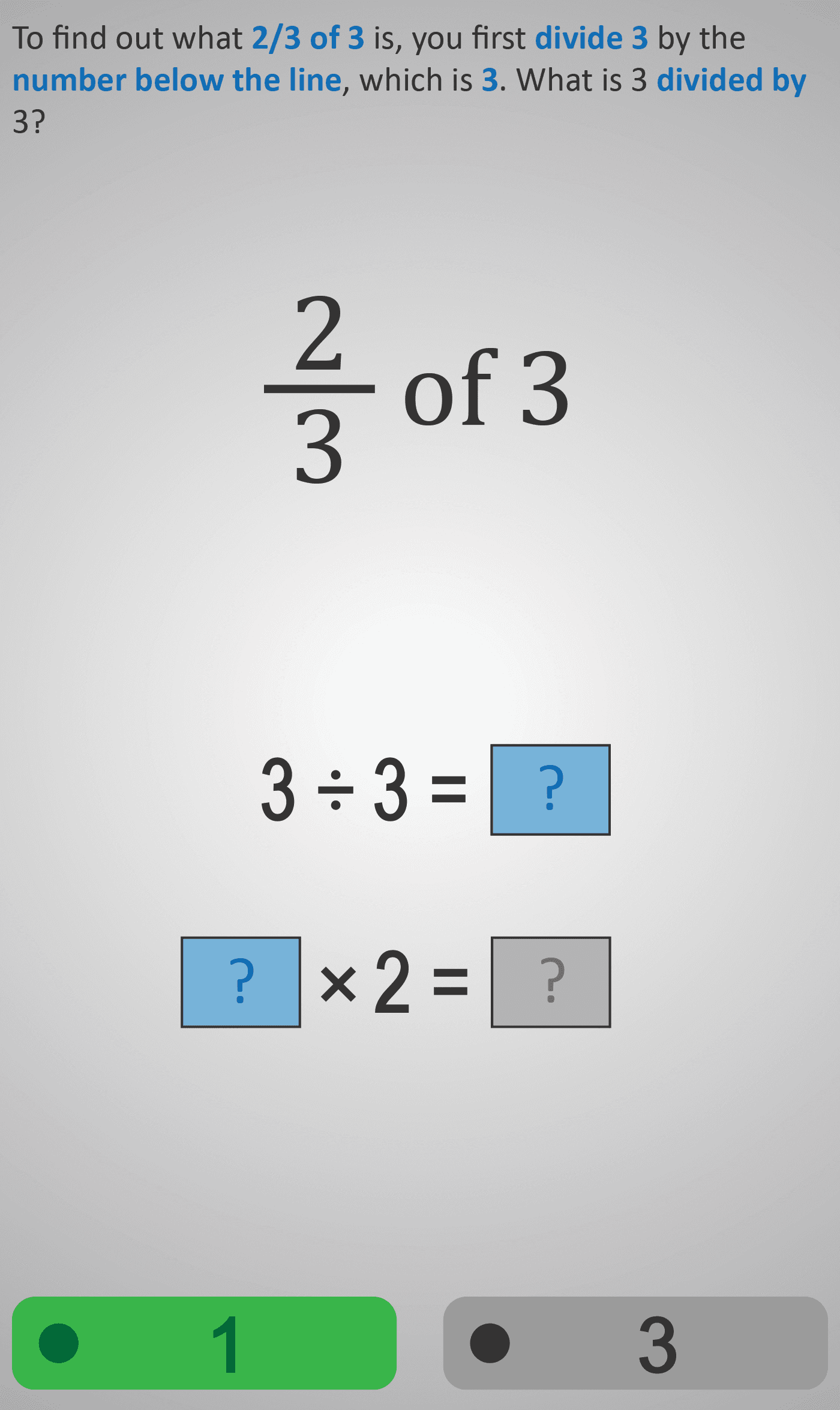
For example, to calculate 2/3 of 3:
3 ÷ 3 = 1
1 × 2 = 2
So, 2/3 of 3 = 2.
The sequence also includes examples like:
1/2 of 4 → 4 ÷ 2 = 2, then 2 × 1 = 2.
These steps reinforce the method of first dividing by the denominator and then multiplying by the numerator. The visuals provide both the written fractions and stepwise calculations, with interactive answer choices that confirm understanding at each step.
Learning Outcome: Students will understand that to find a fraction of a whole number, they must first divide the number by the denominator and then multiply by the numerator, strengthening their foundational fraction skills.
Prerequisite Knowledge Required
- Understanding what a fraction represents (numerator, denominator).
- Knowledge of basic division and multiplication facts.
- Completion of Fraction 2B – Equivalent Fractions and Simplification for familiarity with fraction structure.
Main Category
Number / Fractions
Estimated Completion Time
Approx 6-10 seconds per question. 20 questions total. Total time: 2-4 minute.
Cognitive Load / Step Size
Moderate – each example introduces one new layer (first dividing, then multiplying). The two-step structure keeps processing demands low while reinforcing sequential reasoning.
Language & Literacy Demand
Low – instructions use short, consistent phrasing (“divide by the bottom, multiply by the top”). Numerically driven with clear visual fraction notation and minimal text.
Clarity & Design
Strong visual scaffolding — fraction layout, arrows, and colour cues help link each part of the operation. Interactive prompts and stepwise progression make the logic explicit.
Curriculum Alignment
Irish Curriculum – Number Strand:
- “Understand and use fractions; calculate fractions of quantities; apply knowledge of multiplication and division to solve problems.”
- (Junior Cycle Mathematics – Number)
Engagement & Motivation
Learners experience quick success through immediate feedback after each operation. The visual and interactive layout makes abstract concepts concrete and rewarding.
Error Opportunities & Misconceptions
- Reversing the order (multiplying before dividing).
- Confusing the numerator and denominator roles.
- Misinterpreting “of” as addition or subtraction instead of multiplication.
Transferability / Real-World Anchoring
Applies directly to contexts such as sharing items (½ of 8), budgeting (¾ of €20), or scaling recipes. Builds confidence for ratio and percentage applications later.
Conceptual vs Procedural Balance
Strongly procedural with conceptual reinforcement — learners see why dividing by the denominator “splits the whole,” and multiplying by the numerator “takes parts.”
Learning Objectives Addressed
- Understand and apply the two-step method for finding a fraction of a number.
- Strengthen fluency with division and multiplication.
- Recognise fractions as operators (“part of a whole”).
- Connect visual and numerical representations of fractions.
What Your Score Says About You
- Less than 5: Needs to review the order of operations (divide first, multiply second).
- 6–7: Understands the rule but may slip in execution.
- 8–9: Accurate and consistent in applying both steps.
- 10/10: Confidently finds fractions of numbers and can explain the reasoning behind each step.