
Hyp - Adj - Opp 2
Overview
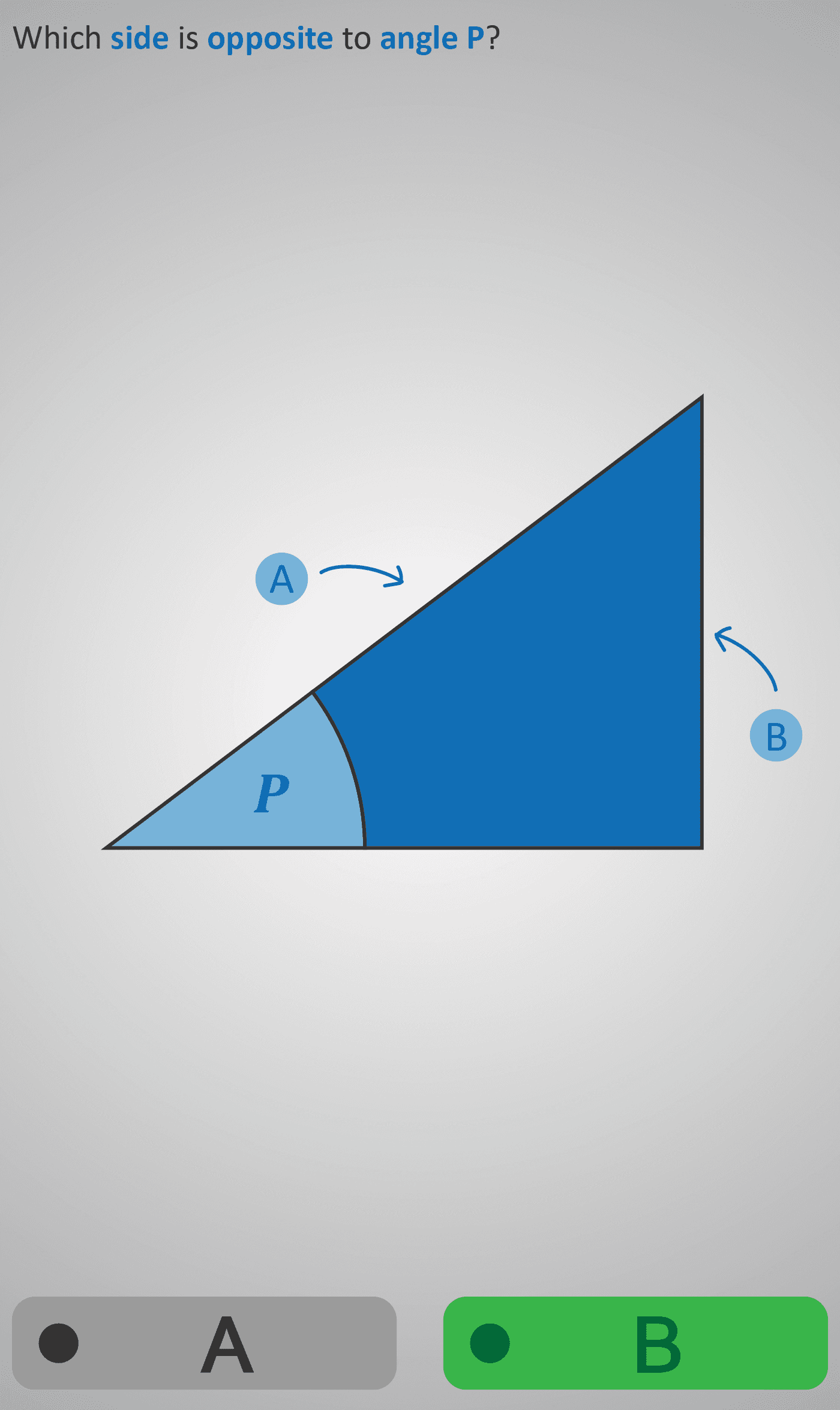
In this Phlow, learners practise identifying the hypotenuse, opposite, and adjacent sides in right-angled triangles relative to a chosen angle. Each question presents a triangle with labelled sides and a marked angle, and students must determine which side corresponds to the given term.
The sequence begins with straightforward examples where the hypotenuse is easily recognised as the longest side opposite the right angle. It then introduces triangles rotated at different orientations to challenge assumptions and strengthen spatial understanding.
Through repetition and feedback, students develop confidence in recognising how the position of the chosen angle determines which sides are “opposite” and “adjacent.” This conceptual skill forms the foundation for future trigonometric problem-solving.
Prerequisite Knowledge Required
- Familiarity with triangle terminology from Triangles 1 and Angles 2A–2C.
- Basic awareness that the hypotenuse is the longest side, opposite the right angle.
- Understanding of what it means for a side to be “opposite” or “next to” an angle.
Main Category
Geometry
Estimated Completion Time
Approx 6-10 seconds per question. 20 questions total. Total time: 2-4 minute.
Cognitive Load / Step Size
Moderate — each step focuses on identifying a single side relative to one angle, with controlled variation between examples. The gradual increase in complexity (from visual identification to linking with lengths) supports retention without overload.
Language & Literacy Demand
Low — questions rely on concise visual prompts with minimal text (e.g., “Which side is opposite angle G?”). Clear labelling (letters for sides and angles) supports comprehension even for students with weaker reading skills.
Clarity & Design
Strong use of geometric diagrams with labelled sides and angles. The consistent colour and layout across questions help learners visually track which side relates to which angle. Visual emphasis ensures the focus remains on spatial reasoning rather than text interpretation.
Curriculum Alignment
Irish Junior Cycle Mathematics – Geometry and Trigonometry Strand:
- “Identify sides and angles in right-angled triangles; recognise and name the hypotenuse, opposite and adjacent sides relative to a given angle.”
Engagement & Motivation
Students engage through visual discovery — identifying sides in different triangles feels like solving a puzzle. The step-by-step design and feedback reinforce correct reasoning quickly, maintaining flow and confidence.
Error Opportunities & Misconceptions
- Confusing the opposite and adjacent sides.
- Assuming the hypotenuse is always the vertical side.
- Relying on orientation rather than positional relationships to the angle.
Transferability / Real-World Anchoring
Recognising sides relative to an angle directly supports later use in trigonometric calculations (sine, cosine, tangent) and in practical geometry, such as measuring heights or distances.
Conceptual vs Procedural Balance
Conceptual — the focus is on understanding relationships between sides and angles rather than computation. The Phlow builds the conceptual foundation for procedural trigonometric work in higher levels.
Learning Objectives Addressed
- Identify the hypotenuse, opposite, and adjacent sides in right-angled triangles.
- Understand how the naming of sides depends on the chosen reference angle.
- Build visual reasoning for triangle orientation.
- Prepare for applying trigonometric ratios in future learning.
What Your Score Says About You
- Less than 5: Needs more visual practice recognising sides relative to an angle.
- 6–7: Understands side names but occasionally confuses adjacent and opposite.
- 8–9: Correctly identifies sides in most orientations.
- 10/10: Fully confident in naming sides — ready to apply in trigonometry.