
Mean 2
Overview
This Phlow teaches students how to calculate the mean (average) of a set of numbers by breaking the process into clear, step-by-step stages.
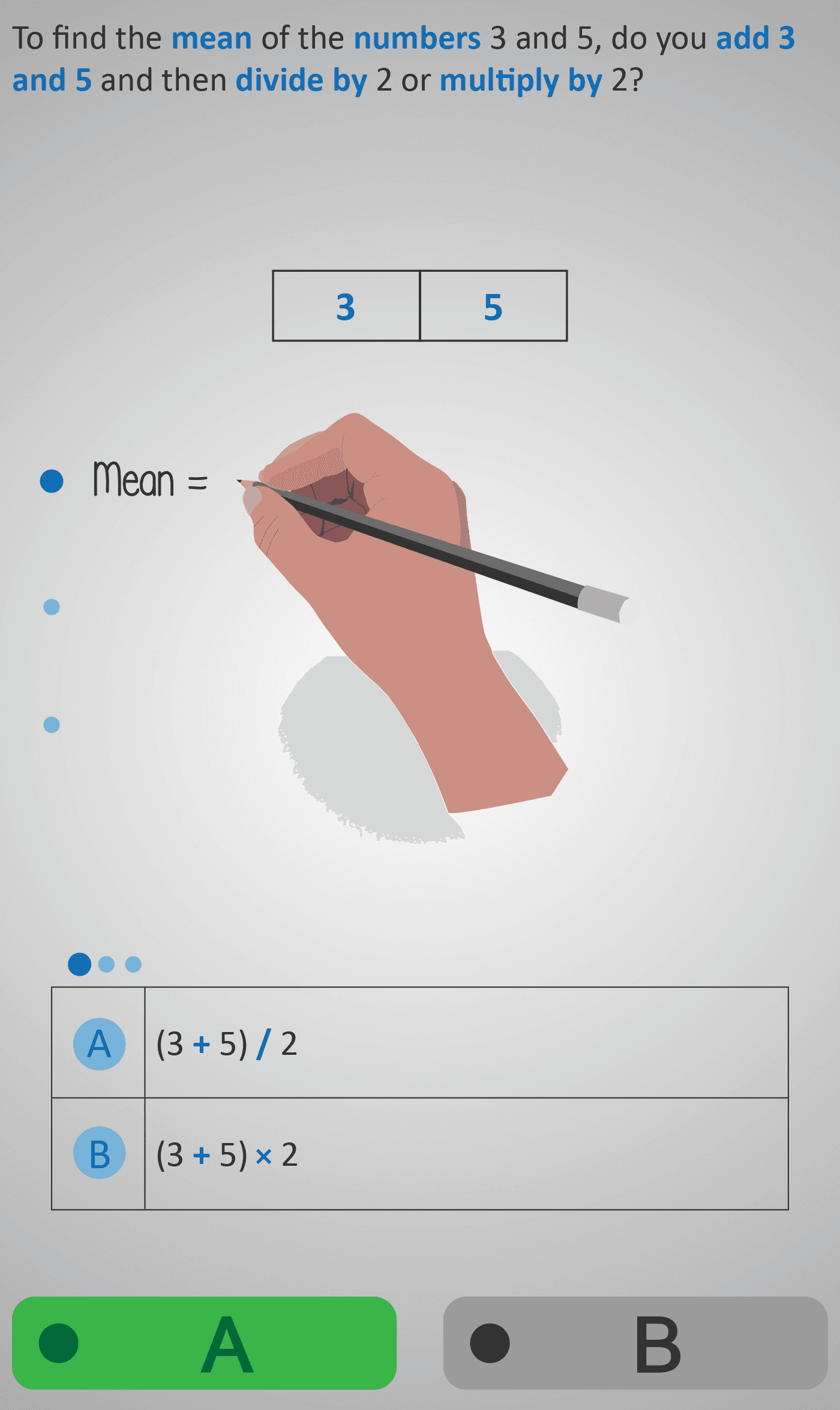
Understanding the process – Students are first asked whether the mean of two numbers is found by dividing or multiplying. They are shown the numbers 3 and 5, with the expression set up as (3 + 5) ÷ 2, reinforcing that division is the correct step.
Simplifying the expression – The calculation (3 + 5) ÷ 2 is presented. Students must simplify the numerator correctly, recognising that 3 + 5 = 8. This encourages careful handling of fractions and algebraic-style expressions.
Final calculation of the mean – The fraction 8 ÷ 2 is simplified to 4, leading students to the conclusion that the mean of 3 and 5 is 4.
By working through these three stages, students build confidence in the systematic process of calculating the mean: add the numbers, then divide by the number of values.
Prerequisite Knowledge Required
- Prior practice with addition and division (see Add 2, Divide 1, and Estimate 2).
- Familiarity with writing numerical expressions and simplifying them.
- Basic understanding that “average” describes a fair share or central value.
Main Category
Statistics
Estimated Completion Time
Approx 6-10 seconds per question. 20 questions total. Total time: 2-4 minute.
Cognitive Load / Step Size
Low to moderate — each stage isolates a single part of the process (operation choice → addition → division). The gradual reveal helps prevent cognitive overload while reinforcing the logical sequence required to calculate a mean.
Language & Literacy Demand
Minimal — questions use short prompts and clear visual examples (e.g., “Which operation finds the mean?”). Mathematical notation supports understanding without heavy reading demands.
Clarity & Design
Clean layout using fraction bars and grouped numbers (e.g., (3 + 5) ÷ 2). The use of colour and step transitions highlights each stage of reasoning, making the process transparent. Visual clarity aids understanding for both visual and symbolic learners.
Curriculum Alignment
Irish Junior Cycle Mathematics – Statistics and Probability Strand:
- “Calculate the mean of a set of numbers and interpret its meaning in context.”
Engagement & Motivation
Students enjoy the clarity of progression — each step feels like a small victory toward the final answer. The everyday familiarity of “averages” makes the concept feel practical and relevant.
Error Opportunities & Misconceptions
- Forgetting to divide by the number of items.
- Dividing before adding the numbers.
- Misinterpreting the mean as the midpoint between two values rather than a calculated result.
Transferability / Real-World Anchoring
Applicable to real-world scenarios such as finding average scores, temperatures, or times. Builds readiness for data analysis, summary statistics, and comparing sets of results.
Conceptual vs Procedural Balance
Balanced — students learn why we divide (to find an equal share) while also practising how to calculate accurately.
Learning Objectives Addressed
- Understand and apply the mean formula: (sum of values) ÷ (number of values).
- Recognise the mean as a measure of central tendency.
- Simplify numerical expressions step by step.
- Build accuracy in combining addition and division in one process.
What Your Score Says About You
- Less than 5: Needs to revisit the order of operations when calculating averages.
- 6–7: Understands the process but may make small arithmetic slips.
- 8–9: Can calculate means correctly in most examples.
- 10/10: Fully fluent in computing and interpreting the mean — ready to apply it to larger data sets.