
Measure 2
Overview
This Phlow introduces students to measuring lengths in centimetres (cm) using a ruler. They practise reading the scale accurately and matching measurements to shapes such as rectangles and squares.
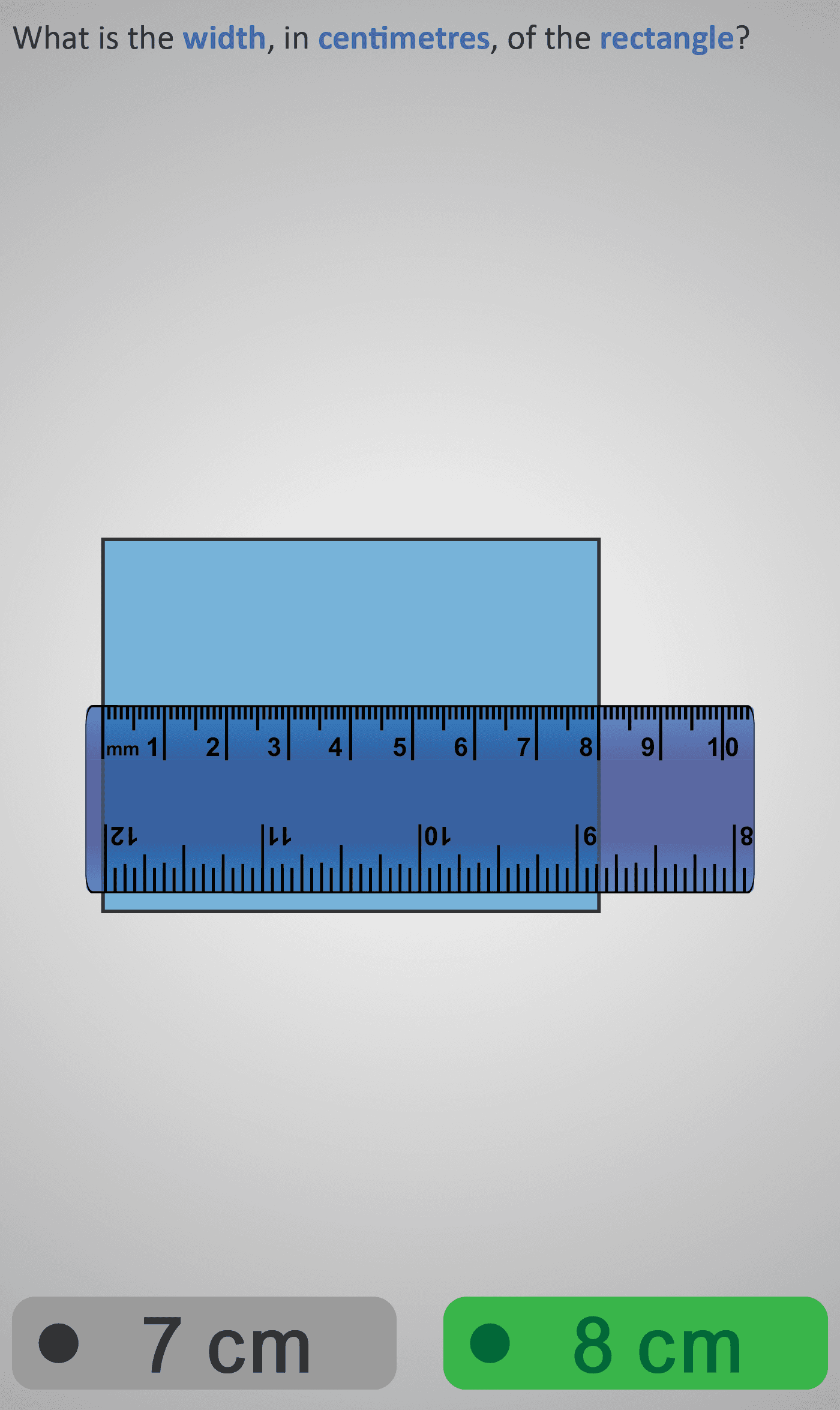
In the first screen, students measure the width of a rectangle using a ruler, with the correct measurement identified as 8 cm.
In the second screen, they measure the height of the rectangle, this time reading vertically, with the answer 6 cm.
In the third screen, the focus shifts to a square, where students use the ruler again to find the width, which is 5 cm.
The sequence builds familiarity with rulers, reinforces the importance of aligning shapes correctly with the zero mark, and ensures students understand that both width and height are measured in centimetres.
Learning outcome: Students gain confidence in using a ruler to measure side lengths of rectangles and squares, laying groundwork for perimeter and area calculations.
Prerequisite Knowledge Required
- Understanding of basic 2D shapes (see Shape 1 and Polygons 1A–B).
- Awareness that length is measured using standard metric units (cm).
- Familiarity with numbers up to at least 20 and comparing lengths.
Main Category
Measurement
Estimated Completion Time
Approx 6-10 seconds per question. 20 questions total. Total time: 2-4 minute.
Cognitive Load / Step Size
Low — each step focuses on a single measurement at a time, first width, then height, then square sides. Gradual progression ensures mastery of ruler use without overwhelming the learner.
Language & Literacy Demand
Low — tasks rely on simple numeric labels and clear diagrams of rulers and shapes. Minimal text means learners can focus on interpreting visuals rather than decoding instructions.
Clarity & Design
Excellent use of visual scaffolding — rulers are clearly marked with centimetre intervals, and the shape outlines guide where to start and stop measuring. Consistent labelling of “width” and “height” reinforces spatial orientation.
Curriculum Alignment
Irish Junior Cycle Mathematics – Measurement Strand:
- “Measure length, area, and volume using standard metric units and appropriate instruments.”
Engagement & Motivation
Interactive visuals of rulers and familiar shapes encourage hands-on engagement. The use of real-world measuring tools adds authenticity and supports kinaesthetic learning.
Error Opportunities & Misconceptions
- Misreading the ruler scale.
- Forgetting to start from the zero mark.
- Confusing width and height when measuring rectangles.
Transferability / Real-World Anchoring
Directly transferable to real-world contexts such as measuring objects, drawing to scale, or reading dimensions in technical drawings. Builds measurement skills needed in geometry, design, and practical tasks.
Conceptual vs Procedural Balance
Balanced — conceptual understanding of what length represents is reinforced alongside procedural fluency in reading and recording measurements.
Learning Objectives Addressed
- Use a ruler correctly to measure lengths in centimetres.
- Read scales accurately and record lengths to the nearest centimetre.
- Distinguish between width and height when measuring rectangles and squares.
- Build readiness for calculating perimeter and area.
What Your Score Says About You
- Less than 5: Needs more practice aligning the ruler and reading scales.
- 6–7: Can measure correctly but may make small reading slips.
- 8–9: Measures accurately and records lengths consistently.
- 10/10: Fully confident — ready to apply measurement skills to perimeter and area.