
Median 2
Overview
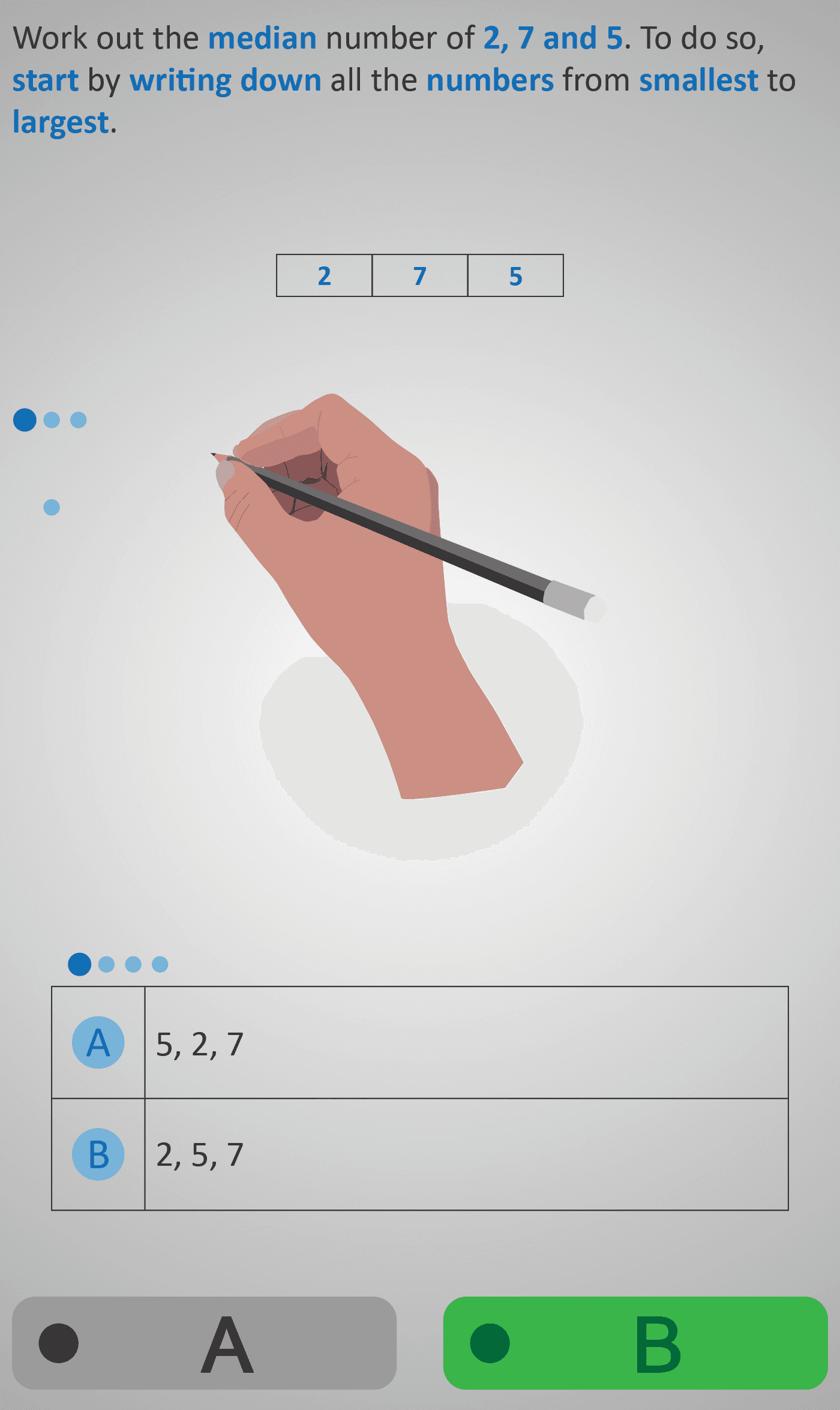
Introduces students to the process of finding the median of a small set of numbers through step-by-step reasoning. The example uses the numbers 2, 7, and 5. Students are first asked to reorder the numbers from smallest to largest, reinforcing the importance of ordering in median calculations.
Next, the lesson defines the median as the middle number and challenges learners to choose the correct method: eliminating numbers from the ends until only the middle value remains. Students then practise identifying which numbers are correctly crossed out before finally concluding that the median of the set {2, 5, 7} is 5.
The sequence builds conceptual understanding through scaffolding:
- Ordering numbers correctly.
- Applying the definition of median.
- Choosing the right elimination strategy.
- Checking the process visually.
- Identifying the final median.
This stepwise approach supports accuracy and ensures students not only calculate the median but also understand why it is the middle value in an ordered list.
Prerequisite Knowledge Required
- Basic number ordering from smallest to largest (see Numbers 1 and Analyse 2B).
- Familiarity with sets of numbers and recognising position within a sequence.
- Understanding that “middle” refers to the central value in an ordered list.
Main Category
Statistics
Estimated Completion Time
Approx 6-10 seconds per question. 20 questions total. Total time: 2-4 minute.
Cognitive Load / Step Size
Low to moderate — each step isolates a clear sub-skill: ordering, eliminating, and identifying the central number. Visual elimination reduces cognitive demand and makes the logic intuitive.
Language & Literacy Demand
Low — text is minimal and procedural. Visual elimination of numbers helps weaker readers follow along without relying on complex instructions.
Clarity & Design
Highly visual and well-structured. The use of crossed-out numbers and ascending order lists reinforces both process and meaning. Each frame highlights exactly one step, ensuring clarity and focus.
Curriculum Alignment
Irish Junior Cycle Mathematics – Statistics and Probability Strand:
- “Order a set of numbers and determine the median; interpret the median as a measure of central tendency.”
Engagement & Motivation
The elimination method feels interactive, like solving a puzzle. Immediate feedback after each step keeps learners engaged and rewards correct logical thinking.
Error Opportunities & Misconceptions
- Forgetting to order the numbers before finding the median.
- Confusing mean and median.
- Eliminating incorrectly or skipping a number during ordering.
Transferability / Real-World Anchoring
Median is directly useful in interpreting data sets such as test scores, salaries, or survey results — where the middle value often gives a more accurate sense of “typical” than the mean.
Conceptual vs Procedural Balance
Conceptual — the focus is on understanding why the middle value represents the median, not just performing a memorised procedure.
Learning Objectives Addressed
- Reorder numbers from smallest to largest.
- Identify the middle value in a list.
- Understand that the median represents the central point of a data set.
- Build readiness to extend the process to larger and even-numbered sets.
What Your Score Says About You
- Less than 5: Needs more practice ordering and isolating the middle number.
- 6–7: Understands the concept but may rush or misorder numbers.
- 8–9: Strong grasp of the median process and reasoning.
- 10/10: Fully confident — ready to apply the concept to larger data sets and real-world contexts.