
Modal 2
Overview
In this exercise, students learn how to identify the mode (the most common number) in a small data set. Each screen presents a set of three numbers, and students are asked to select the value that occurs most frequently.
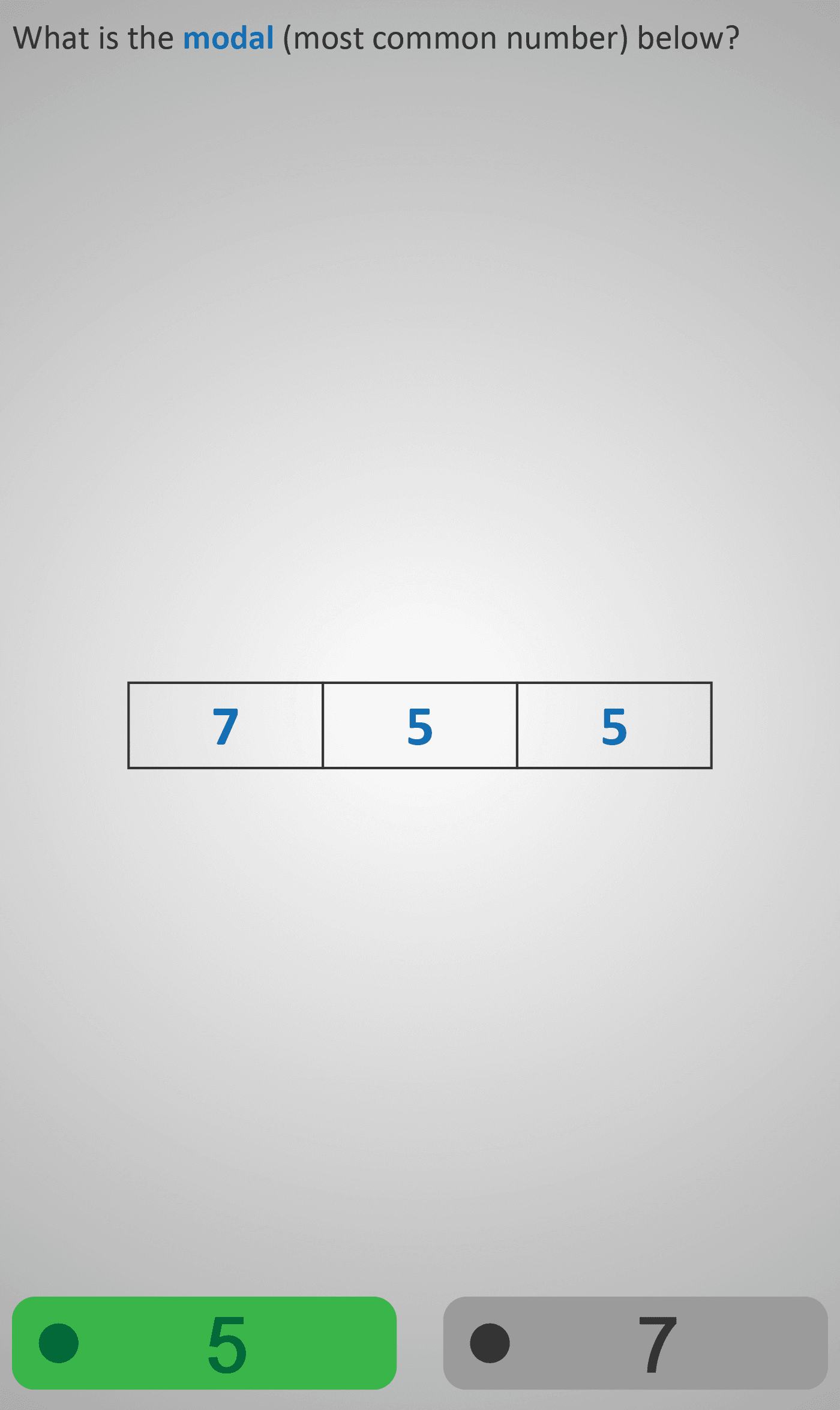
The first example shows the numbers 7, 5, 5, where the mode is 5 since it appears twice.
The second example presents 3, 1, 3, where the mode is 3 because it is repeated.
The third example uses 8, 4, 4, with 4 as the mode.
This activity builds recognition of repeated values and reinforces the concept of the mode in statistics. The simple sets of three numbers ensure accessibility for learners at the early stages, while multiple examples provide practice to confirm understanding.
Prerequisite Knowledge Required
- Familiarity with reading and comparing small sets of numbers (see Numbers 1 and Analyse 2B).
- Awareness that data can contain repeated values.
- Basic understanding that “most” means the highest frequency or count.
Main Category
Statistics
Estimated Completion Time
Approx 6-10 seconds per question. 20 questions total. Total time: 2-4 minute.
Cognitive Load / Step Size
Low — each screen isolates a single set of three numbers, keeping focus on one decision: which value repeats. Clear, consistent formatting ensures attention remains on pattern recognition.
Language & Literacy Demand
Very low — questions use minimal text (“Which number appears most often?”). Visual arrangement of numbers supports understanding for all literacy levels.
Clarity & Design
Simple and well-structured. Numbers are spaced evenly, and repeated values are visually easy to compare. Immediate feedback reinforces the rule that the mode is the most frequent number.
Curriculum Alignment
Irish Junior Cycle Mathematics – Statistics and Probability Strand:
- “Recognise and calculate the mode for a given data set.”
Engagement & Motivation
Learners experience quick wins through short, clear examples. The small number sets build confidence and maintain motivation through immediate reinforcement.
Error Opportunities & Misconceptions
- Choosing the largest or smallest number instead of the most frequent one.
- Misreading or skipping a repeated value in the data set.
Transferability / Real-World Anchoring
The concept of mode connects to everyday situations such as identifying the most common shoe size, favourite colour, or most frequent survey response — grounding statistics in real-world thinking.
Conceptual vs Procedural Balance
Conceptual — focuses on understanding frequency rather than calculation. Procedural fluency follows naturally through repetition.
Learning Objectives Addressed
- Identify the mode in a small data set.
- Recognise frequency as a key property in data analysis.
- Differentiate between “most common,” “largest,” and “middle” values.
- Build foundational understanding for more complex data analysis.
What Your Score Says About You
- Less than 5: Needs more practice identifying repeated values.
- 6–7: Understands the idea of frequency but may misread numbers.
- 8–9: Consistently recognises the mode in small data sets.
- 10/10: Fully confident — ready to apply mode to larger and grouped data.