
Money 2
Overview
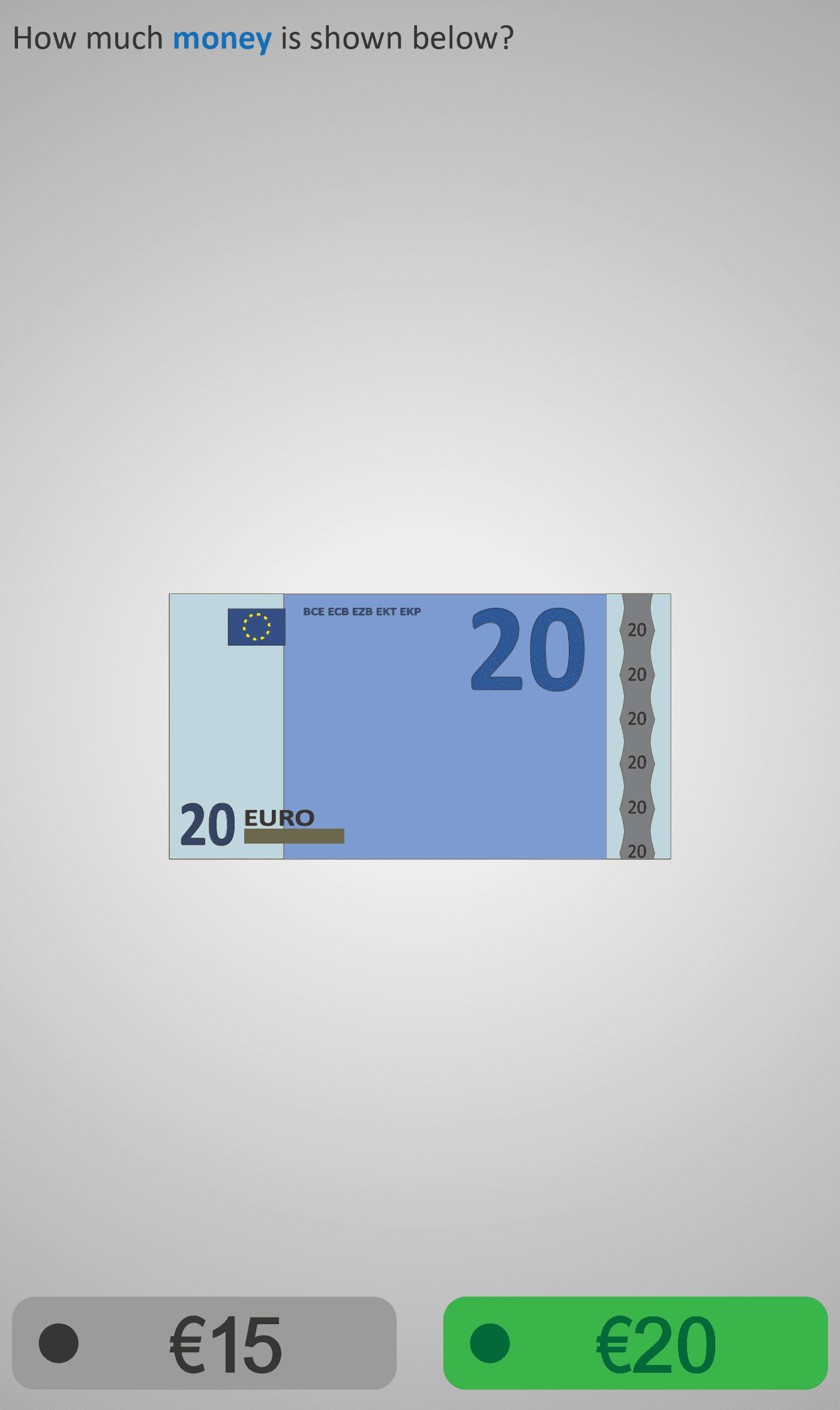
This set of screens helps students practise recognising Euro notes and working out their total value. In the first screen, a single €20 note is shown. Students are asked: “How much money is shown below?” with answer options €15 and €20. The correct choice is €20.
In the second screen, a €5 note and a €10 note are displayed together. Students must add them and select the correct total. The options are €50 and €15, with the correct answer being €15.
In the third screen, two €10 notes are shown. Students are asked the same question, with answer options €20 and €10. The correct answer is €20.
This Phlow builds essential money-handling skills by encouraging students to recognise individual notes and add their values accurately. The use of real-life examples makes it highly practical for everyday numeracy.
Prerequisite Knowledge Required
- Understanding of number recognition and basic addition (see Add 1 and Coins 1).
- Familiarity with Euro currency and the idea that different notes represent different values.
- Ability to visually distinguish between denominations.
Main Category
Arithmetic / Financial Literacy
Estimated Completion Time
Approx 6-10 seconds per question. 20 questions total. Total time: 2-4 minute.
Cognitive Load / Step Size
Low — each question introduces one or two notes at a time, keeping the visual field clear. The transition from single to combined notes builds skill progressively without cognitive overload.
Language & Literacy Demand
Very low — instructions are short and supported by strong visuals. Weaker readers can interpret questions based on images and numbers alone.
Clarity & Design
Highly visual and concrete. Euro notes are clearly illustrated, and answer options are presented as rounded amounts to minimise distraction. Consistent question phrasing supports understanding.
Curriculum Alignment
Irish Primary and Junior Cycle Mathematics – Number and Financial Mathematics Strands:
- “Recognise and use euro notes and coins in practical situations.”
- “Carry out simple calculations involving money.”
Engagement & Motivation
Strong real-world relevance makes the activity engaging. Learners relate easily to tangible examples like cash handling, which increases motivation and perceived usefulness.
Error Opportunities & Misconceptions
- Misidentifying notes (e.g., confusing €10 and €20).
- Incorrectly adding totals or overlooking a note’s value.
Transferability / Real-World Anchoring
Directly applicable to everyday contexts such as shopping, budgeting, or counting change — supporting financial independence and numeracy.
Conceptual vs Procedural Balance
Procedural with conceptual reinforcement — students practise addition while conceptually linking numeric values to physical currency.
Learning Objectives Addressed
- Identify and distinguish between common Euro notes (€5, €10, €20).
- Accurately add the values of one or more notes.
- Strengthen fluency in recognising and working with real-world money.
- Build confidence in applying arithmetic to practical situations.
What Your Score Says About You
- Less than 5: Needs more practice recognising note values.
- 6–7: Understands basic note values but may miscalculate totals.
- 8–9: Accurately identifies and adds notes with minor slips.
- 10/10: Fully confident — ready to handle mixed notes and coins in realistic money problems.