
Multiples 2
Overview
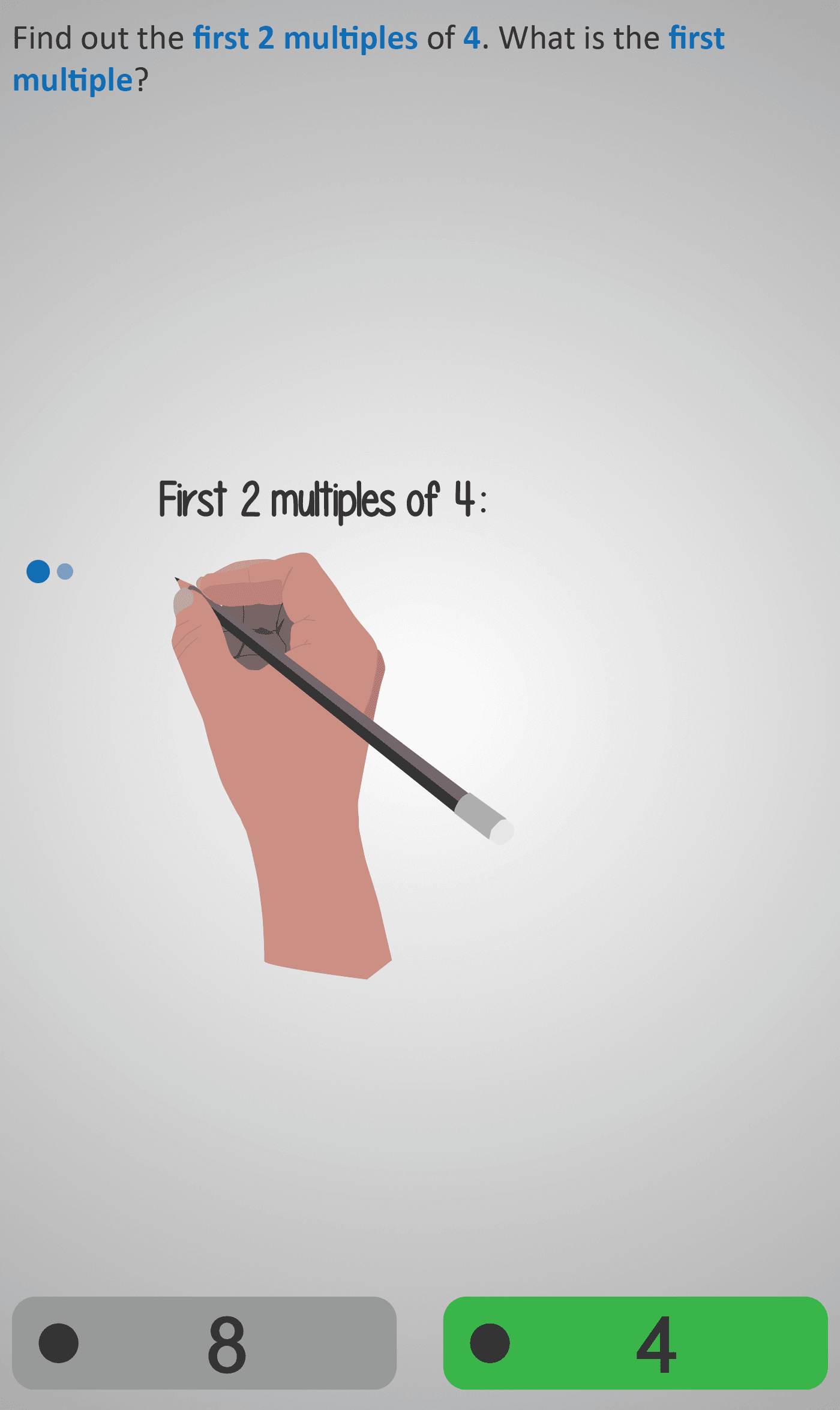
In this lesson, students practise identifying the first two multiples of a given number. The activity begins with the number 4, asking students to find its first multiple. The options are 4 and 8, with the correct answer being 4.
The second step asks for the next multiple of 4, with choices 8 and 10. The correct answer is 8.
The task then switches to the number 9, asking students for the first multiple. The options are 9 and 11, with 9 being correct.
Finally, students must identify the second multiple of 9, choosing between 18 and 22, with 18 as the correct answer.
This sequence helps learners understand multiples as repeated addition or results of multiplication, reinforcing that the first multiple of a number is itself, followed by multiples generated by doubling, tripling, and so on.
Prerequisite Knowledge Required
- Understanding of addition as repeated counting (see Add 1 and Numbers 1).
- Familiarity with basic skip-counting (2s, 4s, etc.).
- Awareness that multiplication represents repeated addition.
Main Category
Number / Multiplication Foundations
Estimated Completion Time
Approx 6-10 seconds per question. 20 questions total. Total time: 2-4 minute.
Cognitive Load / Step Size
Low — each question focuses on one number and its multiples in sequence. Gradual increase in number size (4 → 9) maintains challenge without overwhelm.
Language & Literacy Demand
Very low — the text is minimal (“Which is the first multiple of 4?”). Visual numbers dominate, supporting learners of all literacy levels.
Clarity & Design
Simple and consistent layout. Numbers are large, well-spaced, and clearly contrasted. Repetition in structure builds confidence through predictability.
Curriculum Alignment
Irish Junior Cycle Mathematics – Number Strand:
- “Explore and identify multiples and factors of whole numbers.”
Engagement & Motivation
Learners enjoy the quick, quiz-like structure that rewards recognition of patterns. Repetition and immediate feedback reinforce success and encourage automatic recall.
Error Opportunities & Misconceptions
- Confusing multiples with factors.
- Thinking multiples always increase by one instead of by the base number.
Transferability / Real-World Anchoring
Understanding multiples supports later work in times tables, measurement conversions, and identifying common multiples in problem-solving (e.g., synchronised events or repeating patterns).
Conceptual vs Procedural Balance
Balanced — students develop both conceptual understanding (multiples as repeated addition) and procedural skill (using multiplication patterns).
Learning Objectives Addressed
- Identify the first two multiples of given numbers.
- Understand multiples as results of repeated addition or multiplication.
- Differentiate between multiples and factors.
- Build readiness for full multiplication tables.
What Your Score Says About You
- Less than 5: Needs more practice linking addition to multiplication.
- 6–7: Recognises patterns but may confuse multiples with other sequences.
- 8–9: Accurately identifies multiples across examples.
- 10/10: Fully fluent — ready for extended multiples and times table mastery.