
Numbers 2B
Overview
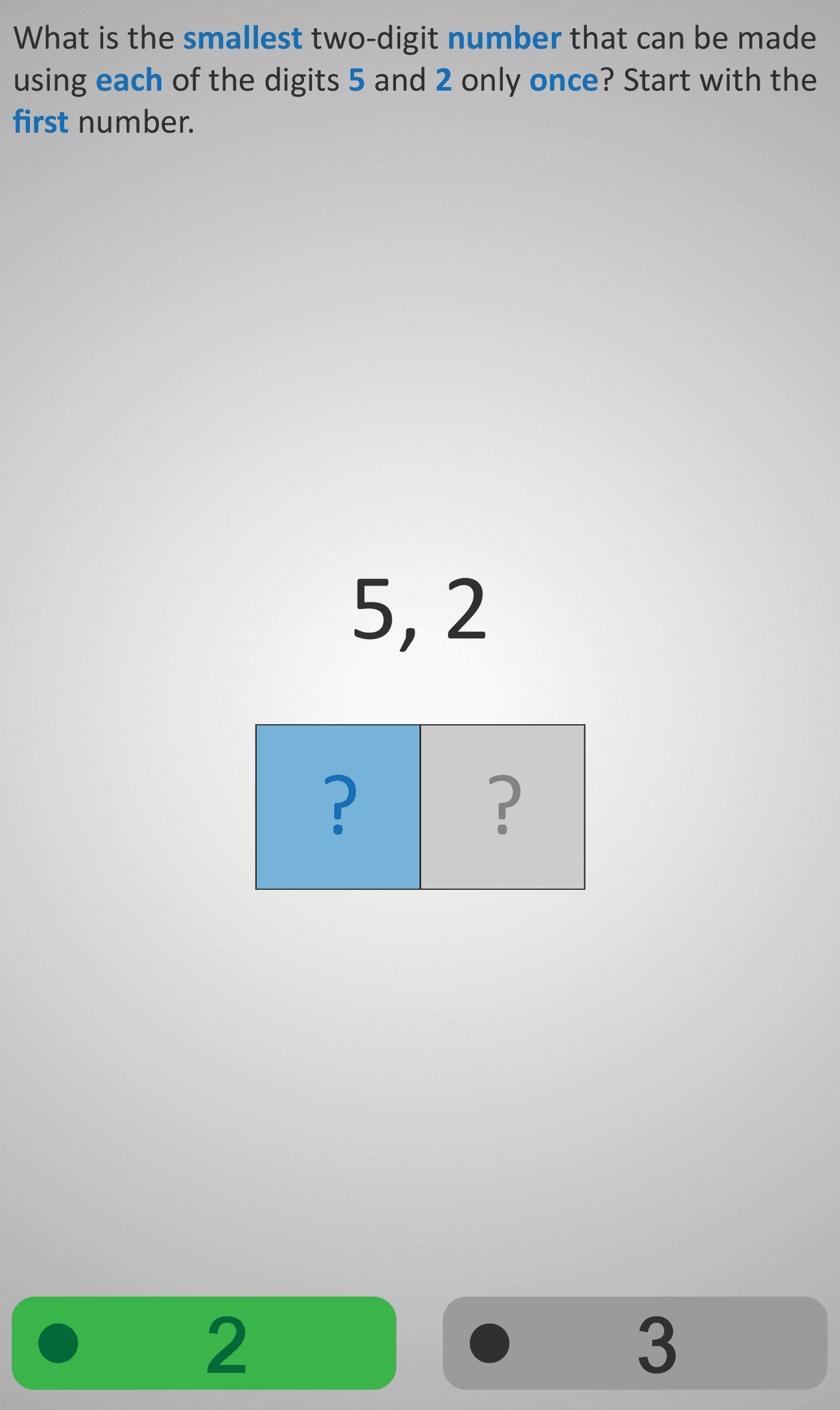
This Phlow challenges learners to construct the smallest and largest possible two-digit numbers using given digits exactly once. Students are guided step-by-step, first identifying which digit should come first, then completing the number with the remaining digit.
Tasks with digits 5 and 2:
Students must form the smallest two-digit number. They learn that the smaller digit (2) must go in the tens place,
followed by 5, creating the number 25.
Tasks with digits 7 and 6:
Students are asked to form the largest two-digit number. Here, the larger digit (7) is placed in the tens position,
followed by 6, giving the number 76.
Through interactive prompts and multiple-choice answers, learners practise comparing digits, understanding place value, and applying logical reasoning to build numbers correctly. This reinforces both numerical comparison and digit placement rules, key foundations for number sense.
Prerequisite Knowledge Required
- Understanding of two-digit numbers and place value (see Numbers 2A).
- Ability to compare single digits (which is larger/smaller).
- Familiarity with tens and ones structure.
Main Category
Number / Place Value
Estimated Completion Time
Approx 6-10 seconds per question. 20 questions total. Total time: 2-4 minute.
Cognitive Load / Step Size
Moderate — introduces reasoning about position and place value, not just comparison. Progression from identifying the smaller/larger digit to constructing full numbers ensures scaffolded thinking.
Language & Literacy Demand
Low — tasks use short instructions (“Form the smallest two-digit number”). The main reasoning is numerical, supported by clear visual layout.
Clarity & Design
Neat and consistent layout. Two digits are displayed side by side with clear options, allowing learners to visualise swapping positions. Colour or positional emphasis helps direct attention to the tens and ones places.
Curriculum Alignment
Irish Junior Cycle Mathematics – Number Strand:
- “Understand and use place value in whole numbers and decimals.”
Engagement & Motivation
Highly engaging due to its puzzle-like format. Students enjoy reasoning through which order makes a number larger or smaller, promoting curiosity and confidence.
Error Opportunities & Misconceptions
- Thinking the order of digits doesn’t affect the size of a number (e.g., 52 vs 25).
- Assuming the smaller digit always comes first without checking the question prompt (“smallest” vs “largest”).
Transferability / Real-World Anchoring
Supports number construction skills used in comparing quantities, prices, and measurements. Builds understanding essential for multi-digit arithmetic and estimation.
Conceptual vs Procedural Balance
Strongly conceptual — emphasises why number order affects magnitude rather than rote comparison.
Learning Objectives Addressed
- Construct the smallest and largest two-digit numbers using given digits.
- Strengthen understanding of place value (tens vs ones).
- Apply logical reasoning to compare and order digits.
- Develop accuracy and confidence in number formation.
What Your Score Says About You
- Less than 5: Needs to strengthen understanding of tens and ones positions.
- 6–7: Can compare digits but may confuse order in two-digit construction.
- 8–9: Good grasp of place value with occasional slips.
- 10/10: Fully fluent — understands number formation and ready for three-digit extensions.