
Patterns 2
Overview
This exercise builds on recognising simple visual patterns and sequences. Students are shown Terms 1 and 2 and must decide which of two options, A or B, correctly represents Term 3. Each question uses different shapes and arrangements to test logical thinking.
Example 1:
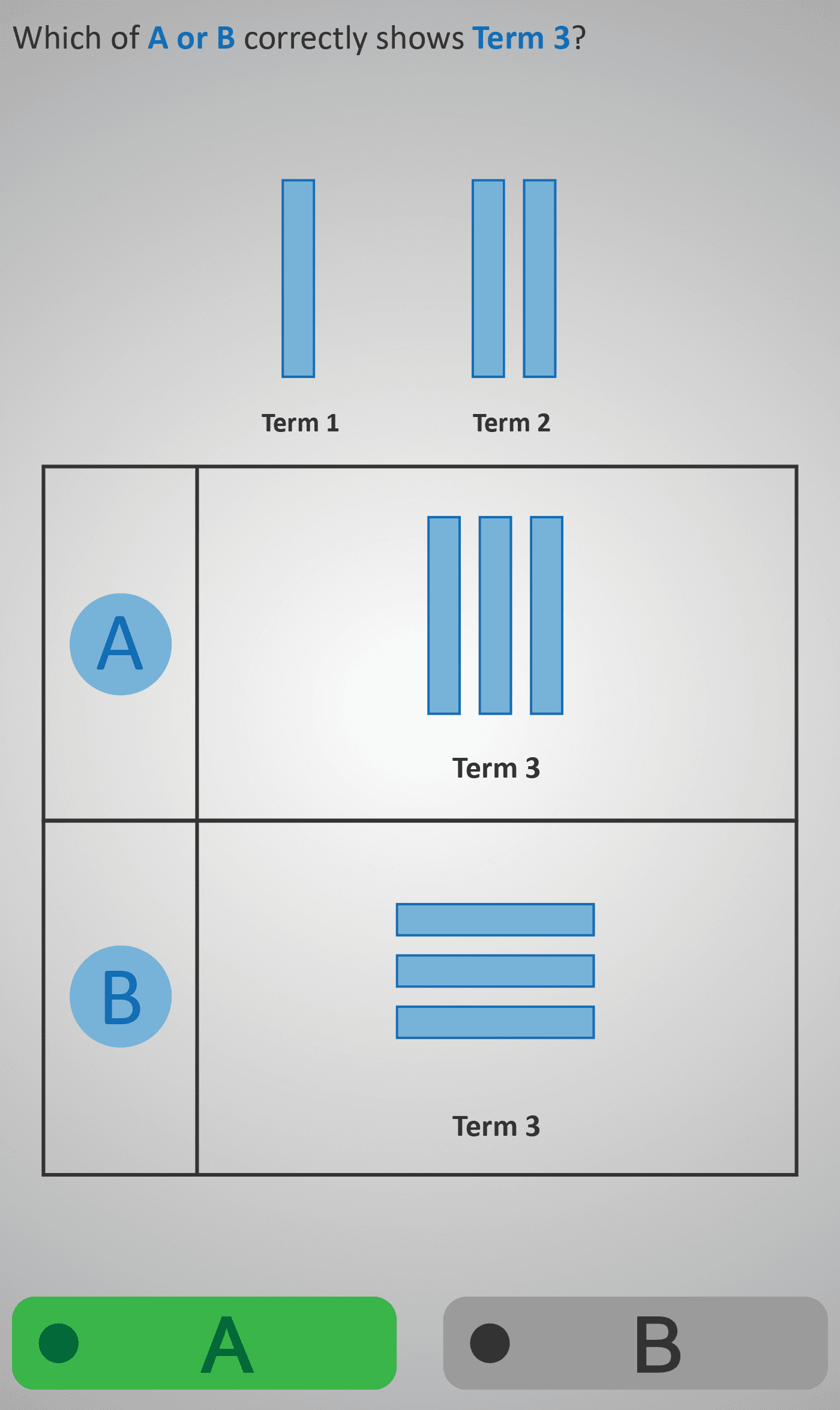
Students see one bar in Term 1, two bars in Term 2, and must choose between three vertical bars (A)
or three horizontal bars (B). The correct answer is A, as the pattern increases by one vertical bar each term.
Example 2:
The sequence uses groups of ovals. Term 1 shows six ovals, Term 2 shows four ovals,
so Term 3 should show three ovals. Students must select the correct arrangement, with A being the correct choice.
Example 3:
The sequence uses triangles. Term 1 has three triangles, Term 2 has two, so Term 3 should have one.
The correct answer is A.
This activity develops pattern recognition, logical sequencing, and visual reasoning, helping students understand how to continue or complete a sequence based on given rules.
Prerequisite Knowledge Required
- Recognition of basic shapes and their arrangements (see Patterns 1).
- Understanding of increasing and decreasing sequences.
- Ability to visually compare number, size, and orientation of objects.
Main Category
Pattern Recognition / Logical Reasoning
Estimated Completion Time
Approx 6-10 seconds per question. 20 questions total. Total time: 2-4 minute.
Cognitive Load / Step Size
Moderate — introduces reasoning about both quantity and orientation. Each step involves small, manageable visual changes to avoid overload while maintaining challenge.
Language & Literacy Demand
Minimal — tasks are visual with simple prompts (“Which is Term 3?”). Ideal for diverse learners as the logic is nonverbal.
Clarity & Design
Strong visual clarity with consistent layout. Shapes are evenly spaced, colour-coded, and well-aligned across terms to highlight differences between A and B. Visual hierarchy supports focus on progression.
Curriculum Alignment
Irish Junior Cycle Mathematics – Algebra and Number Strand:
- “Recognise, extend, and generalise patterns and sequences.”
Engagement & Motivation
High engagement due to its puzzle-like nature. Immediate feedback and clear progression encourage persistence and satisfaction when identifying correct continuations.
Error Opportunities & Misconceptions
- Students may focus on irrelevant features (e.g., colour or orientation instead of quantity).
- May assume patterns always increase, missing decreasing or alternating sequences.
Transferability / Real-World Anchoring
Pattern recognition is transferable to algebraic thinking, coding logic, and problem-solving in geometry, art, and everyday reasoning.
Conceptual vs Procedural Balance
Primarily conceptual — focuses on recognising underlying structure rather than computation, preparing learners for symbolic pattern rules later on.
Learning Objectives Addressed
- Identify the next term in a sequence based on visual or numerical change.
- Recognise increasing and decreasing trends in structured patterns.
- Strengthen logical reasoning and visual analysis.
- Build readiness for abstract pattern generalisation (algebraic thinking).
What Your Score Says About You
- Less than 5: Needs to focus on observing consistent visual changes.
- 6–7: Understands basic pattern growth but may miss subtle variations.
- 8–9: Strong visual reasoning with minor lapses in orientation or counting.
- 10/10: Fully confident — ready to extend pattern recognition to numeric and algebraic forms.