
Perimeter 2
Overview
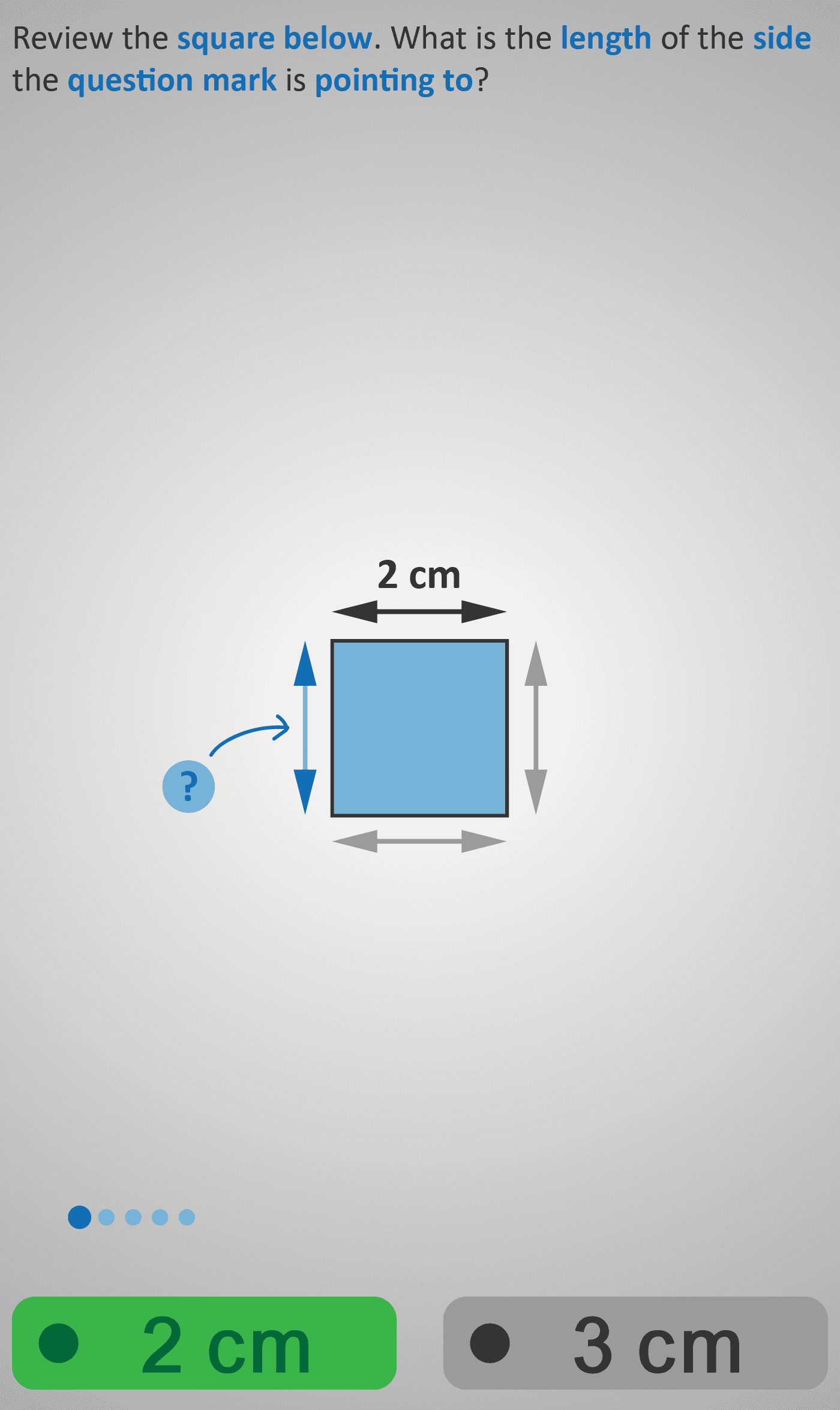
Introduces students to the concept of perimeter using simple 2 cm squares. The lesson begins by reinforcing that all sides of a square are equal, prompting learners to identify the length of each side (2 cm). It then guides them step by step to recognise that the perimeter is found by adding all four sides together.
Students are asked to choose between two expressions (four sides added vs. three sides added) to determine which correctly represents the perimeter. Finally, they calculate the total, confirming that the perimeter of the square is 8 cm.
This Phlow builds understanding gradually: from recognising equal side lengths → to forming the perimeter equation → to solving it. By the end, learners can confidently state and calculate the perimeter of a square.
Prerequisite Knowledge Required
- Understanding of basic shapes, especially squares and rectangles (see Shapes 1).
- Knowledge that perimeter measures total distance around a shape.
- Basic addition of small whole numbers.
Main Category
Measurement / Geometry
Estimated Completion Time
Approx 6-10 seconds per question. 20 questions total. Total time: 2-4 minute.
Cognitive Load / Step Size
Low — builds gradually from recognising equal sides to forming and solving the perimeter equation. Cognitive steps are small and cumulative, ideal for early-stage learners.
Language & Literacy Demand
Low — instructions are short and supported by clear visuals. Mathematical symbols (+, =) are used consistently, reducing text reliance.
Clarity & Design
Strong visual layout featuring squares labelled with side lengths. The progression from side identification to total calculation is presented cleanly, ensuring conceptual clarity and focus on key relationships.
Curriculum Alignment
Irish Junior Cycle Mathematics – Geometry and Measurement Strand:
- “Measure and calculate perimeter and area of regular shapes.”
Engagement & Motivation
Moderate to high — students enjoy seeing simple shapes come to life through arithmetic reasoning. Immediate feedback and visual reinforcement sustain engagement.
Error Opportunities & Misconceptions
- Adding only three sides instead of four.
- Confusing perimeter with area.
Transferability / Real-World Anchoring
Perimeter understanding applies to real-world contexts like fencing, borders, and measuring lengths in design and construction.
Conceptual vs Procedural Balance
Balanced — learners build both conceptual understanding (what perimeter means) and procedural fluency (how to calculate it).
Learning Objectives Addressed
- Recognise that all sides of a square are equal in length.
- Understand perimeter as the total distance around a shape.
- Apply repeated addition to find perimeter values.
- Strengthen understanding of measurement in centimetres.
What Your Score Says About You
- Less than 5: Needs to reinforce the meaning of perimeter and side counting.
- 6–7: Understands the concept but may occasionally omit or miscount sides.
- 8–9: Strong grasp of perimeter with minor calculation slips.
- 10/10: Confidently calculates perimeters and is ready to apply the rule to rectangles and composite shapes.