
Polygons 2A
Overview
Introduces learners to recognising and naming simple 2D shapes. Each screen presents a shape with two possible answer choices, allowing students to select the correct name. The progression builds confidence by starting with very familiar shapes and gradually introducing those with more sides:
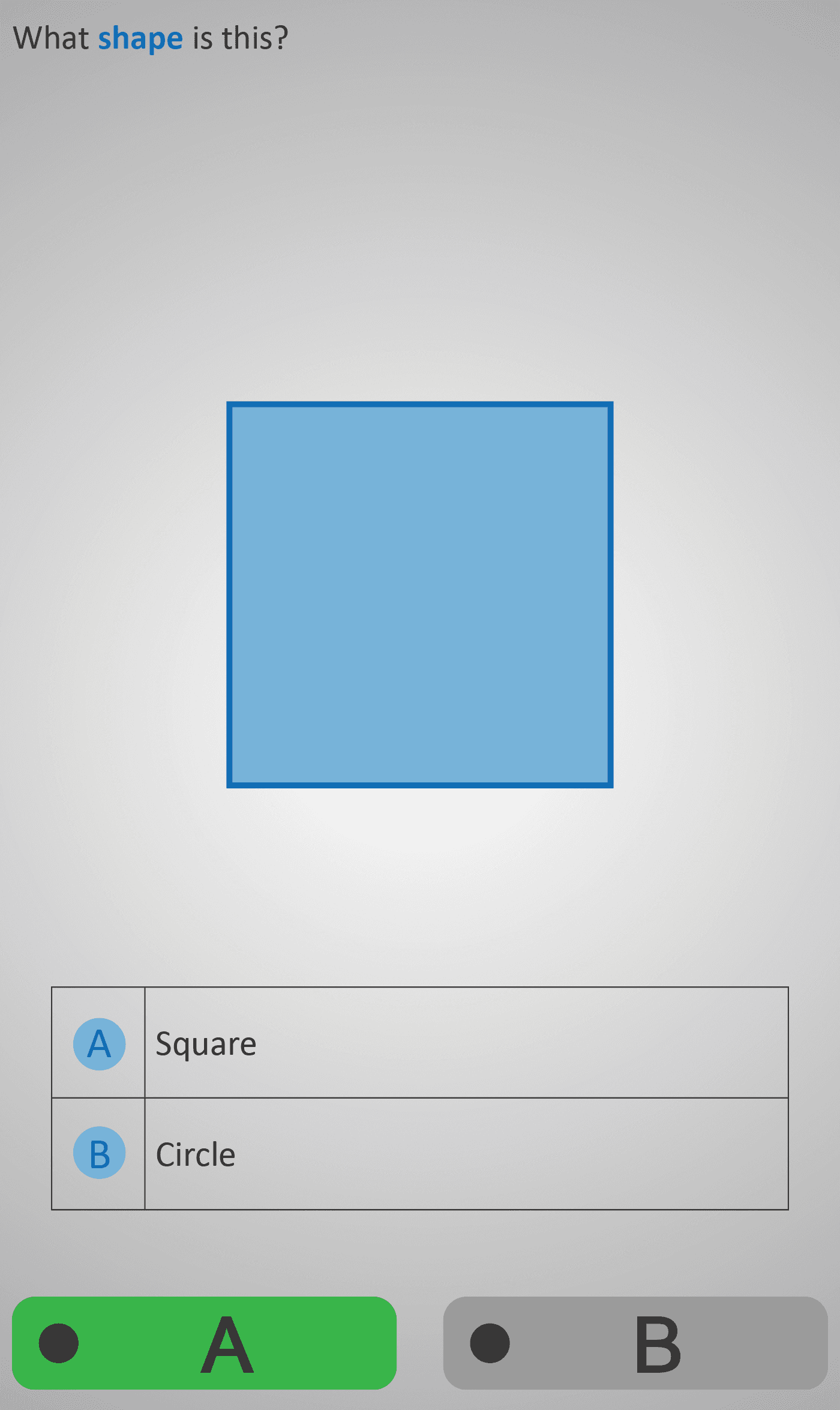
- Screen 1: A square is shown, with answer options “Square” or “Circle.” The correct answer is Square.
- Screen 2: A triangle is displayed, with answer options “Triangle” or “Rectangle.” The correct answer is Triangle.
- Screen 3: A hexagon is shown, with answer options “Square” or “Hexagon.” The correct answer is Hexagon.
- Screen 4: A pentagon is presented, with answer options “Pentagon” or “Circle.” The correct answer is Pentagon.
This sequence helps students practice recognising shapes by their defining features—number of sides and overall outline. The question format is simple (two options), making it well-suited for beginners or as a confidence-building exercise.
Prerequisite Knowledge Required
- Basic recognition of 2D shapes (see Polygons 1A and 1B).
- Understanding that the number of sides and corners defines a shape.
- Early vocabulary of shape names (circle, triangle, square, etc.).
Main Category
Geometry / Shape Recognition
Estimated Completion Time
Approx 6-10 seconds per question. 20 questions total. Total time: 2-4 minute.
Cognitive Load / Step Size
Low — each question isolates one visual and two possible names. Step size is small and well-sequenced, progressing from familiar (square, triangle) to slightly less common (hexagon, pentagon).
Language & Literacy Demand
Low — minimal text per screen, focused on short, familiar words. The visual representation supports recognition without requiring complex reading.
Clarity & Design
Excellent — large, high-contrast shapes make visual features clear. Two-choice format (A/B) ensures focus and accessibility.
Curriculum Alignment
Irish Primary / Junior Cycle Mathematics – Geometry Strand:
- “Recognise, classify, and describe common 2D shapes by number of sides and corners.”
Engagement & Motivation
High — bright, simple visuals and quick success reinforce confidence and motivation. Ideal as an introductory or revision activity.
Error Opportunities & Misconceptions
- Learners may confuse shapes with similar outlines (e.g., pentagon vs. hexagon).
- Some may rely on symmetry alone — clear visuals and two-choice structure reduce these errors.
Transferability / Real-World Anchoring
Strong — connects to everyday recognition of shapes in objects (signs, tiles, packaging). Builds vocabulary useful across art, design, and spatial reasoning.
Conceptual vs Procedural Balance
Conceptual — focuses on visual recognition and classification rather than calculation.
Learning Objectives Addressed
- Identify and name common 2D shapes accurately.
- Recognise shapes by number of sides and vertices.
- Strengthen visual discrimination between geometric figures.
- Build geometric vocabulary and foundational shape knowledge.
What Your Score Says About You
- Less than 5: Needs more familiarity with basic shape names.
- 6–7: Recognises most shapes but confuses some with similar outlines.
- 8–9: Strong recognition of common polygons with minor slips.
- 10/10: Excellent — confidently identifies all basic 2D shapes by sight.