
Polygons 2B
Overview
Introduces learners to the relationship between the sides and angles of different polygons. Each question shows a shape and asks the learner to identify how many sides or angles it has, helping to build understanding of polygon properties.
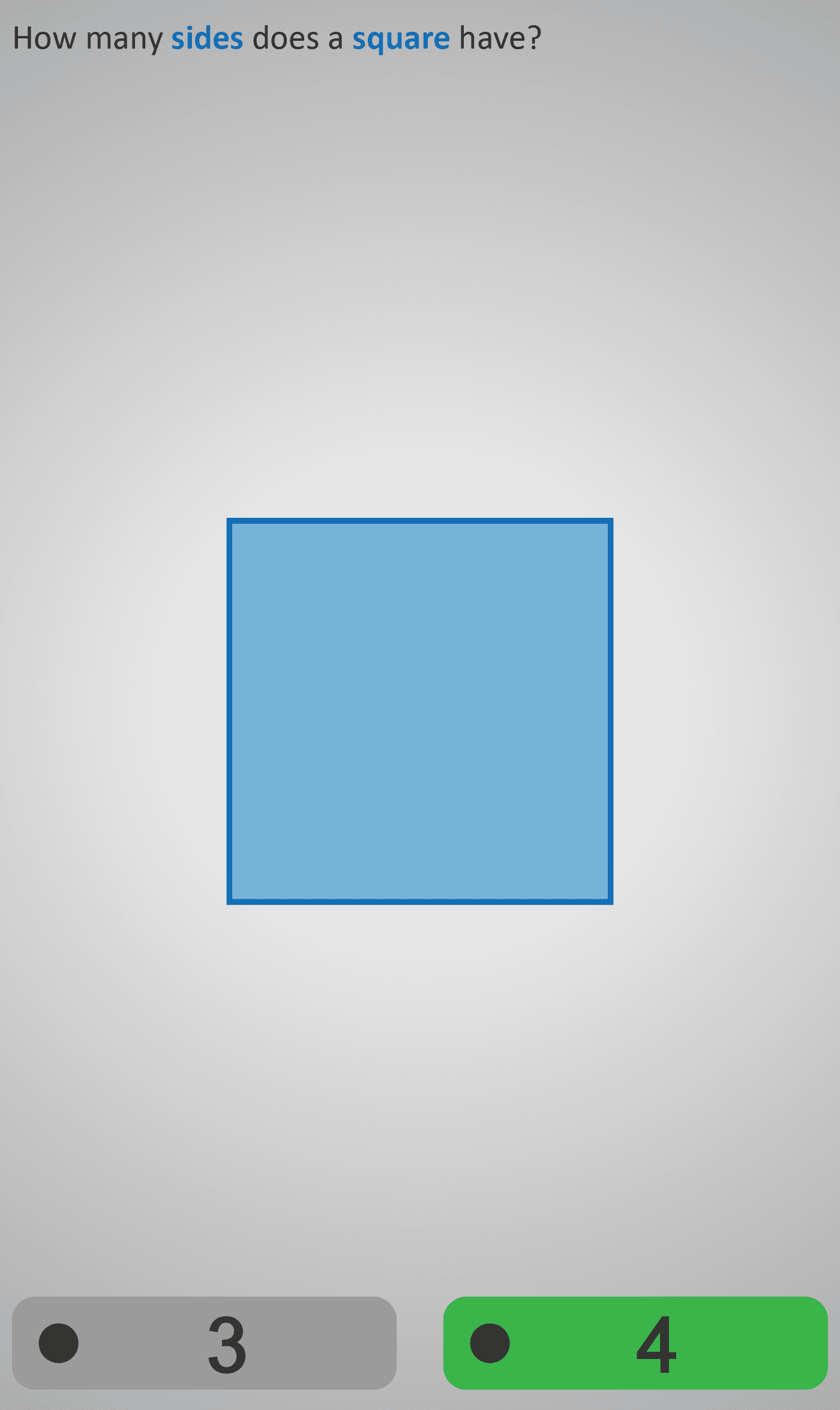
- Screen 1: A square is shown. The question asks how many sides a square has. The correct answer is 4, reinforcing that all squares have four equal sides.
- Screen 2: A triangle is displayed. The question is about how many angles a triangle has. The answer is 3, linking sides and angles.
- Screen 3: A hexagon is presented. Learners must identify the number of sides, which is 6, encouraging recognition of more complex polygons.
- Screen 4: A pentagon is shown. The question asks how many angles it has, with the correct answer being 5.
This set builds on shape recognition by moving from simple identification to counting sides and angles, supporting learners as they develop stronger connections between visual shapes and their mathematical properties.
Prerequisite Knowledge Required
- Ability to recognise basic 2D shapes (see Polygons 2A).
- Understanding that shapes are defined by their sides and corners (angles).
- Basic counting skills (up to 6).
Main Category
Geometry / Shape Properties
Estimated Completion Time
Approx 6-10 seconds per question. 20 questions total. Total time: 2-4 minute.
Cognitive Load / Step Size
Low to moderate — transitions from simple shapes (square, triangle) to more complex ones (pentagon, hexagon). Each step builds predictably without introducing new terminology.
Language & Literacy Demand
Low — uses short, clear language (“How many sides does this shape have?”). The task is primarily visual and numerical.
Clarity & Design
Strong — clean diagrams with clear outlines and minimal distractions. Alternating questions between sides and angles maintains variety while reinforcing connections.
Curriculum Alignment
Irish Primary / Junior Cycle Mathematics – Geometry Strand:
- “Identify, classify, and describe 2D shapes according to the number of sides and angles.”
Engagement & Motivation
High — simple visuals and quick answers maintain flow and engagement. Students gain instant feedback, encouraging confidence through success.
Error Opportunities & Misconceptions
- Learners may confuse sides with angles or miscount when shapes have more vertices (e.g., hexagon).
- The visual clarity and alternating prompts reduce these risks.
Transferability / Real-World Anchoring
Strong — reinforces shape properties seen in everyday contexts (e.g., tiles, signs, objects). Builds spatial reasoning and supports geometry, art, and design understanding.
Conceptual vs Procedural Balance
Conceptual — focuses on visual and structural understanding rather than computation.
Learning Objectives Addressed
- Count and identify the sides and angles of common polygons.
- Understand that the number of angles equals the number of sides in a polygon.
- Strengthen recognition of geometric patterns and properties.
- Develop vocabulary and reasoning around polygon classification.
What Your Score Says About You
- Less than 5: Needs to revise the link between shape names and properties.
- 6–7: Recognises most shapes but may confuse side and angle counts.
- 8–9: Good understanding of polygon properties with minor slips.
- 10/10: Excellent — confidently counts sides and angles for all common polygons.