
Possible Choice 2A
Overview
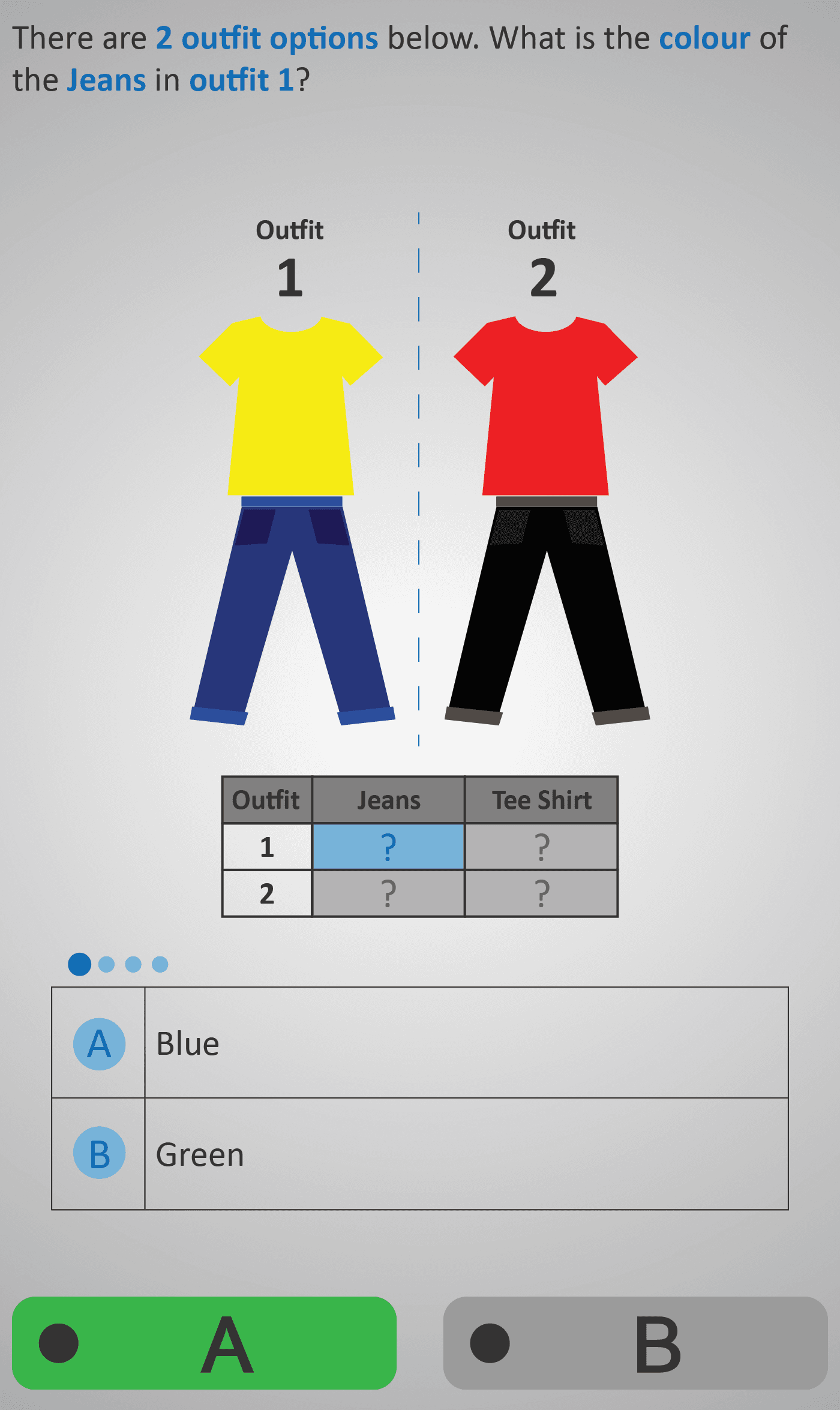
In this activity, students work with outfits made up of jeans and t-shirts to answer questions about their colours. Two outfits are shown side by side, each with a different coloured t-shirt and jeans. A table is provided with rows for each outfit and columns for Jeans and Tee Shirt, where students must fill in the correct colour information.
The questions guide learners step by step:
- Identifying colours in Outfit 1 – e.g., “What is the colour of the Jeans in outfit 1?” with multiple-choice options.
- Identifying the t-shirt colour in Outfit 1.
- Describing Outfit 2 – e.g., “What is the colour of the Jeans in outfit 2?”
- Completing Outfit 2’s t-shirt colour.
Each question is answered through a simple two-choice multiple-choice format (A or B), reinforcing observation and comparison skills.
This exercise helps students:
- Recognise and name colours correctly.
- Match visual information to a structured table.
- Build confidence in handling categorical data (clothing features) with simple recording and interpretation.
It combines visual recognition, decision-making, and recording information in a table — important early skills in both mathematics and logical reasoning.
Prerequisite Knowledge Required
- Basic colour recognition and naming (e.g., blue, red, green).
- Understanding of simple tables (rows and columns).
- Familiarity with making comparisons between two items or categories.
Main Category
Data Handling / Classification
Estimated Completion Time
Approx 6-10 seconds per question. 20 questions total. Total time: 2-4 minute.
Cognitive Load / Step Size
Low — visual information is simple and directly mapped to the table. Step size between questions is small and repetitive, reinforcing structure and consistency.
Language & Literacy Demand
Low — straightforward vocabulary (“jeans,” “t-shirt,” “colour”) and short questions. Suitable for learners with developing reading skills.
Clarity & Design
Strong — clear, contrasting colours and simple table layout aid comprehension. Two-choice format minimises distraction and cognitive load.
Curriculum Alignment
Irish Primary / Junior Cycle Mathematics – Data Strand:
- “Collect, organise, and represent data using simple tables, and interpret the information contained in them.”
Engagement & Motivation
High — relatable, real-world context (clothing choices) encourages engagement. The visual and interactive elements make data handling enjoyable and concrete.
Error Opportunities & Misconceptions
- Potential for mixing up outfits (Outfit 1 vs Outfit 2) or columns (Jeans vs T-shirt).
- Consistent labelling and structured feedback reduce these risks.
Transferability / Real-World Anchoring
Strong — skills transfer to reading charts, completing forms, and interpreting visual data in real-life contexts (e.g., surveys, catalogues).
Conceptual vs Procedural Balance
Conceptual — focuses on understanding how visual data can be organised in tables, not computation.
Learning Objectives Addressed
- Recognise and record categorical data using a simple table.
- Identify colours and match them accurately to given categories.
- Develop observation and data classification skills.
- Build familiarity with interpreting structured information visually.
What Your Score Says About You
- Less than 5: Needs more practice distinguishing items and recording data correctly.
- 6–7: Understands structure but may mix up outfits or categories.
- 8–9: Strong understanding with occasional visual errors.
- 10/10: Excellent — accurately matches all items and records information correctly.