
Possible Choice 2C
Overview
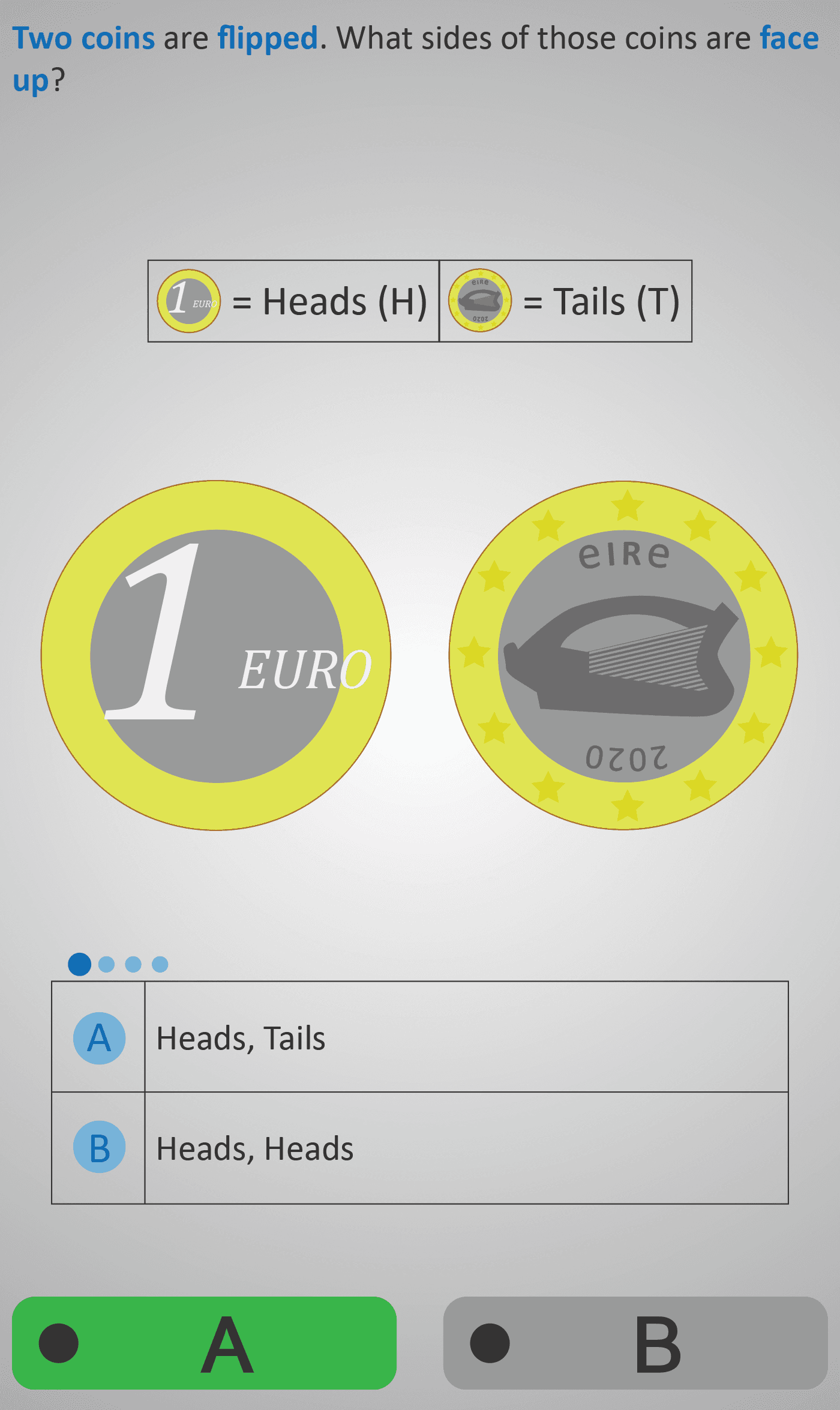
Possible Choice 2C introduces probability and outcomes through coin tosses. Students are asked to determine which sides of two flipped coins are face up, using heads (H) and tails (T) as reference. Each task shows different coin outcomes, and learners must correctly identify the pair:
- Example 1: One coin shows heads and the other tails → correct answer: Heads, Tails.
- Example 2: Both coins show heads → correct answer: Heads, Heads.
- Example 3: Both coins show tails → correct answer: Tails, Tails.
This Phlow develops understanding of basic probability, binary outcomes, and combinations, reinforcing how two independent events create multiple possibilities. The interactive choices guide students to link visual representations of coins with symbolic notation (H, T), bridging concrete examples and abstract reasoning.
Prerequisite Knowledge Required
- Recognition of the two sides of a coin: heads (H) and tails (T).
- Understanding that each coin flip is an independent event.
- Familiarity with reading simple pairs or ordered combinations.
Main Category
Probability / Data Handling
Estimated Completion Time
Approx 6-10 seconds per question. 20 questions total. Total time: 2-4 minute.
Cognitive Load / Step Size
Low — each screen adds one new example of a possible outcome. Repetition strengthens pattern recognition and reinforces the link between visual and symbolic representations.
Language & Literacy Demand
Low — concise, familiar vocabulary (“Heads,” “Tails”) with minimal reading required. Visual cues dominate the activity.
Clarity & Design
Strong — clear coin illustrations and consistent labelling (H, T) make the outcomes easy to distinguish. The two-choice answer format focuses attention and supports independent reasoning.
Curriculum Alignment
Irish Primary / Junior Cycle Mathematics – Probability Strand:
- “List and describe possible outcomes of simple random experiments such as tossing a coin.”
Engagement & Motivation
High — the use of coin tosses makes the task playful and tangible. Students enjoy predicting and identifying outcomes in an accessible real-world context.
Error Opportunities & Misconceptions
- Students may confuse order (e.g., Heads–Tails vs Tails–Heads) or assume only one outcome is possible.
- The repetitive structure clarifies that all outcomes are equally valid and independent.
Transferability / Real-World Anchoring
Strong — connects directly to everyday experiences with chance (coin tosses, dice rolls). Builds foundational thinking for probability and data interpretation.
Conceptual vs Procedural Balance
Conceptual — focuses on understanding possible outcomes and independence, not on calculation.
Learning Objectives Addressed
- Identify all possible outcomes of two independent events.
- Represent outcomes symbolically (H, T).
- Understand randomness and independence in probability.
- Strengthen reasoning about combinations in a simple, visual context.
What Your Score Says About You
- Less than 5: Needs more practice recognising all possible outcomes.
- 6–7: Understands heads/tails but may confuse order.
- 8–9: Strong grasp of combinations with minor slips.
- 10 / 10: Excellent — fully understands binary outcomes and their representations.