
Probability 2A
Overview
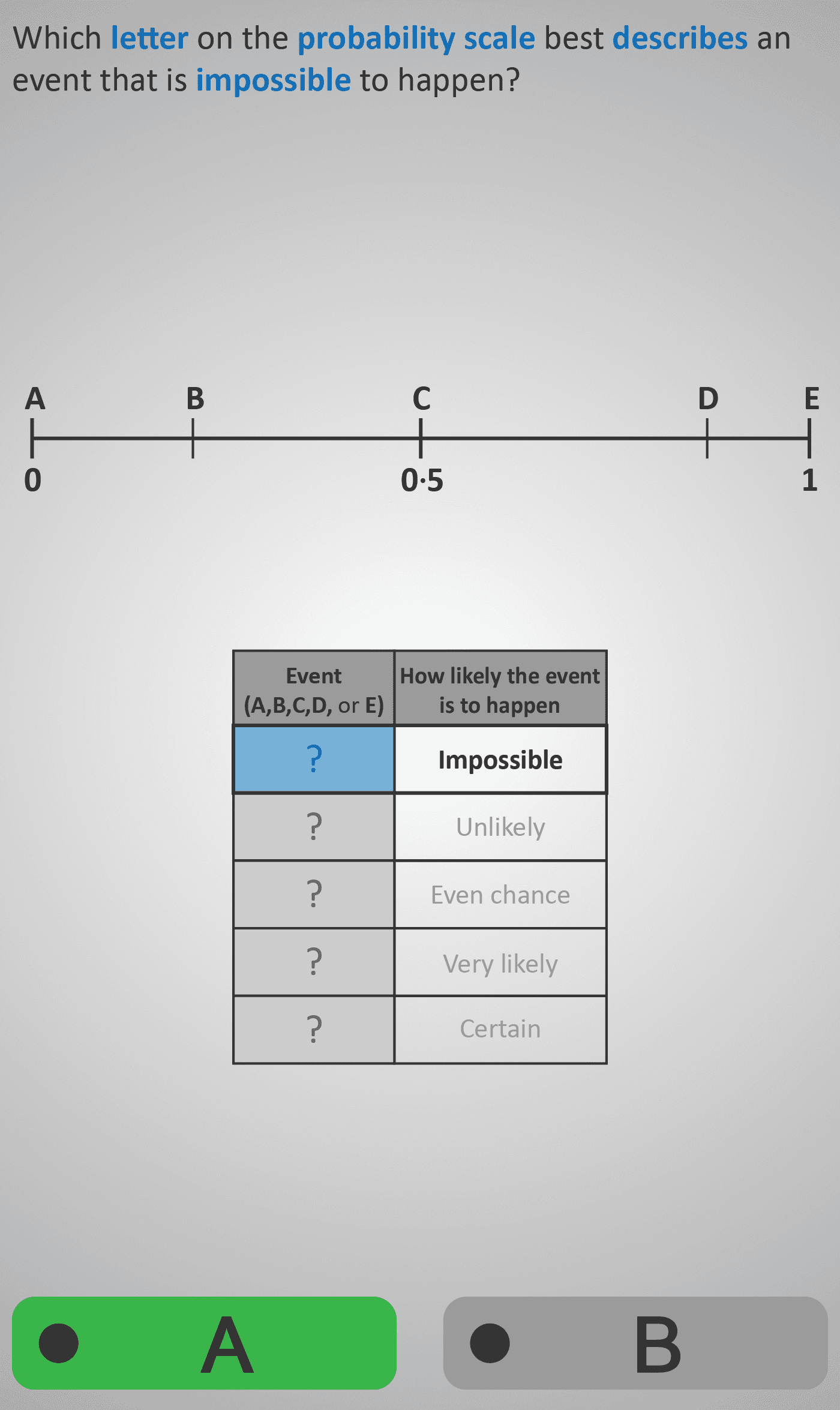
Introduces students to the probability scale and the language of likelihood. The lesson uses a number line marked from 0 to 1, with labelled points (A, B, C, D, E) to represent different levels of probability. Students are guided to match key probability terms — Impossible, Unlikely, Even Chance, Very Likely, and Certain — to the correct position on the scale.
Through simple multiple-choice questions, learners identify that:
- An Impossible event is represented at 0 (A).
- An Unlikely event falls closer to 0 (B).
- An Even Chance event is at 0.5 (C).
- A Very Likely event is placed near 1 (D).
- A Certain event is at 1 (E).
This Phlow reinforces the conceptual link between fractions, decimals, and probability terms, while making the abstract idea of likelihood more tangible. By progressively filling in the probability table with correct labels, students build confidence in using probability language accurately and interpreting events on a probability scale.
Prerequisite Knowledge Required
- Familiarity with fractions and decimals between 0 and 1.
- Understanding that probability represents how likely an event is to occur.
- Basic experience with real-world chance events (e.g., coin toss, weather outcomes).
Main Category
Probability
Estimated Completion Time
Approx 6-10 seconds per question. 20 questions total. Total time: 2-4 minute.
Cognitive Load / Step Size
Low to moderate — gradual introduction of terminology supported by a visual number line. Each step reinforces the concept by connecting words to numeric positions.
Language & Literacy Demand
Moderate — includes abstract terms like Impossible and Certain but supported visually. Reinforced through repetition and examples.
Clarity & Design
Excellent — the visual number line provides a concrete reference for abstract probability terms. Clear spacing of labelled points (A–E) aids memory and comprehension.
Curriculum Alignment
Irish Primary / Junior Cycle Mathematics – Probability Strand:
- “Recognise that the probability of an event lies between 0 and 1 and use the language of probability to describe likelihood.”
Engagement & Motivation
High — intuitive and visual. Learners connect familiar real-world examples (e.g., “It’s certain the sun will rise tomorrow”) to formal probability terms.
Error Opportunities & Misconceptions
- Students may confuse Very Likely with Certain, or Unlikely with Impossible.
- The scaffolded feedback and spaced positioning on the scale help clarify distinctions.
Transferability / Real-World Anchoring
Strong — directly applies to interpreting real-world uncertainty (e.g., weather forecasts, games of chance, sports outcomes). Builds vocabulary for discussing probability beyond maths class.
Conceptual vs Procedural Balance
Conceptual — focuses on understanding probability meaning and scale rather than numerical calculation.
Learning Objectives Addressed
- Interpret probability as a measure between 0 and 1.
- Use appropriate language to describe likelihood.
- Connect numeric and verbal representations of chance.
- Develop confidence in reasoning about uncertain events.
What Your Score Says About You
- Less than 5: Needs to review probability terms and their meanings.
- 6–7: Understands basic order but confuses some midpoints.
- 8–9: Strong conceptual grasp with minor placement slips.
- 10 / 10: Excellent — fully understands the probability scale and key terms.