
Probability 2C
Overview
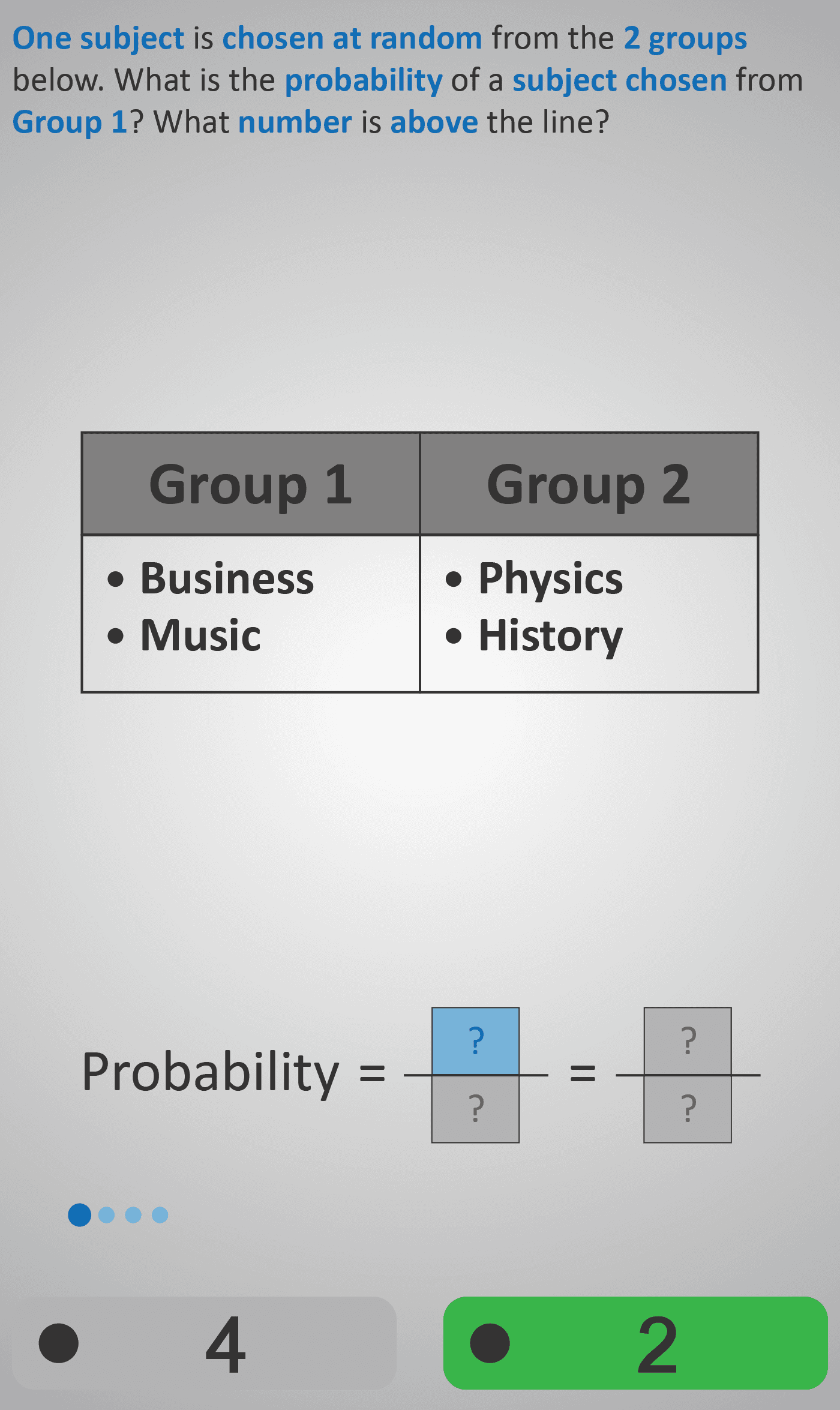
Introduces probability through groups of subjects. Students are asked to calculate the probability of choosing a subject from a specific group when one is selected at random.
In the first task, they identify the number that goes above the line in the probability fraction when finding the probability of choosing from Group 1.
Next, they find the number that goes below the line, representing the total number of choices across both groups.
The following screens guide students to simplify the fraction step by step (e.g., reducing 2/4 to 1/2).
Questions ask explicitly which number should be above or below the line after simplification, reinforcing understanding of numerator and denominator roles.
This sequence supports mastery of probability as fractions, builds confidence in simplifying fractions, and helps students link probability language (e.g., “chosen at random”) with mathematical representation.
Prerequisite Knowledge Required
- Basic understanding of fractions (numerator and denominator).
- Ability to count and compare group sizes (from Possible Choice 2B).
- Familiarity with the concept of random selection.
Main Category
Probability / Fractions
Estimated Completion Time
Approx 6-10 seconds per question. 20 questions total. Total time: 2-4 minute.
Cognitive Load / Step Size
Moderate — learners focus on one component per step (favourable outcomes, total outcomes, simplification). The gradual build from counting to simplification keeps reasoning manageable and cumulative.
Language & Literacy Demand
Low — short, clear instructions (“Which number goes above the line?”) and familiar contexts (subject groups). Uses concise probability and fraction terminology.
Clarity & Design
Excellent — simple visual layout showing two subject groups with numeric labels helps clarify how each number relates to the probability fraction. Multiple-choice format reinforces correct fraction structure and simplification.
Curriculum Alignment
Irish Primary / Junior Cycle Mathematics – Probability and Number Strands:
- “List possible outcomes and represent probabilities as fractions.”
- “Simplify fractions and understand equivalence.”
Engagement & Motivation
High — relatable subject examples make the activity meaningful. The guided question sequence encourages active reasoning and success through repetition.
Error Opportunities & Misconceptions
- Students may confuse which value is the numerator or denominator.
- Explicit questioning and visual labelling reduce this risk and clarify meaning.
Transferability / Real-World Anchoring
Strong — models real-world random selections (e.g., choosing subjects, picking cards). Reinforces transferable fraction reasoning for other probability or ratio contexts.
Conceptual vs Procedural Balance
Balanced — develops conceptual understanding of probability structure while reinforcing procedural fluency in forming and simplifying fractions.
Learning Objectives Addressed
- Identify favourable and total outcomes for grouped data.
- Represent probability as a fraction.
- Simplify fractions and recognise equivalent probabilities.
- Connect everyday selection scenarios with mathematical probability.
What Your Score Says About You
- Less than 5: Needs more practice linking group counts to probability fractions.
- 6–7: Understands structure but may mix up numerator and denominator.
- 8–9: Strong understanding of forming and simplifying probability fractions.
- 10 / 10: Excellent — fully confident in expressing and simplifying probabilities correctly.