
Probability 2D
Overview
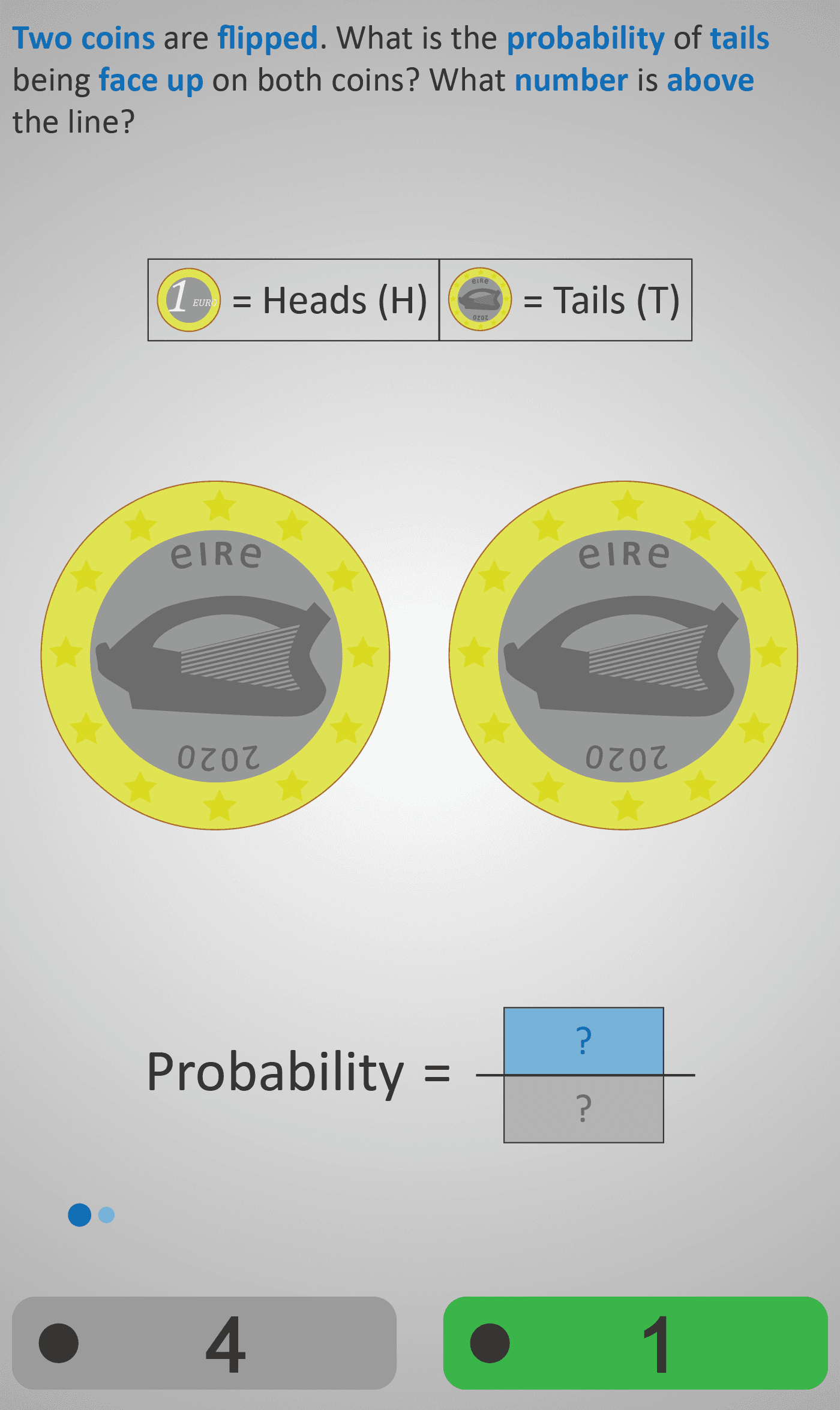
This Phlow introduces probability through the classic experiment of flipping two or more coins and calculating outcomes. Students identify the probability of both coins showing tails, and then extend this to three coins all showing heads. Visuals of euro coins make the abstract concept concrete, while the notation for probability as a fraction reinforces mathematical representation.
The key focus is recognising favourable outcomes (e.g., both tails, or all heads) compared to the total number of possible outcomes, and placing these correctly in the numerator and denominator of a fraction. Students practise identifying which number goes above or below the line, developing both conceptual understanding and procedural accuracy.
By working step-by-step, learners engage with probability at an accessible level, using coin flips as familiar, real-life contexts. This prepares them for later work with probability trees and more complex events.
Prerequisite Knowledge Required
- Understanding of fractions (numerator = part, denominator = whole).
- Familiarity with basic probability terms like “outcome” and “event.”
- Prior experience recognising coin faces (heads/tails) from Possible Choice 2C.
Main Category
Probability
Estimated Completion Time
Approx 6-10 seconds per question. 20 questions total. Total time: 2-4 minute.
Cognitive Load / Step Size
Moderate — builds incrementally from two coins to three, reinforcing consistent reasoning with manageable complexity. Visual scaffolds keep focus on one variable at a time (number of coins, outcomes).
Language & Literacy Demand
Low — short, direct phrasing (“Which number goes above the line?”) and familiar vocabulary (heads, tails). Fraction symbols and probability terms are introduced through repetition.
Clarity & Design
Excellent — realistic euro coin visuals make the concept tangible. The fraction format alongside clear visual examples bridges concrete and abstract representations effectively.
Curriculum Alignment
Irish Primary / Junior Cycle Mathematics – Probability Strand:
- “List all possible outcomes for simple experiments.”
- “Represent probabilities as fractions between 0 and 1.”
Engagement & Motivation
High — coin-flipping is familiar, playful, and intuitive. The use of everyday imagery and interactivity maintains engagement while reinforcing key concepts.
Error Opportunities & Misconceptions
- Students may confuse total outcomes with favourable ones or reverse numerator and denominator.
- Repeated prompts and clear visual models help prevent and correct these errors.
Transferability / Real-World Anchoring
Strong — connects abstract probability rules to a relatable, hands-on context. Builds transferable understanding for dice, cards, and multi-step probability later.
Conceptual vs Procedural Balance
Balanced — students develop conceptual understanding of random outcomes while practising procedural fraction representation.
Learning Objectives Addressed
- Identify favourable and total outcomes in probability experiments.
- Express probabilities as fractions.
- Interpret everyday events using probability language and notation.
- Build a foundation for compound events and probability trees.
What Your Score Says About You
- Less than 5: Needs to review how favourable and total outcomes form a probability fraction.
- 6–7: Understands structure but may confuse numerator/denominator placement.
- 8–9: Strong grasp of outcomes and fraction representation.
- 10 / 10: Excellent — confidently applies probability reasoning with real-world examples.