
Qmark by 10 – 2B
Overview
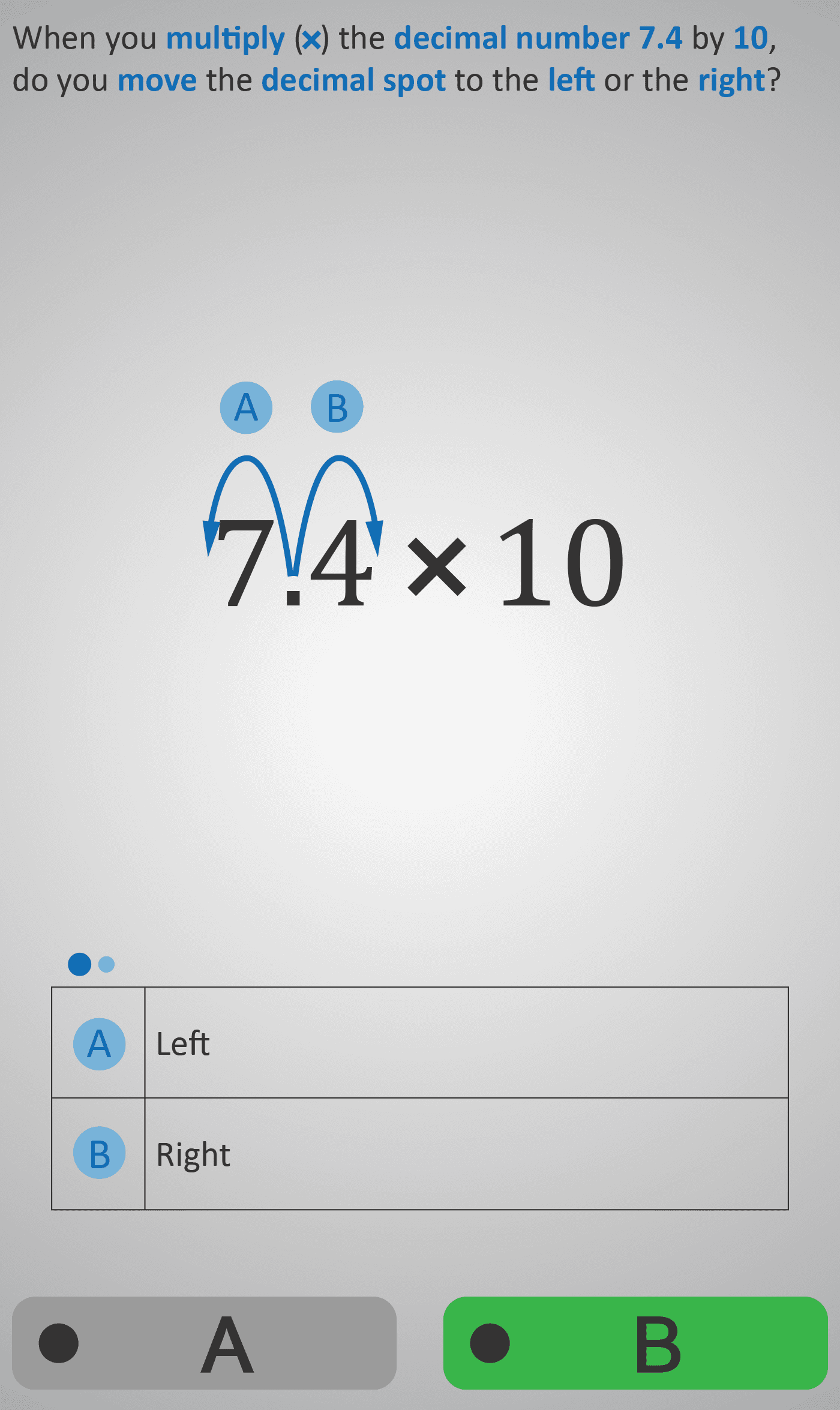
Introduces multiplying and dividing decimal numbers by 10, focusing on how the decimal point shifts. Students first explore 7.4 × 10, where they must decide whether the decimal moves to the left or right. The second step confirms the calculation by showing that 7.4 × 10 = 74.
The lesson then flips to division, with 4.8 ÷ 10. Again, students decide which direction the decimal moves, reinforcing the opposite process of multiplication. Finally, the calculation confirms that 4.8 ÷ 10 = 0.48.
This sequence helps learners connect decimal place value with multiplying and dividing by 10, strengthening their number sense and confidence in handling decimals.
Prerequisite Knowledge Required
- Linked Phlows: Qmark by 10 – 2A – understanding the effect of multiplying and dividing whole numbers by 10.
- Decimals 2A – adding decimal numbers and recognising place value positions.
- Decimals 2B – subtracting decimals accurately with place value alignment.
Main Category
Arithmetic
Estimated Completion Time
Approx 6–10 seconds per question. 20 questions total. Total time: 2–4 minutes.
Cognitive Load / Step Size
Moderate — learners move from whole-number reasoning (×10 or ÷10) to decimals, introducing a visible shift in place value. The step of predicting decimal point movement before calculating ensures strong conceptual anchoring without overwhelming cognitive load.
Language & Literacy Demand
Low — concise phrasing (“Does the decimal move left or right?”) reduces reading demand. Clear visual prompts (decimal point arrows) support comprehension. Mathematical symbols dominate over text, making it accessible to a wide range of reading levels.
Clarity & Design
Highly effective — visuals of numbers with shifting decimal points make the abstract idea of place value concrete. The minimal interface, with directional arrows and side-by-side comparisons, enhances clarity and reduces distraction.
Curriculum Alignment
Irish Curriculum Strand: Number
- Explore and describe the effect of multiplying and dividing decimals by powers of 10.
- Understand how the position of the decimal point changes during scaling operations.
- Relate decimal operations to place value understanding.
Engagement & Motivation
Moderate to High — the visual movement of the decimal point and predict-then-check format provides a satisfying rhythm of discovery and feedback. The immediate confirmation of results keeps engagement high, even in repetitive practice.
Error Opportunities & Misconceptions
- Moving the decimal in the wrong direction.
- Confusing “shifting digits” with “moving the decimal.”
- Treating multiplication by 10 as adding a zero instead of scaling the entire value.
- Forgetting to include a zero placeholder when the decimal crosses into a new place (e.g., 0.48 → 4.8).
The scaffolding helps expose and correct these through contrasting examples.
Transferability / Real-World Anchoring
Strong — connects directly to measurement conversions (cm ↔ mm, g ↔ kg), currency calculations, and scientific notation. Students can generalise this understanding to all powers of 10 in later stages.
Conceptual vs Procedural Balance
Well-balanced — the prediction stage focuses on conceptual understanding of place value, followed by procedural confirmation of correct calculation. Learners internalise both the why and how behind decimal scaling.
Learning Objectives Addressed
- Recognise the change in magnitude when multiplying or dividing decimals by 10.
- Predict and confirm the direction of decimal movement.
- Strengthen place value understanding across tenths, units, tens, and hundreds.
- Build fluency and accuracy in performing decimal scaling operations.
What Your Score Says About You
- Less than 5: Needs more confidence in how the decimal point moves during scaling.
- 6–7: Understands direction but sometimes applies the rule inconsistently.
- 8–9: Very strong grasp of decimal shifts and their numerical effects.
- 10 / 10: Complete mastery — understands both the pattern and reason behind decimal movement when scaling by 10.