
Sets 2
Overview
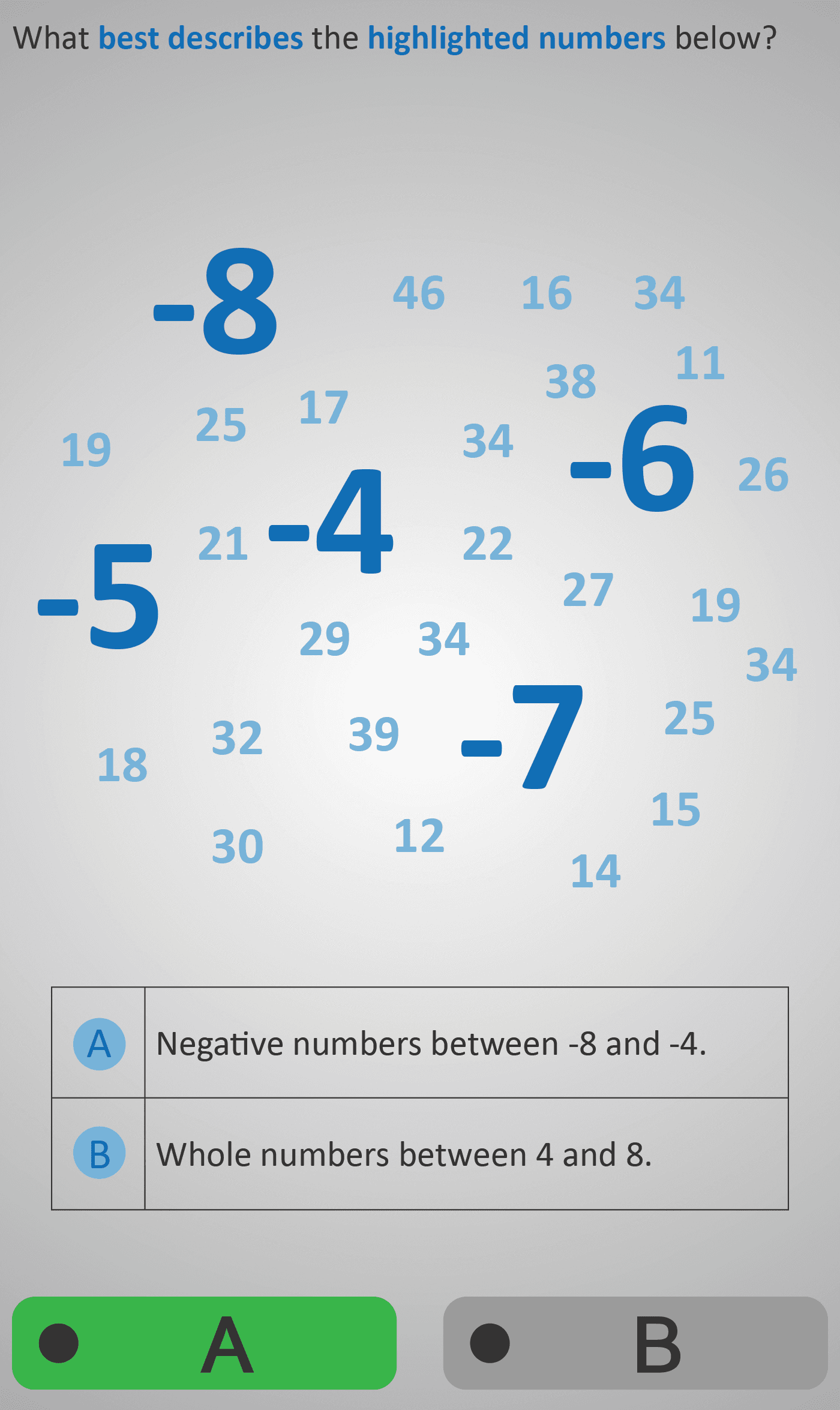
Introduces learners to identifying and listing numbers in a defined set, focusing here on negative whole numbers between -8 and -4. The lesson begins by asking students to recognise the highlighted numbers on screen (–8, –7, –6, –5, –4) and to choose the best description of the set.
Next, learners are guided to build the set step by step, starting with the lowest number (–8) and continuing in sequence. Each slide prompts them to identify the next number until the full set is listed.
The activity uses a structured box format, encouraging learners to see how sets are written with curly brackets and ordered elements.
By the end, students have constructed the complete set: { –8, –7, –6, –5, –4 }, reinforcing both the concept of sets and the ordering of negative numbers.
This sequence strengthens skills in recognising patterns, working systematically, and understanding how sets are represented in mathematics.
Prerequisite Knowledge Required
- Linked Phlows: Numbers 1B – understanding whole numbers and counting sequences.
- Numbers 2A – comparing and ordering positive and negative values.
- Number Line 2 – locating integers on a number line, including below zero.
Main Category
Sets & Number Theory
Estimated Completion Time
Approx 6–10 seconds per question. 20 questions total. Total time: 2–4 minutes.
Cognitive Load / Step Size
Low to Moderate — each step isolates one new concept: identifying individual negative numbers, then combining them into a structured set. The repetition helps solidify both sequence and syntax (curly brackets, commas) without overwhelming learners.
Language & Literacy Demand
Low — uses simple language (“Which number comes next?”, “Select the correct set”). Mathematical symbols and layouts carry most of the meaning, minimising reading load. Visual cues such as colour highlights and number lines support comprehension.
Clarity & Design
Highly clear — the use of boxed sets and colour-coded numbers makes abstract notation tangible. Each screen isolates one cognitive step (recognising, ordering, bracketing), and the clean visual layout ensures focus stays on number relationships.
Curriculum Alignment
Irish Curriculum Strand: Number / Algebra
- Recognise sets as collections of distinct elements.
- Represent sets using curly brackets and commas.
- Order and list negative whole numbers correctly.
- Understand that sets can be defined by numerical conditions.
Engagement & Motivation
Moderate — the activity is visually structured and easy to follow, appealing to learners who enjoy logic-based ordering. Though abstract, the step-by-step build-up keeps attention and provides a satisfying sense of completion when the full set is revealed.
Error Opportunities & Misconceptions
- Reversing order of negative numbers (e.g., assuming –4 is smaller than –8).
- Forgetting to include boundary numbers in the set.
- Omitting commas or brackets, confusing set notation with lists.
- Misunderstanding that sets contain distinct elements, not repeats.
Built-in scaffolding corrects these by reinforcing the order and syntax visually.
Transferability / Real-World Anchoring
Moderate — supports reasoning with ordered collections (e.g., temperatures, altitudes, or account balances below zero). Lays groundwork for set theory applications in probability, logic, and data classification.
Conceptual vs Procedural Balance
Balanced — learners first grasp the concept of a set (a defined collection), then practise the procedure of writing it correctly. The design alternates between recognition and construction to reinforce understanding.
Learning Objectives Addressed
- Identify and order negative integers within a given range.
- Write sets correctly using curly brackets and commas.
- Recognise that sets can be defined by conditions (e.g., “between –8 and –4”).
- Strengthen understanding of ordering and patterning across zero.
What Your Score Says About You
- Less than 5: Needs more practice with ordering and writing negative numbers in sets.
- 6–7: Understands the idea of sets but sometimes confuses order or notation.
- 8–9: Solid grasp of sets and negative sequencing.
- 10 / 10: Excellent mastery — can define and construct sets with full accuracy and correct mathematical notation.